

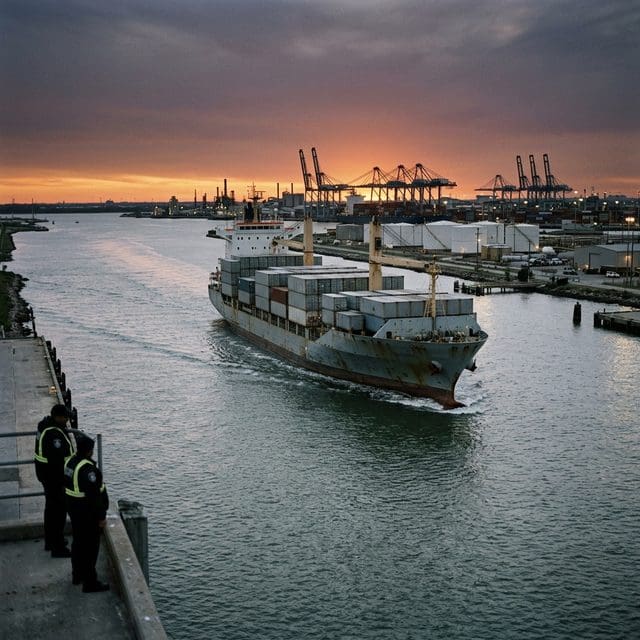
Saudi Arabia reported intercepting missiles and drones on October 18 as Egypt pledged possible support, but available reporting confirms no resulting disruption to trade or shipping.
Saudi Arabia’s report of fresh missile and drone interceptions on October 18 raises a question for traders and manufacturers: whether escalating attacks will affect the movement of goods through the region. The reporting available so far does not establish that they have.
The Saudi-led coalition said it downed two ballistic missiles near Khamis Mushait and three drones over Riyadh and the Eastern Province, according to The National. Saudi Arabia reported the interceptions as fresh attacks and said strikes have increasingly targeted airports, oil infrastructure and other strategic sites. The supplied reports do not identify damage to those facilities or say that operations stopped.
The targets have potential commercial significance. Airports move passengers and time-sensitive cargo; oil infrastructure is central to energy production and transport. If those systems were disrupted, businesses could face delivery delays, fuel concerns or the need to consider alternative routes. That describes possible exposure, not a confirmed account of what happened. The reporting does not document commercial delays, diversions or losses.
Egypt’s National Defense Council pledged on October 18 to provide Saudi Arabia with “all necessary and possible forms of support.” The statement did not specify whether that meant military, intelligence, logistical or other assistance. Egypt’s parliament was due to hold an emergency session that day to consider authorizing support if Riyadh requested it. President Abdel Fattah el-Sisi had called on lawmakers to authorize military assistance and described any support as defensive, The New York Times reported.
The difference between a pledge and an operational decision matters to supply chains. The available material does not confirm that parliament authorized assistance, that Riyadh made a formal request or that Egyptian forces or logistical assets were deployed. It also does not say Egypt’s statement changed commercial carriers’ operations.
For companies sourcing fuel, components and finished goods, the practical questions are whether ports and airports remain open, whether carriers are changing routes or schedules, and whether freight rates or insurance terms have shifted. The reports provide no confirmed information on port closures, shipping diversions, cargo insurance, freight costs or factory output. They establish a security concern, not a change in trade flows.
The scope of Egypt’s commitment remains unresolved. The New York Times described the pledge as a response to Houthi attacks; the supplied material also says the Houthis warned Cairo against military intervention and Egypt planned to intensify diplomatic efforts toward de-escalation. Those details point to competing pressures but do not establish a deployment or commercial disruption. A fatality figure mentioned in an unverified lead could not be confirmed and is not included.
The sports headlines in the source material do not add evidence about trade. Leeds United and Manchester United were scheduled to meet at Elland Road, with the latest available listing showing 0-0 and no verified final score. Michael Carrick said United planned to assess January recruitment and strengthen its defense over the next two transfer windows. Those club plans say nothing about manufacturing locations, import costs or supply-chain investment.
For now, the defensible account is narrow: Saudi Arabia reported intercepting incoming missiles and drones; Egypt pledged possible support without defining its form; and the supplied reporting does not document a commercial disruption. Verified changes to transport operations, energy flows, shipping plans, freight rates or insurance costs would show whether the security risk is affecting goods moving from producer to buyer. No such effects are established in the material available.

Sean Bradley serves as the Senior Correspondent for Trade, Supply Chains, and Global Labor at Just Right News, where he brings a principled, clear-eyed perspective to the complex systems that power the modern world. With a focus on the economic forces that impact the American household, Bradley has distinguished himself as a leading voice in explaining how global shifts in manufacturing and logistics translate to the kitchen table.
Growing up in Long Beach, California, Bradley’s interest in the movement of goods was forged against the backdrop of one of the nation’s most vital maritime gateways. Raised in a community where the towering cranes of the port were a constant fixture on the horizon, he developed an early appreciation for the blue-collar industries that form the backbone of the American economy. This upbringing instilled in him a profound respect for the dockworkers, truckers, and laborers who keep the country moving, a sentiment that remains a cornerstone of his reporting today. For Bradley, trade is not merely a series of abstract figures on a spreadsheet; it is a human endeavor that sustains families and defines the strength of a nation.
Now based in Seattle, Washington, Bradley occupies a strategic vantage point in another of the country’s most significant trade hubs. His location allows him to witness firsthand the intersection of traditional industry and the evolving technological landscape of global logistics. From the Pacific Northwest, he monitors the flow of goods across the ocean, providing Just Right News readers with timely insights into how international tensions, regulatory hurdles, and labor disputes affect the availability and cost of essential goods.
His signature feature series, “The Journey of Things,” has become a staple for readers seeking to understand the intricate path products take from raw materials to the retail shelf. Through this series, Bradley pulls back the curtain on the global marketplace, often highlighting the risks of over-reliance on foreign adversaries and the importance of domestic manufacturing resilience. His reporting consistently emphasizes the conservative values of national sovereignty, free-market competition, and the protection of the American worker from unfair global practices.
As a journalist of Irish heritage, Bradley maintains a deep-seated respect for the dignity of the individual worker and the importance of community stability. He approaches his beat with a commitment to transparency, often questioning the status quo of globalist policies that prioritize corporate efficiency over local prosperity. Whether he is reporting from a warehouse floor or analyzing a new international trade agreement, his goal remains the same: to provide the American public with the truth about where their products come from and what it costs to get them there.
Throughout his tenure at Just Right News, Bradley has remained a steadfast advocate for economic common sense. His work serves as a vital resource for those who believe that a strong nation is built on secure borders, robust trade, and a respected workforce. By combining his local roots in Long Beach with his professional experience in Seattle, Bradley continues to offer a unique and necessary perspective on the forces that shape the American way of life.