

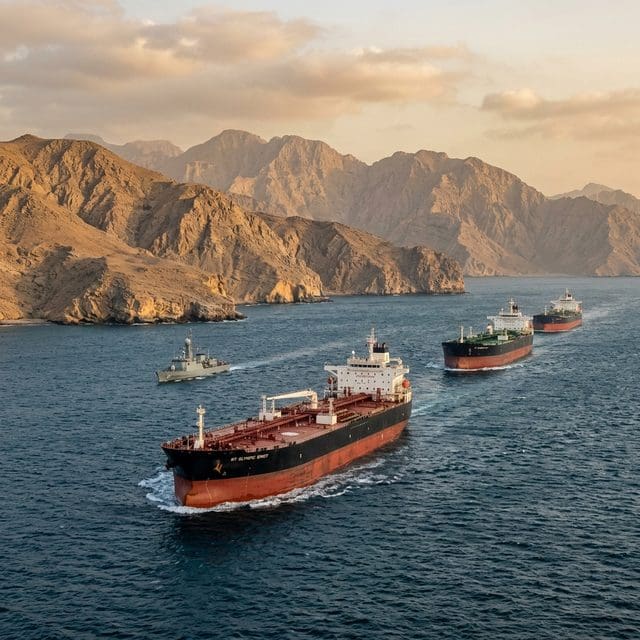
Strait of Hormuz traffic fell to a monthly low as vessels came under attack, renewing pressure on oil markets while U.S. diesel prices remain elevated.
Two vessels struck in the Strait of Hormuz and a sharp fall in shipping through the waterway have renewed attention to the cost of geopolitical risk in global energy markets. Kpler recorded just 2.9 million barrels passing through the strait on October 11, the lowest daily volume of the month. Brent crude was reported at $106.58 a barrel on October 14.
The figures offer a snapshot, not a complete account of the disruption. The supplied reporting does not establish how long the reduced flow will last or how much of the decline reflects attacks, precautionary decisions by ship operators, or other constraints. But the strait’s role as a route for oil and refined products means interruptions can quickly matter to buyers well beyond the region.
The immediate concern is not limited to crude. U.S. diesel prices remained above $6 per gallon on October 13 amid a global diesel shortage, Axios reported. Diesel is a key fuel for freight, agriculture and construction, so sustained high prices can add costs across supply chains, beyond the direct burden on motorists. The available material does not quantify how much of the U.S. price reflects Hormuz shipping risks rather than other market conditions.
The pressure comes amid recent U.S. efforts to increase available fuel. President Donald Trump announced an agreement with Russia on October 9 to increase diesel supplies to U.S. and global markets, including a waiver of some U.S. energy sanctions, according to Axios. A White House official separately described a proposed Russia-Ukraine energy ceasefire as a potential deal that would initially halt attacks on oil refineries.
Those steps point to a practical tension in energy policy. Limiting attacks on infrastructure and expanding supply can help ease near-term shortages and prices. Sanctions relief, however, carries geopolitical consequences, while additional supply does not remove the vulnerability created by dependence on exposed shipping routes. The material does not provide enough detail to assess the agreement’s expected volumes, timing or effect on prices.
The Consumer Price Index is another reason energy costs draw attention: fuel can affect household budgets directly and influence the cost of moving goods. But the source material here does not provide verified September CPI figures or a reliable breakdown of the month’s inflation drivers. It therefore cannot establish how much energy contributed to consumer-price changes, or whether a particular market development has yet passed through to the overall index.
That distinction matters. A high oil benchmark, a diesel shortage and a consumer-price measure describe related but different parts of the economy. Retail fuel prices can respond to crude costs, refining capacity, inventories, transport and local competition. A brief drop in shipping is a risk signal, not by itself proof of a lasting supply loss or a specific inflation outcome.
The episode also underlines the value of resilience alongside efforts to reduce emissions. Diverse sources of energy, efficient infrastructure and reliable transport routes can limit the economic damage of a disruption; no single technology or policy can insulate consumers from every global shock. The evidence available does not quantify the contribution of renewables, nuclear power or domestic production to this particular episode.
For now, the clearest indicators are the reported decline in Hormuz traffic, the vessel strikes, a Brent price above $100 a barrel and U.S. diesel above $6 per gallon. Whether those conditions persist will depend on security and actual flows, not on announcements alone. That is the tradeoff policymakers face: protect access to affordable, dependable energy while weighing the diplomatic costs of supply decisions and the longer-term consequences of the energy mix.

Mark Davis serves as the Senior Correspondent for Energy, Climate, and Resource Economics at Just Right News. In an era where the conversation around the environment is often dominated by alarmism and top-down mandates, Mark provides a vital, market-oriented perspective on the complex forces shaping our world. As the lead voice behind the acclaimed feature series “Power and the Planet,” he explores the intersection of environmental policy, global energy markets, and the fundamental economic principles that sustain modern civilization.
Mark’s pragmatic approach to resource management was forged in the high desert of his hometown, Albuquerque, New Mexico. Growing up in a region defined by both its breathtaking natural beauty and its rugged, resource-dependent landscape, he developed an early appreciation for the delicate balance between conservation and utilization. New Mexico’s unique position as a hub for both traditional energy production and cutting-edge scientific research provided Mark with a front-row seat to the evolution of the American energy sector. This upbringing instilled in him a deep-seated belief that true environmental stewardship is inseparable from economic prosperity and technological innovation.
Now based in Boulder, Colorado, Mark operates from the heart of the nation’s climate research community. While Boulder is often seen as a bastion of environmental idealism, Mark utilizes his post to provide a necessary counterweight, grounded in the realities of resource economics. He understands that energy policy does not exist in a vacuum; it has tangible consequences for the American taxpayer, the stability of the national power grid, and the strength of the domestic manufacturing sector. By reporting from the front lines of the climate debate, he is able to challenge prevailing narratives with hard data and a commitment to the principles of the free market.
Throughout his tenure at Just Right News, Mark has distinguished himself by focusing on the “Resource Economics” aspect of his beat. He frequently highlights the hidden costs of rapid energy transitions and advocates for an “all-of-the-above” energy strategy that prioritizes American energy independence. His work often shines a light on the geopolitical implications of resource scarcity, arguing that a secure nation must first be an energy-secure nation. Whether he is analyzing the impact of federal land-use regulations or investigating the supply chains required for new technologies, Mark remains focused on how policy decisions affect the lives and livelihoods of everyday citizens.
In “Power and the Planet,” Mark continues to bridge the gap between complex scientific concepts and the economic realities facing the country. He rejects the false choice between a healthy environment and a thriving economy, instead seeking out solutions that leverage American ingenuity and private-sector competition. For Mark, reporting on the climate is not about following the latest trends, but about ensuring that the conversation remains tethered to the foundational values of liberty, property rights, and fiscal responsibility. His contributions ensure that Just Right News readers receive a comprehensive, clear-eyed view of the challenges and opportunities defining the future of our planet.