

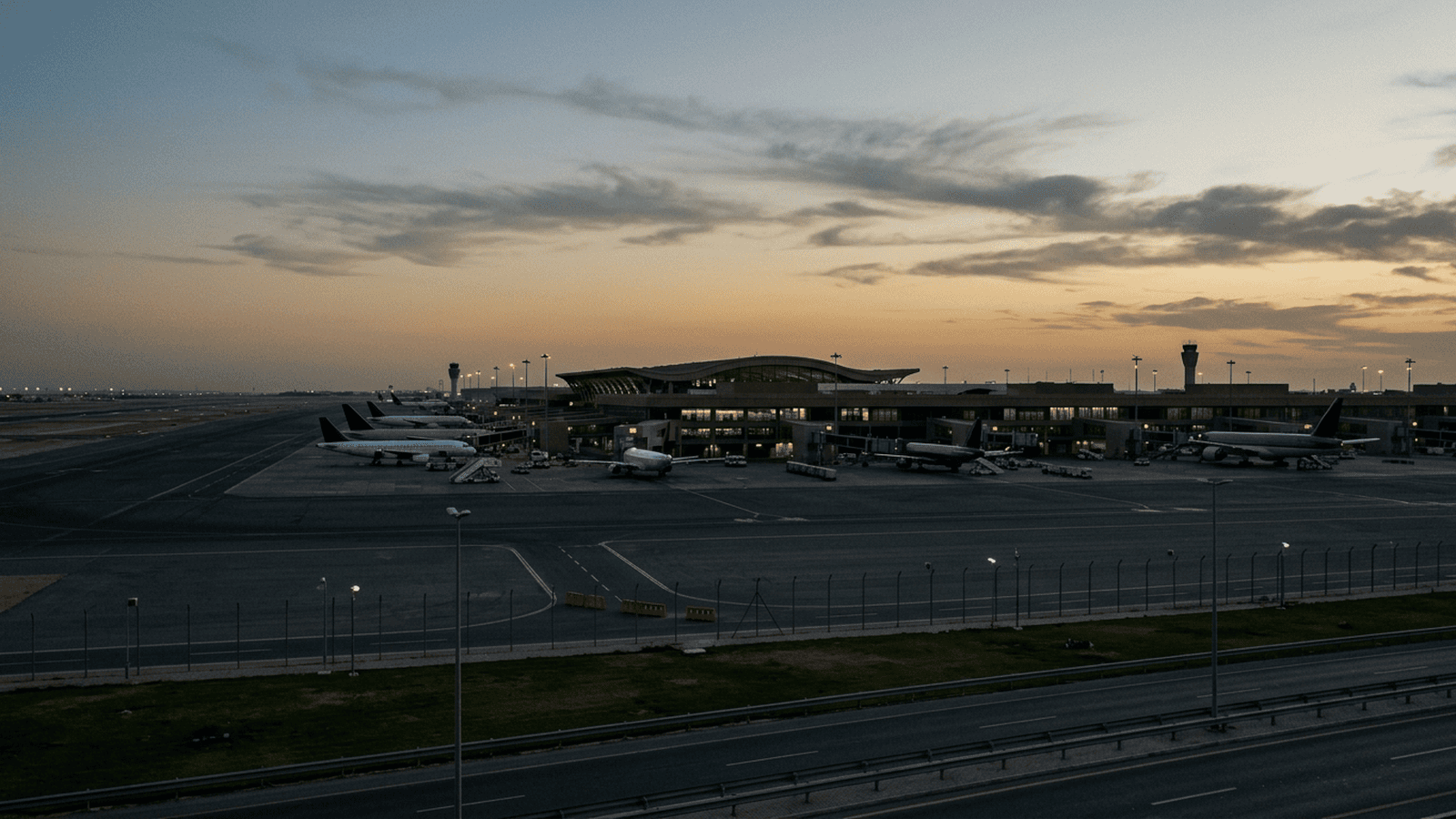
A projectile struck a passenger terminal at Riyadh’s King Khalid International Airport on Sunday, according to a Saudi-led coalition, a day after an airport attack killed at least 12 people and injured 309. The latest strike’s damage and casualty figures were not immediately available. The airport remained closed, flights were diverted, Riyadh schools moved online, and several countries advised citizens to avoid the site. The Houthis threatened further attacks on Saudi airports, while the Trump administration condemned the deadly strike and said it remained in close contact with Saudi partners. No reopening date, new security arrangement, or final U.S. decision on joining Saudi strikes was reported.
TLDR: A second reported strike hit Riyadh’s airport complex after Saturday’s attack killed at least 12 people and injured 309. The airport stayed closed, flights were diverted, and schools moved online as governments warned citizens to avoid the site.
A projectile struck a passenger terminal at King Khalid International Airport in Riyadh on Sunday, according to the Saudi-led coalition fighting Yemen’s Houthis. The reported strike came hours after the Houthis issued a new threat to Saudi airspace and a day after an attack at the airport killed at least 12 people and injured hundreds. Officials had not provided immediate details about Sunday’s impact or any casualties from the latest strike.
No official policy rationale for a government change appears in the available account. The immediate response described there is practical: the airport remained closed, flights were diverted, and Riyadh schools moved to online instruction amid the threat. Those steps disrupted travel and ordinary routines while authorities and residents faced renewed uncertainty about the risk to civilian sites.
The Saudi-led coalition said the latest projectile hit the same airport complex that houses terminals 3 and 4, which serve domestic flights. A regional official, who spoke anonymously because they were not authorized to address the media, also identified that complex as the site of the strike. The airport has no military facilities, according to the account, making the repeated attacks a direct danger to civilian air travel.
Saturday’s strike killed at least 12 people, including a U.S. citizen, and wounded 309, according to Saudi statements cited in the report. Several hospitals were treating the injured, some of whom were in serious condition. The reported dead included four Saudi citizens, two Bangladeshi nationals, and citizens of the United States, Egypt, Jordan, Syria, and Sudan, as well as a Palestinian.
An Egyptian flight attendant, Azza Ramzy, 28, was among those killed, according to Egyptian state-run Al-Qahera News television. She worked for the Saudi airline Flynas. The loss of a civilian worker underlines how the attacks can affect people who have no role in the fighting, as well as travelers and airport staff.
The Houthis did not immediately claim responsibility for Saturday’s deadly airport attack. They did threaten new attacks on Saudi airports, with the stated exception of the holy sites in Mecca and Medina, and warned passengers not to travel. Houthi military spokesman Brig. Gen. Yahya Saree said on X that Saudi airports and airspace were exposed to targeting and called on people to take the warnings seriously.
The Houthis also said Sunday that Sanaa’s airport, which is under their control, had been struck again. They blamed Saudi Arabia but gave no details in the account. The competing claims and the absence of immediate information about the latest Riyadh strike leave important questions about responsibility and damage unresolved.
The Riyadh airport attack on Saturday was described as the deadliest on Saudi soil in more than a decade and as a major escalation in the conflict between the Iran-backed Houthis and Saudi Arabia. It also further complicated faltering efforts to halt the U.S.-Iran war, according to the report. A Saudi-led coalition had launched a major offensive against the Houthis in the week before the recent surge in attacks on Saudi airports, military facilities, and oil infrastructure.
The United States condemned the attacks. Secretary of State Marco Rubio said the strike had taken innocent lives, including an American citizen, and a State Department spokesperson said the Trump administration was in close contact with Saudi partners. President Trump said he was considering joining Saudi strikes against the Houthis. The report did not describe a final decision or a timetable for one.
The immediate practical impact is clear, even as details remain limited: King Khalid International Airport was closed on Sunday, flights were diverted, and Riyadh schools shifted online. The United States, Britain, Germany, Australia, and Canada warned their citizens to avoid the airport. The account gives no reopening date, travel fee, required form, or specific compliance process, so those details remain unknown rather than established parts of a plan. Travelers faced lost access to the airport and changed schedules, while students and families had to adjust to remote schooling.
The United Nations and several world leaders condemned the Saturday attack. European Commission President Ursula von der Leyen said the attacks were destabilizing important transport and energy links, while Israeli Prime Minister Benjamin Netanyahu also condemned the strike and offered condolences. These statements reflect concern over civilian safety and the wider regional risk, but the report does not identify a new security arrangement or guarantee that further attacks will be prevented.
The next steps described are limited to continued contact between the Trump administration and Saudi partners, alongside the airport closure and public warnings to avoid the site. No deadline for reopening or formal oversight process is reported. Those necessary steps remain important for tracking the threat and the practical effects on travelers and residents; the available facts do not establish that experts have the situation under control.

Rachel Vaughn serves as a Senior Correspondent for Just Right News, where she leads the network’s coverage of Global Health, Climate, and Development. With a career defined by intellectual rigor and a commitment to principled reporting, Rachel provides a vital conservative perspective on some of the most complex and high-stakes issues facing the world today. Her work is characterized by a refusal to accept bureaucratic narratives at face value, focusing instead on how international policies impact national sovereignty, individual liberty, and the American taxpayer.
Raised in New Haven, Connecticut, Rachel grew up in an environment dominated by elite academic discourse. This upbringing provided her with a front-row seat to the inner workings of the American establishment, but it also instilled in her a healthy skepticism of the “ivory tower” consensus. She learned early on that while academic theories may sound promising in a lecture hall, they often fail to account for the practical realities of the working class. This background drives her to bridge the gap between high-level policy discussions and the common-sense concerns of everyday citizens, ensuring that her reporting remains grounded and accessible.
Now based in Burlington, Vermont, Rachel operates from a unique vantage point within one of the nation’s most progressive political landscapes. Living and working in a region that often serves as a testing ground for radical social and environmental experiments allows her to witness the real-world consequences of these policies firsthand. From her base in the Green Mountain State, she provides Just Right News readers with essential “boots on the ground” reporting, documenting the friction between local mandates and the constitutional freedoms of the individual. Her presence in Burlington ensures that her critiques of globalist agendas are informed by a direct understanding of how those ideologies manifest at the local level.
In her acclaimed feature series, “Planetary Stakes,” Rachel explores the intersection of international development and environmental stewardship. She rejects the alarmism often found in mainstream media, opting instead for a sober analysis of the economic and geopolitical costs of global climate agreements. Her reporting frequently highlights the importance of market-driven innovation and the role of American leadership in fostering global health without ceding authority to unelected international bodies. Through “Planetary Stakes,” she has become a leading voice for those who believe that true conservation and public health are best achieved through transparency, accountability, and the protection of private property rights.
Throughout her tenure at Just Right News, Rachel has distinguished herself as a journalist who is unafraid to ask difficult questions of global institutions. Whether she is investigating the influence of non-governmental organizations on domestic policy or analyzing the fiscal transparency of international health initiatives, her goal remains the same: to provide her audience with the facts necessary to navigate an increasingly interconnected world. Her blend of East Coast intellectual heritage and her current immersion in the political heart of the Northeast makes her an indispensable asset to the newsroom and a trusted source for readers seeking a principled, conservative take on the issues that define our era.