

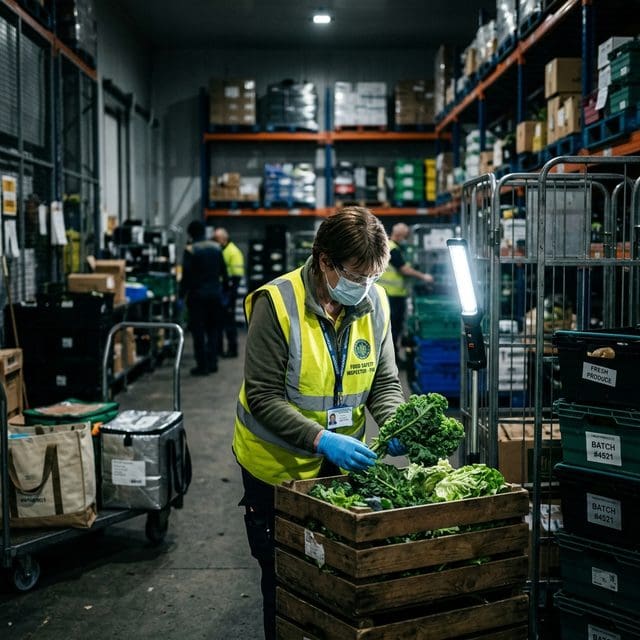
Telangana authorities suspended licenses at major quick-commerce hubs after discovering moldy produce, pest infestations, and severe storage violations across sixteen urban delivery outlets.
The rapid expansion of quick-commerce delivery services has hit a regulatory wall in Hyderabad, where Telangana’s food safety task force, TG SAFE, shuttered several high-profile ‘dark stores’ this week. On September 30, ten enforcement teams fanned out across the Core Urban Region to inspect 16 outlets, resulting in the immediate suspension of four FSSAI licenses. The crackdown targeted facilities operated by major industry players, including Swiggy Instamart locations at Pet Basheerabad and Saidabad, the Flipkart Instakart facility on Panjeshah Road in Charminar, and a Zepto outlet at Ram Koti.
Inspectors reported a litany of stomach-turning violations that highlight the risks of prioritizing delivery speed over basic hygiene. Evidence gathered at the sites included mold-contaminated vegetables, active cockroach infestations, and rusted storage racks covered in thick layers of dust. Perhaps most concerning for public health were reports of food items stored directly alongside non-food chemicals and a widespread failure to maintain proper cold-room temperature control, which is essential for preventing bacterial growth in a tropical climate. The task force collected fifteen specific samples for suspected adulteration testing to determine if the contamination extends deeper into the supply chain.
Beyond the physical filth, the task force identified significant labeling breaches and the presence of expired or damaged goods intended for consumer delivery. TG SAFE plans to issue improvement notices for three additional outlets—specifically Flipkart stores at Chintal and Gajularamaram and a Swiggy Instamart at Chintal—while five other locations face show-cause notices. Officials have signaled that re-inspections will be mandatory before these hubs can resume operations, emphasizing that the convenience of an app does not grant a license to ignore the health of the community or the fundamental standards of the Food Safety and Standards Authority of India.
While urban regulators tackle retail safety, the agricultural sector in neighboring Karnataka is grappling with systemic environmental threats that mirror the challenges faced by American growers. The Institution of Agricultural Technologists (IAT) has formally recommended the creation of a dedicated Karnataka Drought Resilience Mission. This proposal seeks to unify disparate agencies—ranging from horticulture and watershed development to animal husbandry, rural development, and the meteorological department—under a single banner to combat chronic water scarcity and provide a stable infrastructure for the region’s food supply. By linking agricultural universities and professional bodies, the mission aims to create a scientific bulwark against the increasing volatility of the local climate.
Central to the IAT’s recommendation is the recognition that environmental distress is inextricably linked to the economic survival of the family farm. With approximately 20 percent of Karnataka’s 7.9 million small and marginal farmers now over the age of 65, the IAT is advocating for a specialized farmers’ pension scheme or life insurance cover to insulate these workers from distress. IAT President A.B. Patil presented these findings directly to Chief Minister Siddaramaiah, emphasizing that immediate village-level crop-loss assessments are necessary to ensure compensation reaches those actually tilling the soil rather than being lost in administrative overhead. The proposal suggests these safety nets should work alongside existing crop insurance to provide a comprehensive shield for the aging workforce.
These developments serve as a cautionary tale for domestic regulators. As American consumers increasingly rely on rapid-delivery grocery apps and as Western farmers face similar aging demographics and water volatility, the need for grounded, local oversight remains paramount. Whether it is ensuring a warehouse is free of pests or securing a stable water future for the next generation of growers, the responsibility lies in transparent enforcement and private-sector accountability. The failures in Hyderabad prove that when regulation takes a backseat to tech-driven convenience, the American family—and families worldwide—are the ones who pay the price at the dinner table. Protecting the food supply requires more than just digital innovation; it requires the steady hand of common-sense stewardship.

Eric Nolan serves as the Senior Correspondent for Food, Water, and Environmental Health at Just Right News, where he brings a principled, common-sense perspective to the most fundamental issues facing the American public. With a career dedicated to uncovering the truth behind the policies that govern our natural resources, Eric has become a trusted voice for readers who value traditional stewardship over bureaucratic overreach. His reporting is defined by a commitment to the idea that true environmentalism is rooted in the protection of the American family and the preservation of the nation’s agricultural heritage.
Raised in Fresno, California, Eric’s worldview was shaped in the heart of the San Joaquin Valley. Growing up in one of the world’s most productive agricultural hubs, he witnessed firsthand the vital connection between the land, the water, and the dinner table. In Fresno, he saw the resilience of farmers and the devastating impact that distant, top-down regulations can have on local communities. This upbringing instilled in him a deep respect for the producers who feed the country and a lifelong skepticism toward the alarmist narratives often pushed by mainstream media. For Eric, environmental health is not an abstract political talking point; it is a matter of ensuring that the people who work the land have the freedom and the resources to do so effectively.
Now based in Eugene, Oregon, Eric operates from a unique vantage point in the Pacific Northwest. Living in a region often defined by intense environmental debate, he provides a necessary counter-narrative to the prevailing trends of the area. From his base in Eugene, he monitors the shifting tides of federal and state policies, ensuring that the voices of rural citizens and property owners are not drowned out by urban activism. His reporting often bridges the gap between the rugged realities of the outdoors and the legislative halls where decisions are made, offering a grounded perspective that prioritizes local sovereignty and practical solutions.
As the lead for the acclaimed feature series “Earth on the Table,” Eric explores the intricate journey of the American food supply. He tackles critical issues such as water rights, soil health, and food security through a lens of national stability and individual liberty. He believes that a healthy environment and a thriving economy are not mutually exclusive, but rather two sides of the same coin of national prosperity. His work consistently highlights how innovation and private-sector ingenuity are the most effective tools for ensuring clean water and a safe food supply, rather than the expansion of the administrative state.
At Just Right News, Eric’s reporting serves as a vital resource for those who seek accountability and transparency. Whether he is investigating the impact of federal land management on local economies or examining the safety of the national food infrastructure, his work remains anchored in the values of heritage and hard work. Eric Nolan continues to be a leading voice in environmental journalism, championing the belief that the best way to protect our natural resources is to empower the people who live and work closest to them.