

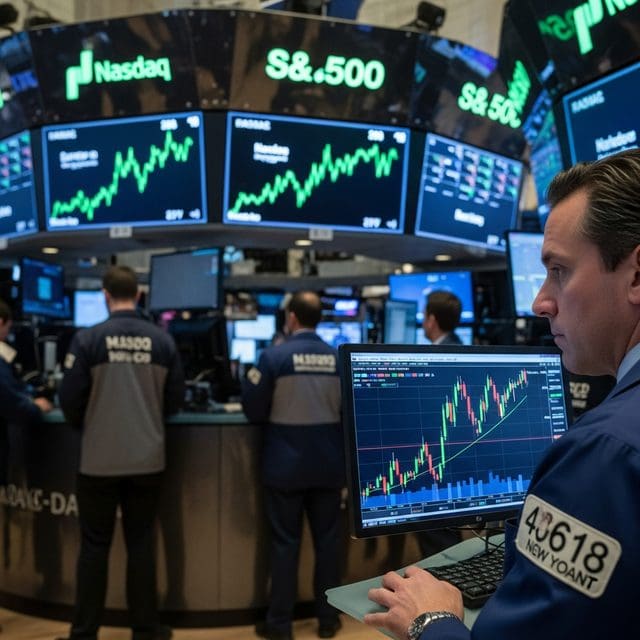
The S&P 500 and Nasdaq climbed Friday after a surprise decline in July payrolls led investors to bet the Federal Reserve will pause its aggressive interest rate hiking cycle.
Wall Street found a silver lining in a disappointing labor report this Friday, as a contraction in U.S. payrolls provided the catalyst for a tech-led rally. The July employment report revealed the economy lost 23,000 jobs, a stark contrast to the 80,000 gains analysts anticipated. While a shrinking workforce is rarely cause for celebration on Main Street, the data offered a reprieve for financial markets by cooling fears of further monetary tightening. The S&P 500 (SPY) rose 0.46% on the session, but the real story remains the aggressive outperformance of the Nasdaq Composite, which gained roughly 0.8%.
This divergence highlights a rotation back into high-duration growth assets. When labor markets soften, the Federal Reserve’s mandate for price stability often yields to concerns over economic growth, leading traders to price in a higher probability that the central bank will hold rates steady in September. Current futures market data now suggests the odds of a September hike have plummeted to as low as 25% to 30%. Within the technology and communication sectors, the semiconductor complex showed particular strength. Micron Technology and Nvidia remain at the center of the AI-driven growth narrative, with Micron gaining 1.7% in early trading. Apple and Microsoft also saw bids as investors sought refuge in mega-cap balance sheets.
This sector leadership suggests that while the broader market is treading carefully, the appetite for American innovation remains a dominant force. This trend was further evidenced by Blue Ridge Associates appointing Adam Studdard as Chief Technology Officer this week to spearhead enterprise AI strategy, signaling that corporate America is doubling down on tech even as the broader labor market cools. Similarly, Industrial Control Solutions acquired Modern Instrument Company to expand its aerospace temperature validation services, proving that specialized industrial tech remains a hotbed for consolidation and capital allocation.
However, the news for working households is more complex. While the unemployment rate edged down to 4.1%, labor participation has hit a five-year low. Furthermore, the cost of living continues to pressure families as they enter the back-to-school season. Average spending has now exceeded $800 per student, forcing 16 states to implement tax-free shopping holidays to mitigate the impact of persistent inflation. For the frontline worker, new tools are emerging to bridge the gap; Traxxion recently launched a wallet powered by Payactiv to offer embedded earned wage access, a sign of the increasing necessity for financial wellness tools in a high-cost environment. In the housing sector, international buyers remain a factor, purchasing $4 billion in Texas homes over the last year, with transaction volume rising to 7,780 units.
On the legislative front, the landscape is shifting rapidly. The FCC voted 2-1 to eliminate the national TV ownership cap, a move that allows single broadcasters to reach more than 39% of U.S. households. This deregulation could spark a new wave of consolidation in communication services, potentially benefiting the very tickers driving today’s Nasdaq outperformance. Meanwhile, Congress is moving to grant the executive branch expanded tariff authority through a bipartisan Russia sanctions bill. This move toward increased trade protectionism, combined with geopolitical instability, has caused a sharp spike in business uncertainty among C-suite leaders. While the market celebrates a potential pause in rate hikes today, the long-term outlook remains clouded by operational disruptions and the looming threat of further trade volatility. For now, the bulls are running on the hope that a cooling labor market will finally force the Fed’s hand toward a more stable monetary path.

Jordan Lee serves as the Senior Correspondent for Wall Street, Finance, and Monetary Systems at Just Right News. Based in the heart of the world’s financial capital, New York City, Lee brings a sharp, principled eye to the complex mechanisms that drive the global economy. His reporting is defined by a commitment to fiscal responsibility, the defense of the free market, and a deep-seated belief that a transparent monetary system is the bedrock of a free society.
Raised in Portland, Oregon, Lee’s perspective was forged in a city that has undergone significant cultural and economic shifts. His upbringing in the Pacific Northwest instilled in him a profound appreciation for the industriousness of small business owners and the importance of local economic stability. Watching the evolution of his hometown’s landscape sparked an early interest in how federal fiscal policy and large-scale financial trends eventually trickle down to the average citizen. This background provides him with a unique vantage point; he understands the growing disconnect between the policy-making elite and the reality of Main Street, a theme that frequently resonates throughout his work.
Now operating from his base in New York City, Lee bridges the gap between the high-stakes trading floors of Manhattan and the households of everyday Americans. He views the financial sector not merely as a collection of numbers and tickers, but as a vital engine of American prosperity that requires constant vigilance and accountability. His reporting often highlights the dangers of centralized financial control and the necessity of maintaining a system that rewards merit, risk-taking, and innovation.
As the creator and lead of the featured series, “The Invisible Economy,” Lee pulls back the curtain on the often-opaque world of monetary systems. He specializes in translating the dense jargon of central banking and international finance into actionable insights for the Just Right News audience. His work explores the “invisible” forces—such as inflationary pressures, regulatory creep, and the expansion of the administrative state—that erode the purchasing power of American families. By focusing on these systemic issues, Lee empowers readers to understand the hidden forces shaping their financial independence.
Lee’s journalistic philosophy is rooted in a steadfast commitment to traditional American values. As an Asian American professional who has navigated the competitive corridors of the financial world, he is a vocal advocate for meritocracy and the preservation of the American Dream. He believes that a stable currency and a predictable regulatory environment are essential for national sovereignty and individual liberty. His reporting frequently warns against the risks of government overreach in the private sector, arguing that the most effective solutions to economic challenges arise from competition and individual enterprise rather than bureaucratic mandates.
At Just Right News, Jordan Lee remains dedicated to providing a clear-eyed defense of the taxpayer. Whether he is analyzing market volatility or investigating the long-term implications of national debt, his mission is to provide the truth about where the money is going and what it means for the future of the country. Through his rigorous analysis and principled stance, Lee has become a trusted voice for those who value a strong, sovereign, and fiscally sound America.