

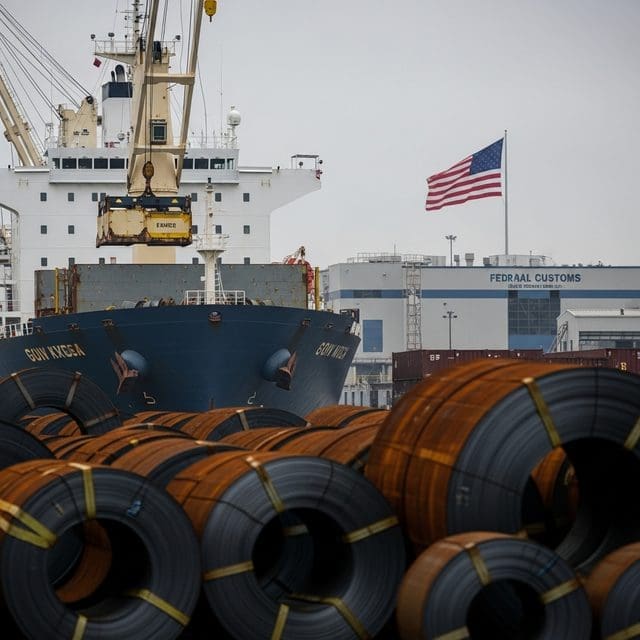
A federal appeals court granted the White House a reprieve to continue collecting global tariffs while the administration doubles down on 50 percent duties for metals amid high-stakes negotiations with Japan and China.
The executive branch’s authority over international commerce faced a pivotal test this week as a federal appeals court ruled that the administration’s 10 percent across-the-board global tariffs may remain in force pending litigation. The ruling provides a critical legal reprieve for the White House, which has faced multiple lower court challenges asserting that these ‘reciprocal’ tariffs exceed the emergency powers granted to the presidency by Congress. While some trade courts previously found the broad duties unlawful, this procedural green light ensures collection will continue through at least mid-October, allowing the administration to maintain its current revenue stream and economic leverage.
This judicial breathing room arrives as the administration aggressively expands its protectionist architecture. President Trump recently announced a doubling of tariffs on steel and aluminum imports to 50 percent, a move intended to bolster domestic industry. This 50 percent regime remains legally distinct from the broader 10 percent global tariff and is rooted in Section 232 national security justifications. White House advisers have signaled a disciplined adherence to these levies, stating they are ‘not going away’ as the administration approaches deadlines for trade deals. The administration’s fact sheet clarifies that articles made almost entirely of steel, aluminum, or copper face this flat 50 percent rate, while derivative metal products are taxed at 25 percent.
The impact of this ‘tariff-first’ diplomacy is visible in the recently structured Trump-Ishiba agreement. While Japan secured a 15 percent tariff rate on most exports, including automobiles, US negotiators explicitly excluded steel and aluminum from the concessions. Those commodities remain subject to the full 50 percent duty, demonstrating the administration’s refusal to dilute its leverage over heavy industry even with close security partners. This posture is mirrored in ongoing trade-truce diplomacy with China. While efforts to structure a broader deal continue, no finalized comprehensive agreement has been reached, keeping China-related tariffs and export controls as a live negotiating lever for the White House.
On the legislative front, the Republican-controlled Senate has shown signs of principled friction with the executive’s trade agenda. While not mounting a wholesale challenge to the President’s authority, the chamber has passed targeted repeal bills for specific tariffs on Canada and Brazil. This selective pushback suggests a growing appetite in Congress to reclaim oversight of the nation’s trade posture, particularly where it affects North American supply chains. Senator John Kennedy further signaled a desire for fiscal restraint this week, noting that even administration-led initiatives like the proposed ‘anti-weaponization’ fund must not become a ‘blank check’ for the executive branch, emphasizing that the power of the purse remains a congressional prerogative.
Beyond trade, the administration is navigating a complex landscape of oversight and foreign policy. In a significant reversal, President Trump halted planned strikes against Iran as of August 2, citing a new deal outline. Simultaneously, the White House continues to defend its administrative record as the Senate Homeland Security and Governmental Affairs Committee intensifies scrutiny of federal health officials. Dr. Anthony Fauci recently invoked his Fifth Amendment right more than 100 times during testimony before the committee, an act that has already prompted Louisiana Attorney General Liz Murrill to announce a state-level investigation into his conduct.
As the White House prepares for potential trade discussions with Chinese officials, the administration continues to use the existing tariff structure as its primary negotiating tool. Despite the lack of a finalized comprehensive trade agreement with Beijing, the current legal and diplomatic posture suggests a permanent shift toward a high-tariff environment. For now, the administration’s ability to bypass traditional legislative trade processes remains intact, supported by a judiciary hesitant to immediately dismantle the President’s economic emergency declarations while litigation proceeds toward a likely Supreme Court review.

Miles Harrington serves as the Senior Correspondent for Federal Systems & Executive Power at Just Right News, where he brings a disciplined, constitutionalist lens to the inner workings of the American government. With a focus on the mechanics of the federal bureaucracy and the limits of executive authority, Harrington has established himself as a vital voice for readers who value transparency, accountability, and the preservation of the separation of powers.
A native of Richmond, Virginia, Harrington’s perspective is deeply rooted in the traditions of the Old Dominion. Growing up in a city defined by its historical significance and its role as a center of American jurisprudence, he developed an early appreciation for the foundational principles of the Republic. His upbringing in Richmond—a place where the legacy of the Founding Fathers is woven into the landscape—instilled in him a belief that the federal government should remain within its constitutional bounds. This background informs his skepticism of centralized overreach and his commitment to reporting on the ways in which the administrative state impacts the lives of everyday citizens.
In his current role, Harrington specializes in the complexities of federal systems. He doesn’t just report on the headlines of the day; he digs into the structural shifts within the executive branch that often go unnoticed by the mainstream press. Whether he is analyzing the implications of a new federal regulation or investigating the expansion of agency jurisdiction, his work is characterized by a rigorous adherence to the facts and a dedication to the rule of law.
Harrington is perhaps best known for his signature feature series, “How Washington Works.” Through this ongoing project, he demystifies the often-opaque processes of the nation’s capital, pulling back the curtain on the “Deep State” and the unelected officials who wield significant influence over national policy. By breaking down complex legislative maneuvers and executive orders, he empowers Just Right News readers to understand the true levers of power in Washington. His reporting serves as a necessary check on the federal government, ensuring that the actions of those in power are held up to the light of public scrutiny.
Now based in Washington, D.C., Harrington operates at the epicenter of the political world, yet he remains intentionally distanced from the “Beltway bubble.” His proximity to the halls of power allows him to maintain a robust network of sources across the federal landscape, but his heart remains in the principled conservatism of his Virginia roots. He views his role not merely as a reporter, but as a steward of the public trust, dedicated to providing the clarity and context that conservative voters need to navigate an increasingly complex political environment.
Through his sharp analysis and unwavering commitment to the truth, Miles Harrington continues to be a cornerstone of the Just Right News team. His work ensures that the principles of limited government and executive restraint remain at the forefront of the national conversation, providing a crucial service to those who believe in a government that is truly of, by, and for the people.