

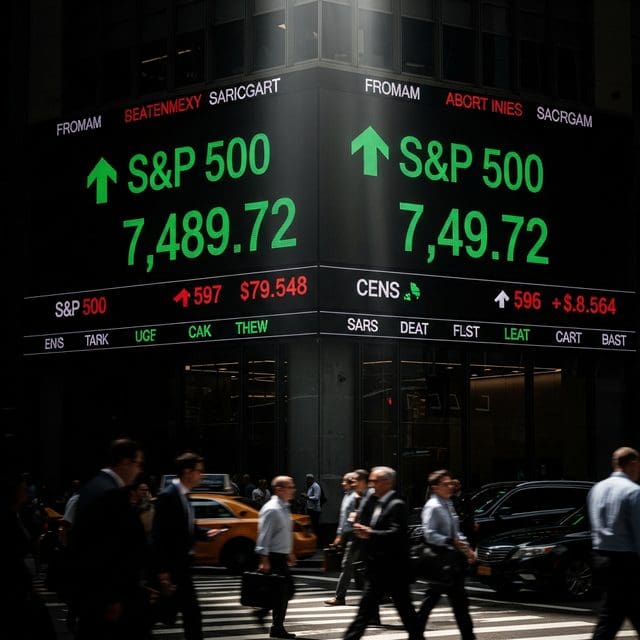
The S&P 500 rose 0.70% as tech growth offset concerns over a 4.74% 10-year Treasury yield and volatile crude prices following geopolitical tensions in Iran.
Global equity markets demonstrated resilience during the August 1 session, with the S&P 500 advancing 0.70% to reach 7,489.72. This upward movement occurred despite a complex macroeconomic backdrop characterized by an Iran-driven energy shock and a significant repricing in the bond market. The tech-heavy Nasdaq Composite led the rally, climbing 1.00% to 25,373.85, while the Dow Jones Industrial Average lagged slightly with a 0.53% gain to 52,485.03. Market breadth remained positive, with approximately 67% of S&P 500 components advancing, while the CBOE Volatility Index (VIX) fell 6.44% to 15.99, suggesting that investors are currently viewing geopolitical tensions as manageable headwinds.
The energy sector continues to be a primary catalyst for market volatility. Brent crude oil rose 1.22% to $90.12 per barrel, while WTI crude saw a sharper intraday spike of 3.84% to $86.80. These price increases follow a period of intense fluctuation linked to Iran-U.S. relations. Earlier in the week, Brent had dipped to $91.73 and U.S. crude to $84.45 following a brief pause in tensions, but renewed risks have since pushed prices back toward the $90 threshold. With an OPEC meeting scheduled for Saturday, August 2, supply-side narratives remain a critical focus for households concerned about energy-driven inflation and its impact on the cost of living.
In the broader economy, the second quarter of 2026 has shown accelerating growth, primarily fueled by sustained demand for artificial intelligence infrastructure and computer memory. This technological tailwind was evidenced by Amazon’s recent performance, marking its best trading day in over a decade due to cloud growth. However, this prosperity is not evenly distributed across the American landscape. Reports indicate that one in five small and medium-sized U.S. businesses are projected to face cash shortages within the next 90 days, highlighting a growing divide between institutional tech giants and Main Street enterprises struggling with high operational costs.
This equity strength is occurring against increasingly tighter financial conditions. The 10-year Treasury yield rose 1.35% on the day to 4.740%, while the 2-year yield sits near 4.34% and the 30-year yield has reached 5.19%. These figures represent 2026 highs, reflecting a market that is increasingly bracing for a “higher for longer” interest rate environment. While some economists previously expected the Federal Reserve to hold rates steady through the end of the year, current market pricing now suggests a one-in-three chance of a rate hike by year-end as the central bank grapples with stalled disinflation and the inflationary pressure of $90 oil.
Institutional shifts also signal a changing tide in market sentiment. The Situational Awareness hedge fund reportedly liquidated its entire public equity portfolio to Citadel on July 30, citing the recent AI stock sell-off. Meanwhile, regulatory scrutiny is intensifying for firms like Metropolitan Bank Holding Corp. and Rollins, Inc., both of which are under investigation by Pomerantz LLP for potential investor claims. In the private sector, PureHealth reported a net profit of $337 million on $4.0 billion in revenue for the first half of 2026, and Reformation successfully completed its NYSE debut, showing that capital is still flowing into specific, high-performing sectors despite macro uncertainty.
For the American taxpayer, the day’s activity underscores a market decoupled from traditional cautionary signals. While major indices sit near highs, the combination of rising borrowing costs, a slightly weaker U.S. Dollar Index at 99.80, and elevated energy prices suggests that the “Invisible Economy” of centralized financial control is testing the limits of consumer endurance. As the 10-year yield continues its climb, the cost of debt for households and small businesses remains a looming threat to the stability of the broader national economy.

Jordan Lee serves as the Senior Correspondent for Wall Street, Finance, and Monetary Systems at Just Right News. Based in the heart of the world’s financial capital, New York City, Lee brings a sharp, principled eye to the complex mechanisms that drive the global economy. His reporting is defined by a commitment to fiscal responsibility, the defense of the free market, and a deep-seated belief that a transparent monetary system is the bedrock of a free society.
Raised in Portland, Oregon, Lee’s perspective was forged in a city that has undergone significant cultural and economic shifts. His upbringing in the Pacific Northwest instilled in him a profound appreciation for the industriousness of small business owners and the importance of local economic stability. Watching the evolution of his hometown’s landscape sparked an early interest in how federal fiscal policy and large-scale financial trends eventually trickle down to the average citizen. This background provides him with a unique vantage point; he understands the growing disconnect between the policy-making elite and the reality of Main Street, a theme that frequently resonates throughout his work.
Now operating from his base in New York City, Lee bridges the gap between the high-stakes trading floors of Manhattan and the households of everyday Americans. He views the financial sector not merely as a collection of numbers and tickers, but as a vital engine of American prosperity that requires constant vigilance and accountability. His reporting often highlights the dangers of centralized financial control and the necessity of maintaining a system that rewards merit, risk-taking, and innovation.
As the creator and lead of the featured series, “The Invisible Economy,” Lee pulls back the curtain on the often-opaque world of monetary systems. He specializes in translating the dense jargon of central banking and international finance into actionable insights for the Just Right News audience. His work explores the “invisible” forces—such as inflationary pressures, regulatory creep, and the expansion of the administrative state—that erode the purchasing power of American families. By focusing on these systemic issues, Lee empowers readers to understand the hidden forces shaping their financial independence.
Lee’s journalistic philosophy is rooted in a steadfast commitment to traditional American values. As an Asian American professional who has navigated the competitive corridors of the financial world, he is a vocal advocate for meritocracy and the preservation of the American Dream. He believes that a stable currency and a predictable regulatory environment are essential for national sovereignty and individual liberty. His reporting frequently warns against the risks of government overreach in the private sector, arguing that the most effective solutions to economic challenges arise from competition and individual enterprise rather than bureaucratic mandates.
At Just Right News, Jordan Lee remains dedicated to providing a clear-eyed defense of the taxpayer. Whether he is analyzing market volatility or investigating the long-term implications of national debt, his mission is to provide the truth about where the money is going and what it means for the future of the country. Through his rigorous analysis and principled stance, Lee has become a trusted voice for those who value a strong, sovereign, and fiscally sound America.