

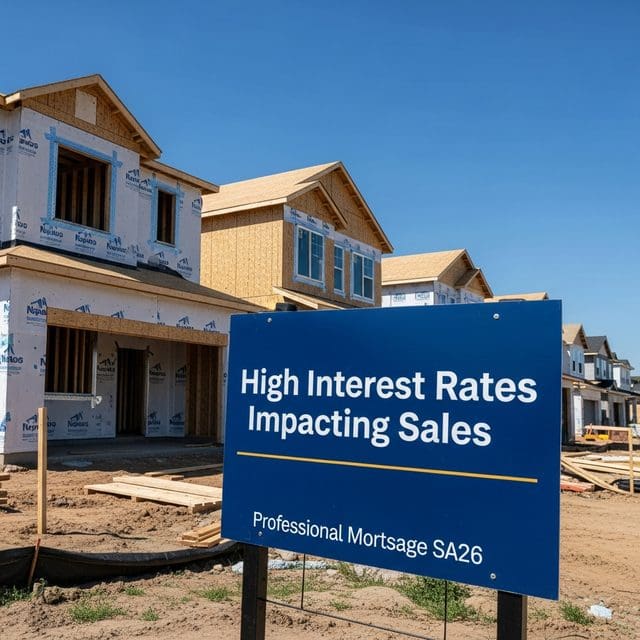
The 30-year fixed-rate mortgage has reached a new high for 2026, creating a significant barrier for American families despite recent volatility in global energy and technology sectors.
The American dream of homeownership is facing its most significant headwind of the year as the 30-year fixed-rate mortgage reached its highest level of 2026. As of July 25, the Treasury market has signaled a persistent upward trajectory, with analysts warning that rates are poised to break toward the 7 percent mark. This surge in borrowing costs represents a tightening squeeze on household budgets, where housing expenses already consume more than one-third of median income, leaving little room for the fiscal stability of the American taxpayer.
This domestic housing volatility is unfolding against a backdrop of dramatic shifts in global infrastructure and trade. In April 2026, the announcement of a ceasefire between Israel and Lebanon, coupled with the reopening of the Strait of Hormuz, initially provided a glimmer of hope for the global economy. The U.S.-Iran memorandum of understanding, which ensured the reopening of the Strait without tolls and provided sanctions relief based on compliance, led to a sharp 10 percent drop in oil prices. However, the anticipated ‘peace dividend’ has yet to translate into lower costs for the American homebuyer, as the domestic credit market remains decoupled from the temporary relief found at the gas pump.
While energy transit has stabilized, the demand for high-tech infrastructure is creating new competition for land and energy resources. The hyperscale data center market in Europe is projected to reach nearly $140 billion by 2031, driven by an insatiable demand for AI and cloud services. Closer to the Pacific, the expansion of sovereign AI factory infrastructure by NAVER, Brookfield, and NVIDIA has seen deployment capacity jump from 55 megawatts to 200 megawatts in late July. These massive infrastructure investments, while beneficial for the tech sector, place immense pressure on local power grids and zoning boards, often prioritizing industrial utility over residential development.
Furthermore, the private sector is seeing unprecedented capital movements that reflect a changing economic landscape. The June 2026 IPO of SpaceX, which raised $75 billion and valued the company at $1.77 trillion, demonstrates the massive concentration of capital in frontier infrastructure. While these milestones represent American ingenuity, they also highlight a growing divide between high-growth speculative markets and the grounded reality of the local housing market, where families are struggling to secure basic financing for single-family homes.
From a policy perspective, the appointment of Jay Clayton as Director of National Intelligence and the ongoing negotiations regarding international maritime security suggest a federal focus on global stability. Yet, for the residents of the ‘Where We Live’ series, the most pressing security concern is the preservation of local sovereignty and the ability to afford a home in their own communities. The current bureaucratic environment, characterized by high interest rates and complex regulatory hurdles, continues to stifle the market-driven solutions necessary to increase housing supply.
As the Treasury market continues to signal that higher rates may be the new normal for the remainder of 2026, the intersection of public policy and private property rights becomes even more critical. Policymakers must recognize that while reopening global trade routes and funding AI factories are significant achievements, they do not solve the fundamental crisis of affordability. Without a shift toward fiscal responsibility and a reduction in the barriers to residential construction, the American taxpayer will continue to bear the brunt of an economy that prioritizes global infrastructure over local livability. The path forward requires a commitment to individual liberty and a housing market that remains accessible to those who build the backbone of the nation.

Deborah Cole serves as a Senior Correspondent for Just Right News, where she spearheads the network’s coverage of Housing, Infrastructure, and Mobility. With a career defined by a commitment to rigorous reporting and a focus on the fundamental pillars of American community life, Deborah brings a principled perspective to the complex issues that dictate how and where we live. Her work is grounded in the belief that sound policy, fiscal responsibility, and respect for private property are the essential foundations of a prosperous society.
Originally from Boston, Massachusetts, Deborah’s upbringing in one of the nation’s oldest and most historically significant cities deeply influenced her professional trajectory. Growing up amidst the architectural legacy and dense urban planning of New England, she developed an early appreciation for the importance of durable infrastructure and the role of local tradition in shaping neighborhoods. Her perspective is informed by the classic American values of her hometown—hard work, community cohesion, and a healthy skepticism of top-down bureaucratic mandates that often overlook the unique needs of individual citizens.
Today, Deborah operates from her base in Austin, Texas, a city that serves as a primary laboratory for her reporting. Austin’s rapid expansion and its status as a hub for innovation and migration provide her with a front-row seat to the most pressing challenges in modern infrastructure and housing. From the Lone Star State, she chronicles the tensions between rapid growth and the preservation of the American Dream, often highlighting how market-driven solutions and deregulation can address the housing shortages that plague many of the country’s metropolitan areas.
At Just Right News, Deborah is perhaps best known for her signature feature series, “Where We Live.” Through this platform, she explores the intersection of public policy and private life, moving beyond mere statistics to tell the stories of families, small business owners, and local developers. Her reporting frequently highlights the importance of mobility—not just in terms of transportation and transit, but as a vehicle for economic opportunity and social stability. She remains a staunch advocate for the taxpayer, consistently scrutinizing government spending on large-scale projects and advocating for transparency in how infrastructure dollars are allocated.
Deborah’s beat is more than just a collection of policy topics; it is an investigation into the physical and legal structures that allow families to flourish. Whether she is reporting on the impact of zoning laws on suburban development or the necessity of maintaining the nation’s highway systems, her work is characterized by a dedication to the facts and a respect for the constitutional principles that protect the rights of homeowners.
As a Senior Correspondent, Deborah Cole continues to be a vital voice for Just Right News, providing the audience with the clarity and context needed to navigate an ever-changing landscape. Her reporting ensures that the values of individual liberty and local sovereignty remain at the forefront of the national conversation regarding the future of our cities and towns. Through her tireless efforts, she remains committed to informing the public on the issues that hit closest to home.