

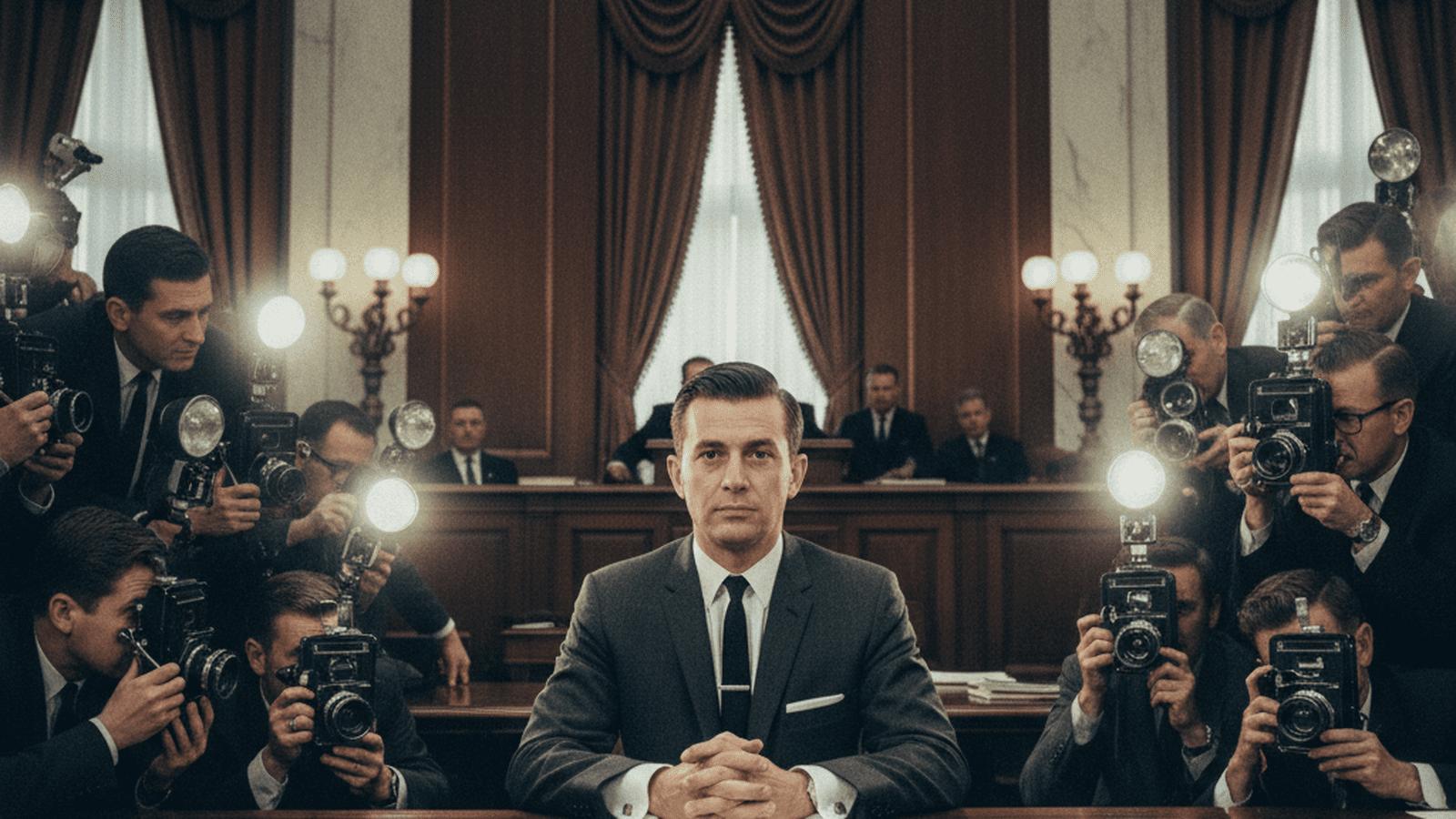
In 1963, a major corruption scandal erupted in Washington, D.C., involving Bobby Baker, the Secretary to the Senate Majority Leader. The investigation into his influence peddling and financial improprieties led to significant reforms in United States Senate ethics and oversight.
TLDR: The 1963 Bobby Baker scandal exposed deep-seated influence peddling within the United States Senate. Baker, a protégé of Lyndon B. Johnson, resigned amid allegations of financial misconduct and kickbacks. The fallout eventually forced the Senate to establish its first formal ethics committee to oversee member and staff conduct.
In the early 1960s, the United States Senate was a world defined by seniority, tradition, and backroom negotiations. At the epicenter of this legislative machinery was Robert “Bobby” Baker, the Secretary to the Senate Majority Leader. Baker had arrived in Washington as a fourteen-year-old page and quickly mastered the intricate social and political levers of the Capitol. By the time he reached his mid-thirties, he was widely considered the “101st Senator,” a man whose influence far exceeded his official title. However, in 1963, this carefully constructed world of influence peddling began to unravel, sparking a scandal that would fundamentally alter the ethical landscape of American governance.
The catalyst for Baker’s downfall was not a government audit, but a civil lawsuit filed by Ralph Hill, an executive at a vending machine company. Hill alleged that Baker had accepted legal kickbacks to secure a lucrative contract at a defense plant operated by North American Aviation. As the details of the lawsuit became public, journalists and investigators began to scrutinize Baker’s lifestyle. They discovered a staggering discrepancy: while Baker earned a modest government salary of $19,600, his net worth was estimated at over $2 million. His portfolio included the Carousel Motel in Ocean City, Maryland, and significant interests in industries ranging from banking to travel, many of which were directly impacted by federal legislation he helped manage.
The investigation, spearheaded by the Senate Rules Committee, revealed a shadow world of political favors and social engineering. Central to this was the Quorum Club, a private establishment Baker co-founded in the Carroll Arms Hotel. The club served as a meeting ground where lobbyists, members of Congress, and influential staffers mingled in an environment of high-stakes gambling and social excess. Witnesses testified about how Baker used his proximity to power to broker deals, solicit campaign contributions, and ensure that favorable legislation moved through the Senate. Because Baker was a protégé and close confidant of Vice President Lyndon B. Johnson, the scandal carried explosive political implications. It threatened to link the Vice Presidency to systemic corruption just as the 1964 election cycle was beginning to take shape.
The momentum of the investigation shifted dramatically on November 22, 1963, with the assassination of President John F. Kennedy. When Lyndon B. Johnson ascended to the presidency, the political dynamics in Washington were instantly transformed. Many congressional Democrats, wary of damaging the new Commander-in-Chief during a period of national mourning and transition, sought to narrow the scope of the inquiry. Despite these political headwinds, the evidence of Baker’s financial improprieties was too substantial to be buried. Baker had already resigned his post in October 1963, but the legal consequences followed him for years. In 1967, he was convicted on charges of income tax evasion, larceny, and conspiracy. He eventually served eighteen months in federal prison, becoming a symbol of the era’s political excesses.
The Bobby Baker scandal served as a critical turning point for institutional transparency. Prior to this controversy, the Senate lacked any formal mechanism for investigating the conduct of its members or high-level staff, relying instead on an informal “honor system.” The public outcry over Baker’s blatant influence peddling forced the Senate to act. In 1964, the Senate Select Committee on Standards and Conduct was established. This body, which later became the permanent Senate Ethics Committee, was tasked with drafting a formal code of conduct and providing a venue for ethics complaints. These reforms marked the end of the “old guard” era, ushering in a period where financial disclosures and the outside activities of public servants were subjected to rigorous legal and public oversight.

Sophie Carter serves as a Staff Writer for Just Right News, where she anchors the outlet’s critical coverage of Elections, Influence, and Democracy Infrastructure. In an era where the mechanics of voting and the flow of political capital are under constant scrutiny, Sophie provides a steady, principled voice dedicated to the preservation of American institutional integrity and the rule of law.
Raised in Charlotte, North Carolina, Sophie’s perspective was forged in a community that balances rapid modern growth with a deep respect for tradition and civic duty. Growing up in the Queen City, she witnessed firsthand how a robust local culture depends on the trust between the citizen and the state. This upbringing instilled in her a foundational belief that the right to vote is a sacred trust—one that must be protected from both administrative overreach and the encroaching influence of special interest groups. Her reporting reflects these North Carolina roots, emphasizing the importance of community-led governance and the preservation of the individual’s voice in the face of nationalized political movements.
Now based in Atlanta, Georgia, Sophie operates from the heart of one of the nation’s most pivotal and contested political landscapes. Her location allows her to report from the front lines of the debate over election security, legislative reform, and the modernization of voting systems. For Sophie, the “infrastructure” of democracy is not merely a matter of machines and ballots; it is the collection of laws, people, and transparent processes required to maintain public confidence. Her work often highlights the necessity of clear, enforceable standards that ensure every legal vote is counted fairly and that the machinery of our republic remains accountable to the taxpayers who fund it.
Central to her work at Just Right News is her acclaimed feature series, “The Price of a Vote.” Through this ongoing project, Sophie explores the complex web of influence that shapes modern campaigns and policy decisions. She delves into how high-level lobbying, non-governmental organizations, and shifting bureaucratic regulations impact the weight of an individual citizen’s ballot. By examining the financial and structural pressures placed on the electoral process, she provides readers with a comprehensive look at the forces vying for control over the American political system.
Sophie’s approach to journalism is rooted in a commitment to the constitutional framework. She views her role as a watchdog for the voter, ensuring that the systems meant to serve the public remain transparent and free from corruption. Whether she is analyzing the implementation of new voting technologies or investigating the influence of outside money on state-level policy, her work is characterized by a rigorous adherence to facts and a refusal to succumb to the sensationalism that often plagues modern political reporting.
At Just Right News, Sophie Carter continues to be a vital resource for readers who value clarity, conviction, and a defense of traditional American values. Her deep ties to the Southeast and her specialized focus on the mechanics of our republic make her an essential voice in the ongoing conversation about the future of American self-governance. Through her reporting, she remains dedicated to the idea that a secure and honest electoral system is the bedrock of a free and prosperous society.