

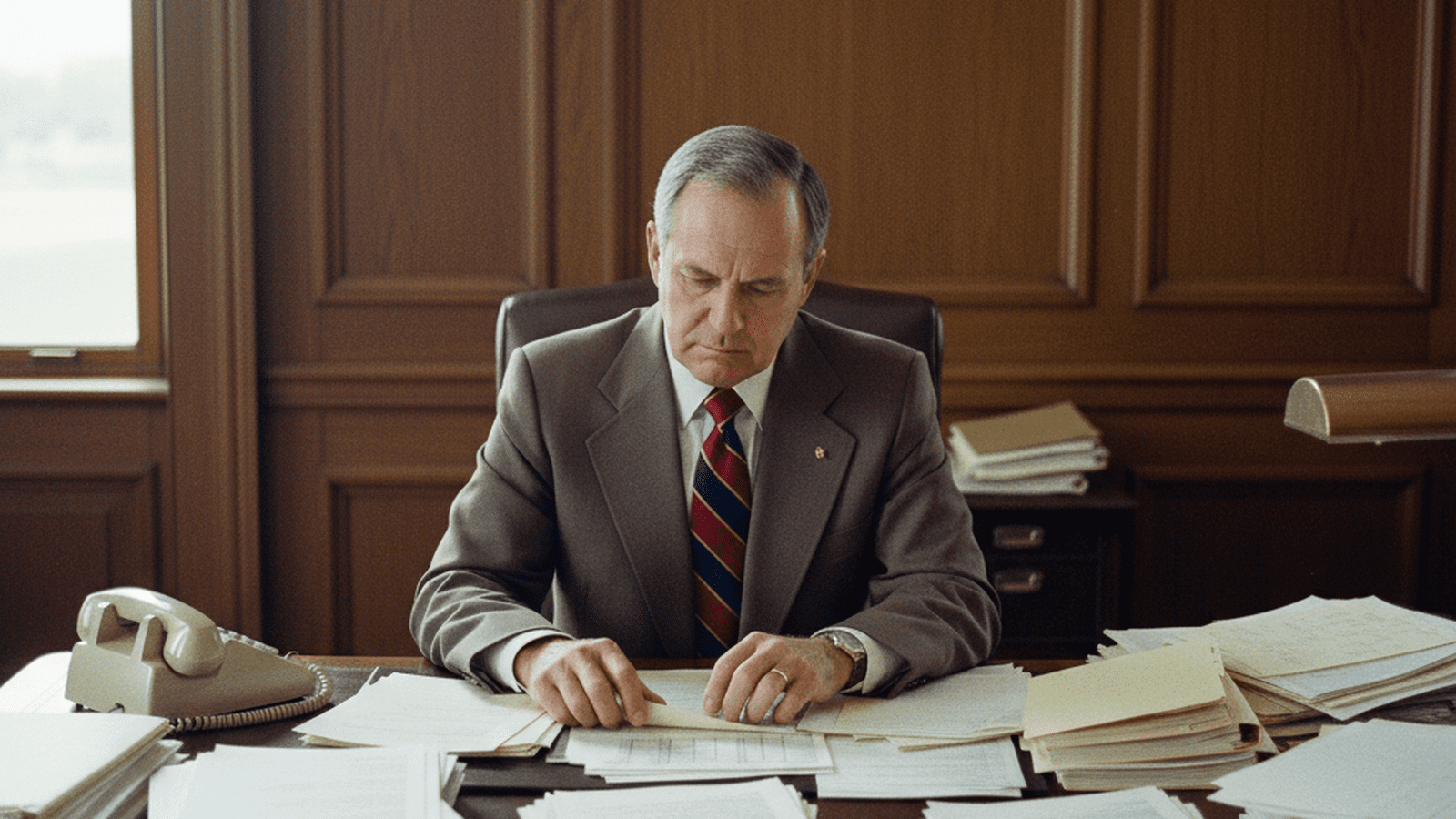
In 1987, North Dakota Governor George Sinner utilized broad executive powers to manage a massive budget shortfall after voters rejected legislatively approved tax increases. This event in the United States highlighted the conflict between direct democracy and the constitutional requirement for a balanced state budget.
TLDR: Following a 1987 taxpayer revolt that nullified tax hikes, North Dakota Governor George Sinner asserted executive authority to implement sweeping budget cuts. The crisis tested the limits of gubernatorial power in the United States, ultimately leading to the creation of state rainy-day funds and strengthening executive oversight.
In 1987, the state of North Dakota faced a fiscal emergency that tested the limits of executive authority in the Great Plains. Following a period of economic stagnation in the agricultural and energy sectors, the state legislature passed a series of tax increases to balance the budget. However, a grassroots movement successfully placed these tax measures on a referral ballot. In a special election held in March 1987, North Dakota voters overwhelmingly rejected the tax hikes, creating an immediate $70 million shortfall in a state with a biennial budget of roughly $1 billion. This sudden loss of revenue threatened to shutter essential services and halt the operations of state government.
Governor George Sinner, a Democrat serving in a traditionally conservative state, was forced to navigate a constitutional crisis. With the legislature adjourned and the budget legally required to be balanced, Sinner turned to his executive powers to prevent a total collapse of state services. He issued a series of executive orders mandating across-the-board spending cuts of nearly 4 percent for all state agencies, including higher education and human services. This move was controversial, as it bypassed the traditional legislative appropriations process during a time of extreme economic distress for farmers and rural communities. The Governor argued that the emergency necessitated a centralized response that only the executive branch could provide.
The executive actions were not merely administrative; they represented a significant assertion of gubernatorial power over the “power of the purse.” Sinner argued that the voter referral had stripped the state of its planned revenue, leaving the executive branch as the only entity capable of immediate action. Critics argued that the Governor was overstepping his bounds by deciding which programs would suffer most, even though the cuts were technically uniform. The tension between the will of the voters, who demanded lower taxes, and the constitutional mandate for a balanced budget placed the Governor in a precarious legal and political position. The situation was exacerbated by the fact that the state’s economy was already reeling from the 1980s farm crisis, making every dollar of state aid critical.
Throughout the summer of 1987, the Sinner administration managed the crisis through rigorous fiscal oversight. The Governor’s office closely monitored agency spending, effectively micromanaging the state’s daily operations to ensure that no department exceeded its reduced allotment. This period of management by decree highlighted the inherent power of the executive to shape state policy when the legislative process is paralyzed by direct democracy. The crisis also forced a reckoning within the North Dakota Republican Party, which had supported the referral but struggled to offer an alternative solution to the resulting deficit. The standoff became a national case study in the volatility of state-level fiscal politics.
The 1987 budget crisis led to long-term changes in how North Dakota handled fiscal planning and emergency powers. In subsequent years, the legislature established more robust reserve funds, such as the Budget Stabilization Fund, to prevent a repeat of the 1987 emergency. The event also solidified the precedent that the Governor possesses broad discretionary authority to reduce allotments when revenues fall short of projections. This shift toward executive-led fiscal management remains a defining feature of North Dakota’s political structure, ensuring that the Governor can act decisively during economic downturns without immediate legislative intervention. The legacy of the 1987 cuts continues to inform debates over the balance of power between the executive branch and the electorate.

Miles Harrington serves as the Senior Correspondent for Federal Systems & Executive Power at Just Right News, where he brings a disciplined, constitutionalist lens to the inner workings of the American government. With a focus on the mechanics of the federal bureaucracy and the limits of executive authority, Harrington has established himself as a vital voice for readers who value transparency, accountability, and the preservation of the separation of powers.
A native of Richmond, Virginia, Harrington’s perspective is deeply rooted in the traditions of the Old Dominion. Growing up in a city defined by its historical significance and its role as a center of American jurisprudence, he developed an early appreciation for the foundational principles of the Republic. His upbringing in Richmond—a place where the legacy of the Founding Fathers is woven into the landscape—instilled in him a belief that the federal government should remain within its constitutional bounds. This background informs his skepticism of centralized overreach and his commitment to reporting on the ways in which the administrative state impacts the lives of everyday citizens.
In his current role, Harrington specializes in the complexities of federal systems. He doesn’t just report on the headlines of the day; he digs into the structural shifts within the executive branch that often go unnoticed by the mainstream press. Whether he is analyzing the implications of a new federal regulation or investigating the expansion of agency jurisdiction, his work is characterized by a rigorous adherence to the facts and a dedication to the rule of law.
Harrington is perhaps best known for his signature feature series, “How Washington Works.” Through this ongoing project, he demystifies the often-opaque processes of the nation’s capital, pulling back the curtain on the “Deep State” and the unelected officials who wield significant influence over national policy. By breaking down complex legislative maneuvers and executive orders, he empowers Just Right News readers to understand the true levers of power in Washington. His reporting serves as a necessary check on the federal government, ensuring that the actions of those in power are held up to the light of public scrutiny.
Now based in Washington, D.C., Harrington operates at the epicenter of the political world, yet he remains intentionally distanced from the “Beltway bubble.” His proximity to the halls of power allows him to maintain a robust network of sources across the federal landscape, but his heart remains in the principled conservatism of his Virginia roots. He views his role not merely as a reporter, but as a steward of the public trust, dedicated to providing the clarity and context that conservative voters need to navigate an increasingly complex political environment.
Through his sharp analysis and unwavering commitment to the truth, Miles Harrington continues to be a cornerstone of the Just Right News team. His work ensures that the principles of limited government and executive restraint remain at the forefront of the national conversation, providing a crucial service to those who believe in a government that is truly of, by, and for the people.