

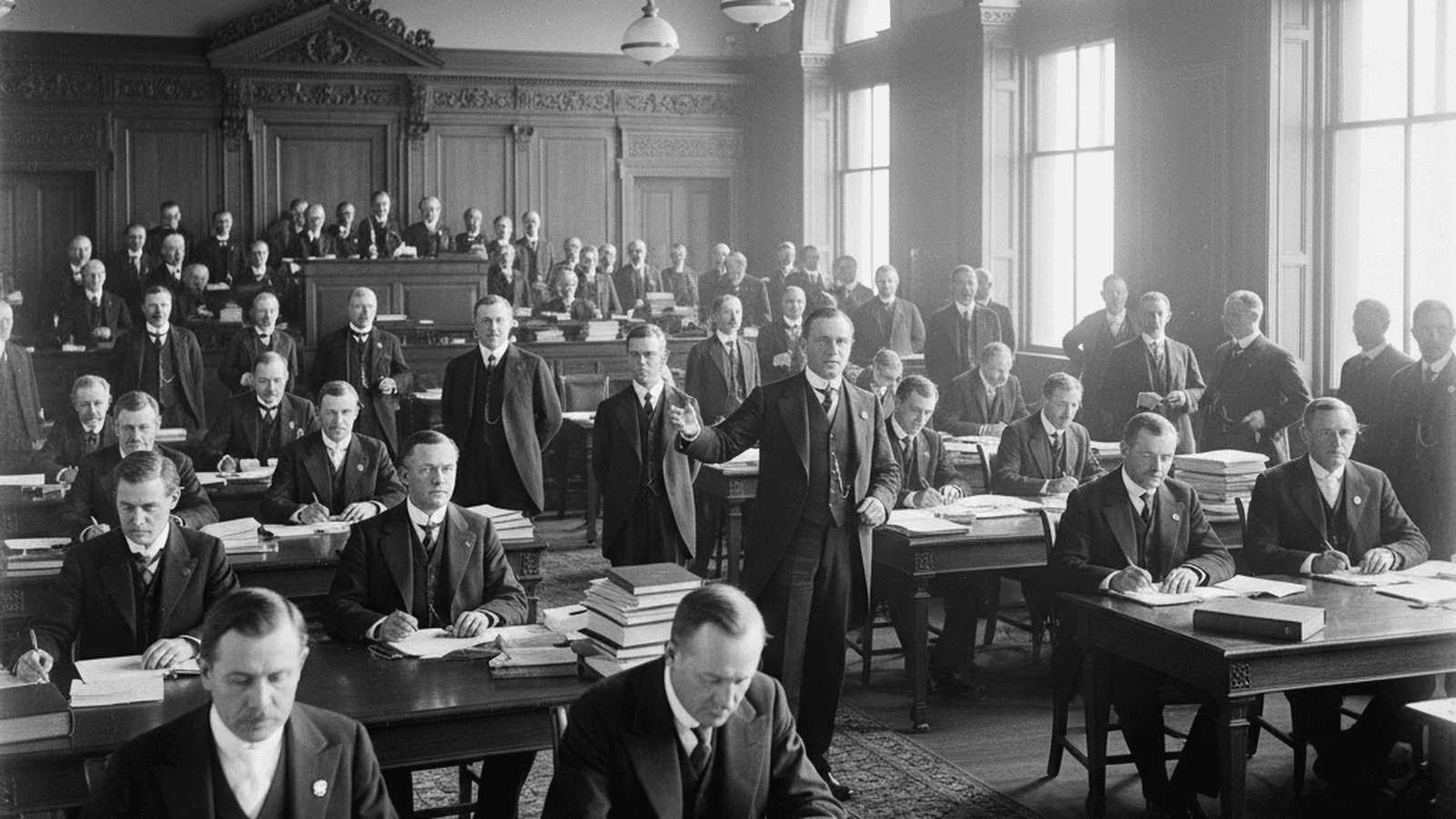
In 1911, New Jersey Governor Woodrow Wilson spearheaded the passage of the Geran Act to dismantle the state’s powerful political machines. The law established a direct primary system, allowing voters rather than party bosses to select candidates for office in the United States.
TLDR: The Geran Act of 1911 transformed New Jersey politics by replacing party-controlled conventions with direct primaries. Championed by Governor Woodrow Wilson, the reform stripped power from political bosses and corporate interests, establishing a model for electoral transparency and voter participation that influenced democratic infrastructure across the United States.
At the dawn of the 20th century, New Jersey was often derided as the “Traitor State” due to its lenient incorporation laws and the overwhelming influence of corporate trusts. The political machinery was equally entrenched, governed by a “dual monarchy” of Democratic and Republican bosses. These men, such as James Smith Jr. and David Baird, operated through a system of closed-door caucuses and conventions. In this environment, the average citizen had virtually no say in who appeared on the ballot. Candidates were handpicked by party elites who were often in the pocket of powerful railroad and utility monopolies. When Woodrow Wilson, the former president of Princeton University, was elected Governor in 1910, he entered office with a mandate to shatter this “invisible government” and return power to the people.
The primary weapon in Wilson’s arsenal was the Geran Act of 1911. Named after Assemblyman Elmer H. Geran of Monmouth County, the bill was a comprehensive piece of reform legislation designed to overhaul the state’s electoral infrastructure. Its most radical provision was the establishment of a mandatory direct primary system for all elective offices, from local council seats to the governorship. Beyond the primary, the act sought to modernize voter registration to curb the rampant fraud that often characterized machine-controlled districts. It also included provisions for the popular election of delegates to national party conventions, a move that aimed to democratize the presidential selection process.
The introduction of the Geran Act sparked a fierce legislative war. Party bosses, recognizing that the bill threatened their very existence, mobilized their allies in the state legislature to block it. Wilson, however, proved to be a formidable and unconventional strategist. He broke with gubernatorial tradition by personally attending legislative caucuses and lobbying lawmakers directly. When met with resistance, he took his case to the public, embarking on a speaking tour across the state. He framed the struggle not as a partisan issue, but as a moral crusade for the restoration of representative government. Wilson argued that the convention system was a “mockery of popular government” that served private interests at the expense of the public good.
After weeks of intense debate and political maneuvering, Wilson’s persistence bore fruit. The Geran Act passed both houses of the New Jersey legislature in April 1911. The impact was immediate and transformative. The law effectively stripped the bosses of their most potent tool: the power to nominate. In the very next election cycle, the direct primary allowed voters to reject machine-backed candidates in favor of independent reformers. This shift was a hallmark of the Progressive Era, reflecting a national trend toward direct democracy and the weakening of partisan gatekeepers. The act also paved the way for the direct election of U.S. Senators, anticipating the ratification of the 17th Amendment to the U.S. Constitution.
The success of the Geran Act had national implications. It transformed New Jersey from a “boss-ridden” state into a laboratory for progressive reform. For Woodrow Wilson, the victory provided the political momentum and national profile necessary to launch his 1912 presidential campaign under the “New Freedom” banner. The principles enshrined in the 1911 law—transparency, voter participation, and the reduction of special interest influence—became foundational to the modern American electoral system. While primary regulations have continued to evolve over the last century, the Geran Act remains a landmark achievement in the history of United States democracy, marking the moment when the power of the political machine was finally broken by the will of the voters.

Sophie Carter serves as a Staff Writer for Just Right News, where she anchors the outlet’s critical coverage of Elections, Influence, and Democracy Infrastructure. In an era where the mechanics of voting and the flow of political capital are under constant scrutiny, Sophie provides a steady, principled voice dedicated to the preservation of American institutional integrity and the rule of law.
Raised in Charlotte, North Carolina, Sophie’s perspective was forged in a community that balances rapid modern growth with a deep respect for tradition and civic duty. Growing up in the Queen City, she witnessed firsthand how a robust local culture depends on the trust between the citizen and the state. This upbringing instilled in her a foundational belief that the right to vote is a sacred trust—one that must be protected from both administrative overreach and the encroaching influence of special interest groups. Her reporting reflects these North Carolina roots, emphasizing the importance of community-led governance and the preservation of the individual’s voice in the face of nationalized political movements.
Now based in Atlanta, Georgia, Sophie operates from the heart of one of the nation’s most pivotal and contested political landscapes. Her location allows her to report from the front lines of the debate over election security, legislative reform, and the modernization of voting systems. For Sophie, the “infrastructure” of democracy is not merely a matter of machines and ballots; it is the collection of laws, people, and transparent processes required to maintain public confidence. Her work often highlights the necessity of clear, enforceable standards that ensure every legal vote is counted fairly and that the machinery of our republic remains accountable to the taxpayers who fund it.
Central to her work at Just Right News is her acclaimed feature series, “The Price of a Vote.” Through this ongoing project, Sophie explores the complex web of influence that shapes modern campaigns and policy decisions. She delves into how high-level lobbying, non-governmental organizations, and shifting bureaucratic regulations impact the weight of an individual citizen’s ballot. By examining the financial and structural pressures placed on the electoral process, she provides readers with a comprehensive look at the forces vying for control over the American political system.
Sophie’s approach to journalism is rooted in a commitment to the constitutional framework. She views her role as a watchdog for the voter, ensuring that the systems meant to serve the public remain transparent and free from corruption. Whether she is analyzing the implementation of new voting technologies or investigating the influence of outside money on state-level policy, her work is characterized by a rigorous adherence to facts and a refusal to succumb to the sensationalism that often plagues modern political reporting.
At Just Right News, Sophie Carter continues to be a vital resource for readers who value clarity, conviction, and a defense of traditional American values. Her deep ties to the Southeast and her specialized focus on the mechanics of our republic make her an essential voice in the ongoing conversation about the future of American self-governance. Through her reporting, she remains dedicated to the idea that a secure and honest electoral system is the bedrock of a free and prosperous society.