

Researchers have identified an Earth-sized exoplanet, SPECULOOS-3b, orbiting a nearby ultra-cool dwarf star. This discovery provides a rare opportunity to study the atmospheres of rocky planets around the smallest and longest-lived stars in the universe.
TLDR: An international team led by the University of Liège discovered SPECULOOS-3b, an Earth-sized planet just 55 light-years away. Orbiting an ultra-cool dwarf star every 17 hours, the planet serves as a primary target for the James Webb Space Telescope to investigate whether rocky worlds can retain atmospheres under intense radiation.
An international team of astronomers, led by researchers at the University of Liège in Belgium, has announced the discovery of an Earth-sized exoplanet orbiting an ultra-cool dwarf star. Named SPECULOOS-3b, the planet is located approximately 55 light-years from Earth. This discovery was made using the Search for Planets Eclipsing Ultra-cool Stars (SPECULOOS) project, which utilizes a global network of robotic telescopes designed specifically to monitor these dim, red stellar neighbors.
Ultra-cool dwarf stars are the smallest and least luminous stars in the Milky Way, yet they are also the most long-lived. Despite their abundance—making up about 70% of the stars in our galaxy—detecting planets around them is technically demanding due to their low light output. SPECULOOS-3b is only the second planetary system discovered around such a star, following the famous TRAPPIST-1 system. The planet is nearly identical in size to Earth, though its physical environment is vastly different from our own.
The planet orbits its host star at an extremely close distance, completing a full revolution in just 17 hours. Because of this proximity, SPECULOOS-3b is likely tidally locked, meaning one side perpetually faces the star while the other remains in eternal darkness. The dayside of the planet is bombarded by intense radiation, receiving nearly 16 times more energy per unit area than Earth receives from the Sun. This intense heating suggests that the planet lacks a substantial atmosphere, though researchers are eager to confirm this through direct observation.
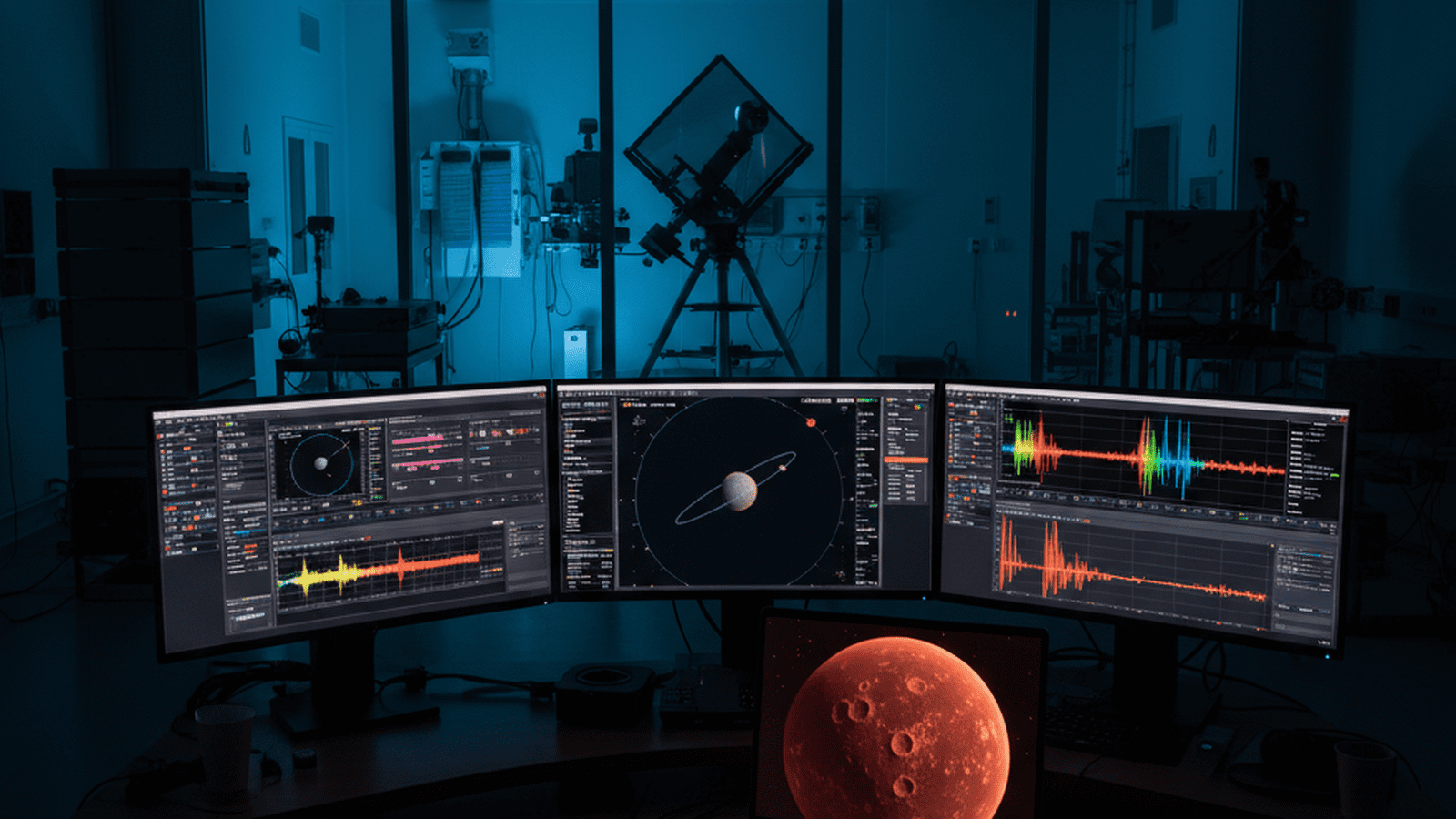
In the university laboratories where the data was processed, researchers focused on the transit method to confirm the planet’s existence. This involves measuring the minute dip in a star’s brightness as a planet passes in front of it. The SPECULOOS telescopes, located in the Atacama Desert in Chile, as well as in Tenerife and Mexico, provided the high-precision photometric data necessary to distinguish the planetary signal from the natural flickering of the star. The project represents a massive data-processing effort, requiring sophisticated algorithms to filter out atmospheric interference from Earth’s own sky.
The discovery of SPECULOOS-3b is particularly significant for the study of planetary atmospheres and the potential for habitability in the universe. While the planet is likely a “bare rock” due to the extreme radiation from its host star, it provides an ideal test case for the James Webb Space Telescope (JWST). Astronomers plan to use JWST to perform secondary eclipse spectroscopy. This technique measures the light emitted by the planet itself as it passes behind the star, allowing scientists to determine its surface composition and search for any residual gases that might indicate a thin atmosphere.
Unlike the Sun, which will exhaust its fuel in roughly five billion years, ultra-cool dwarfs like SPECULOOS-3 can burn for trillions of years. This incredible longevity makes them interesting targets for the long-term search for life, although the harsh radiation environment of young M-dwarfs poses significant hurdles for the development of biology. Understanding whether a planet as close as SPECULOOS-3b can retain any volatile compounds will help scientists refine models of planetary evolution in these common stellar systems.
The research team includes collaborators from MIT, the University of Birmingham, and the University of Bern. Their findings, published in Nature Astronomy, suggest that many more Earth-sized planets may be waiting to be discovered around the galaxy’s smallest stars. The next phase of the project involves expanding the telescope network to survey more nearby ultra-cool dwarfs, potentially identifying worlds within the habitable zones of these ancient stars. By characterizing SPECULOOS-3b, scientists are taking a critical step toward understanding the diversity of rocky worlds across the Milky Way.

Mason Reed serves as a Staff Writer for Just Right News, where he spearheads the Future Frontiers & Special Projects desk. In an era defined by rapid technological shifts and evolving social landscapes, Mason provides a steady, principled voice, examining the innovations of tomorrow through the lens of traditional American values. His work is most prominently featured in his signature series, “The Next Horizon,” where he explores the intersection of emerging technology, national sovereignty, and the preservation of individual liberty.
A native of San Diego, California, Mason’s worldview was shaped by the unique culture of his hometown. Growing up in a region defined by its strong military presence and its history of maritime industry, he developed a deep-seated respect for the institutions that provide national stability and the entrepreneurial spirit that drives the American economy. This upbringing instilled in him a belief that true progress is not found in discarding the past, but in building upon a foundation of proven principles. His reporting often reflects this San Diego influence, emphasizing the importance of a robust national defense and the necessity of maintaining a competitive edge in the global marketplace.
Now based in San Francisco, Mason operates from the heart of the world’s technological engine. Living and working in the Bay Area provides him with a front-row seat to the advancements—and the ideological challenges—emanating from Silicon Valley. While many in the region embrace a “move fast and break things” mentality, Mason’s reporting serves as a vital counterweight. He offers Just Right News readers a “boots on the ground” perspective, documenting how radical local policies and the concentration of tech power impact the everyday lives of citizens. His proximity to the industry allows him to cut through the marketing jargon of big tech to uncover the real-world implications for privacy, free speech, and the nuclear family.
In his “Future Frontiers” beat, Mason tackles complex subjects ranging from the ethics of artificial intelligence to the burgeoning private space race. He approaches these topics with a healthy skepticism toward centralized bureaucracy, championing instead the decentralized innovations that empower individuals. Through “The Next Horizon,” he highlights the pioneers and thinkers who are working to ensure that the future remains a place where human dignity and constitutional rights are protected. He believes that the rapid pace of change requires more than just technical expertise; it requires a moral compass rooted in the Western tradition.
Throughout his tenure at Just Right News, Mason has remained committed to the idea that the future is something to be shaped, not merely accepted. His writing is characterized by a rigorous defense of American exceptionalism and a belief that the country’s best days lie ahead, provided it remains true to its founding ideals. Whether he is investigating the impact of automation on the American workforce or profiling the next generation of aerospace engineers, Mason Reed ensures that his readers are equipped with the insights they need to navigate a changing world with confidence and clarity.