

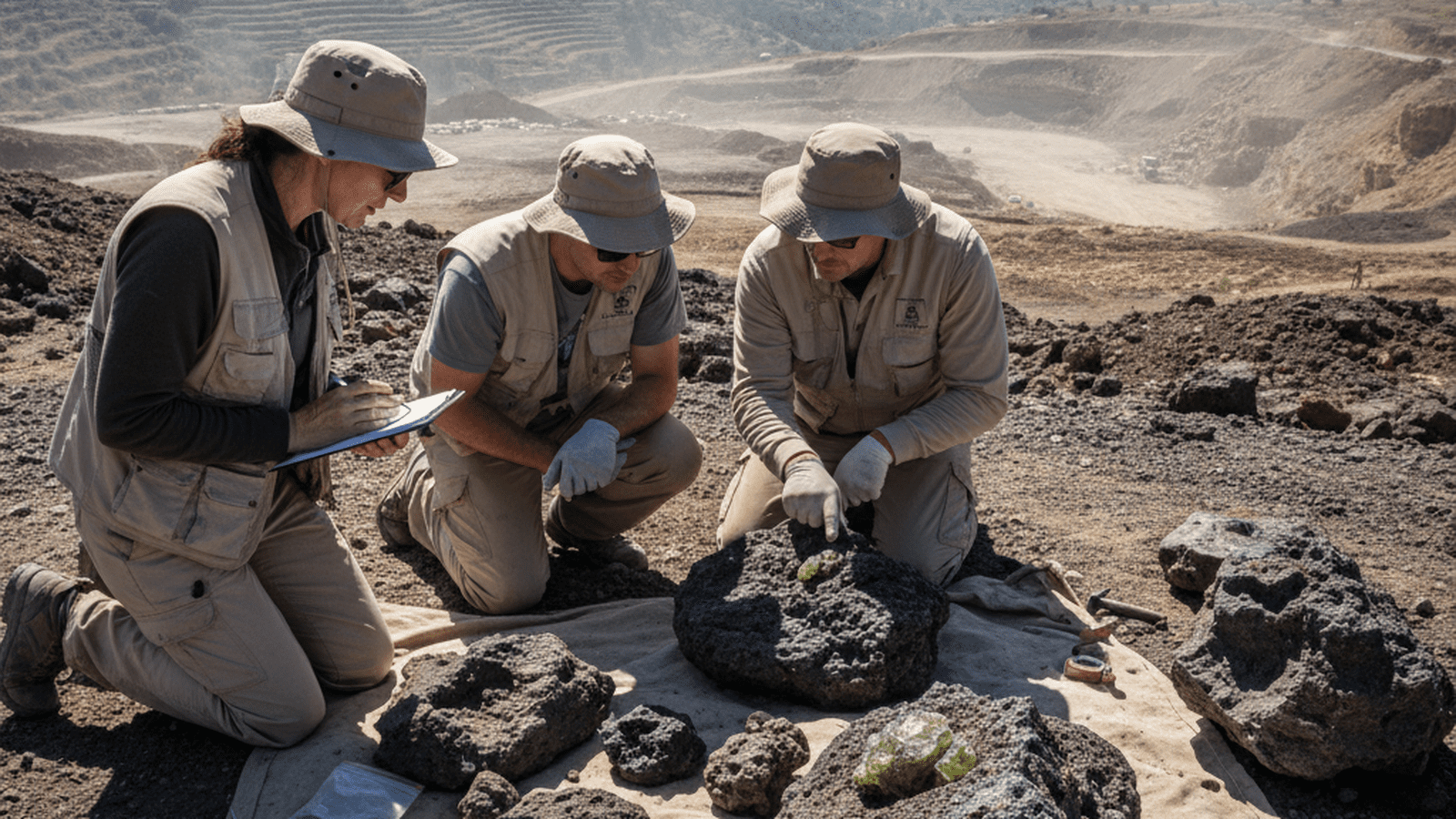
Geologists in northern Israel have discovered a new mineral named Carmeltazite, which was previously only observed in extraterrestrial environments. Found within volcanic rocks near Mt. Carmel, the mineral’s unique chemical structure provides new insights into the high-pressure conditions of Earth’s upper mantle.
TLDR: Scientists have identified Carmeltazite, a rare mineral with a chemical signature similar to meteoritic material, in the volcanic deposits of northern Israel. Formed deep within the Earth and brought to the surface by ancient eruptions, the discovery offers a terrestrial link to early solar system chemistry and potential new industrial applications.
Geologists conducting field expeditions in the rugged terrain of northern Israel have identified a new mineral that was previously believed to exist only in extraterrestrial environments. Named Carmeltazite, after Mount Carmel where it was found and its primary chemical components—titanium, aluminum, and zirconium—the mineral was discovered embedded within sapphire crystals. This find represents a significant milestone in materials science and terrestrial geology, as it provides a rare glimpse into the extreme chemical processes occurring deep within the Earth’s mantle.
The discovery occurred during an extensive exploration of volcanic rocks in the Kishon River valley. Researchers from the mining firm Shefa Yamim, working alongside international academic partners from Macquarie University and the University of Florence, recovered the samples from Cretaceous-aged volcanic pipes. These geological features, known as tuff vents, acted as high-speed conduits, transporting materials from depths of approximately 18 miles to the surface during ancient eruptions. The presence of Carmeltazite within these deposits suggests that the mineral formed under conditions of intense heat and pressure near the crust-mantle boundary.
Chemical analysis revealed that Carmeltazite is a complex oxide with a unique crystalline structure. Interestingly, its composition closely mirrors that of Allendeite, a mineral first identified in the Allende meteorite that fell in Mexico in 1969. Until this discovery, such mineralogical signatures were largely associated with the early solar system’s high-temperature environments. The identification of a terrestrial equivalent challenges existing models of mantle chemistry and suggests that Earth’s interior may harbor a wider variety of exotic materials than previously suspected.
The mineral typically appears as tiny inclusions within larger “Carmel Sapphire” crystals. These sapphires themselves are notable for their unusual colors and inclusions, which differ significantly from standard corundum found elsewhere in the world. Carmeltazite exhibits a metallic luster and ranges in color from dark brown to black with occasional green tints. Because of its dense atomic packing and structural stability, it has immediately drawn the attention of materials scientists interested in high-performance ceramics and wear-resistant coatings.
The International Mineralogical Association (IMA) officially recognized Carmeltazite as a distinct mineral species after a battery of tests confirmed its unique atomic arrangement. The validation process involved electron microscopy and X-ray diffraction to map the positions of atoms within the crystal lattice. This rigorous vetting ensures that the mineral is not merely a variant of a known substance but a truly novel addition to the Earth’s mineralogical catalog. The discovery team utilized advanced spectroscopic techniques to differentiate it from other titanium-rich oxides.
Beyond its scientific novelty, the discovery has economic implications for the region. The Mt. Carmel area is now recognized as a unique geological province capable of producing rare gemstones and industrial minerals. The mining operations have shifted focus to better understand the distribution of Carmeltazite-bearing rocks, which could lead to the discovery of other high-pressure phases. Local authorities are also considering the impact of this discovery on the region’s geological heritage and tourism.
Future research will focus on the potential for synthetic production. By replicating the high-pressure, high-temperature conditions of the upper mantle in laboratory settings, scientists hope to create larger quantities of Carmeltazite for industrial testing. These studies will investigate the mineral’s thermal stability and electrical conductivity, which are critical for applications in aerospace engineering and advanced electronics. Additionally, geologists plan to revisit other volcanic sites globally to see if similar “extraterrestrial” minerals have been overlooked in terrestrial contexts.

Mason Reed serves as a Staff Writer for Just Right News, where he spearheads the Future Frontiers & Special Projects desk. In an era defined by rapid technological shifts and evolving social landscapes, Mason provides a steady, principled voice, examining the innovations of tomorrow through the lens of traditional American values. His work is most prominently featured in his signature series, “The Next Horizon,” where he explores the intersection of emerging technology, national sovereignty, and the preservation of individual liberty.
A native of San Diego, California, Mason’s worldview was shaped by the unique culture of his hometown. Growing up in a region defined by its strong military presence and its history of maritime industry, he developed a deep-seated respect for the institutions that provide national stability and the entrepreneurial spirit that drives the American economy. This upbringing instilled in him a belief that true progress is not found in discarding the past, but in building upon a foundation of proven principles. His reporting often reflects this San Diego influence, emphasizing the importance of a robust national defense and the necessity of maintaining a competitive edge in the global marketplace.
Now based in San Francisco, Mason operates from the heart of the world’s technological engine. Living and working in the Bay Area provides him with a front-row seat to the advancements—and the ideological challenges—emanating from Silicon Valley. While many in the region embrace a “move fast and break things” mentality, Mason’s reporting serves as a vital counterweight. He offers Just Right News readers a “boots on the ground” perspective, documenting how radical local policies and the concentration of tech power impact the everyday lives of citizens. His proximity to the industry allows him to cut through the marketing jargon of big tech to uncover the real-world implications for privacy, free speech, and the nuclear family.
In his “Future Frontiers” beat, Mason tackles complex subjects ranging from the ethics of artificial intelligence to the burgeoning private space race. He approaches these topics with a healthy skepticism toward centralized bureaucracy, championing instead the decentralized innovations that empower individuals. Through “The Next Horizon,” he highlights the pioneers and thinkers who are working to ensure that the future remains a place where human dignity and constitutional rights are protected. He believes that the rapid pace of change requires more than just technical expertise; it requires a moral compass rooted in the Western tradition.
Throughout his tenure at Just Right News, Mason has remained committed to the idea that the future is something to be shaped, not merely accepted. His writing is characterized by a rigorous defense of American exceptionalism and a belief that the country’s best days lie ahead, provided it remains true to its founding ideals. Whether he is investigating the impact of automation on the American workforce or profiling the next generation of aerospace engineers, Mason Reed ensures that his readers are equipped with the insights they need to navigate a changing world with confidence and clarity.