

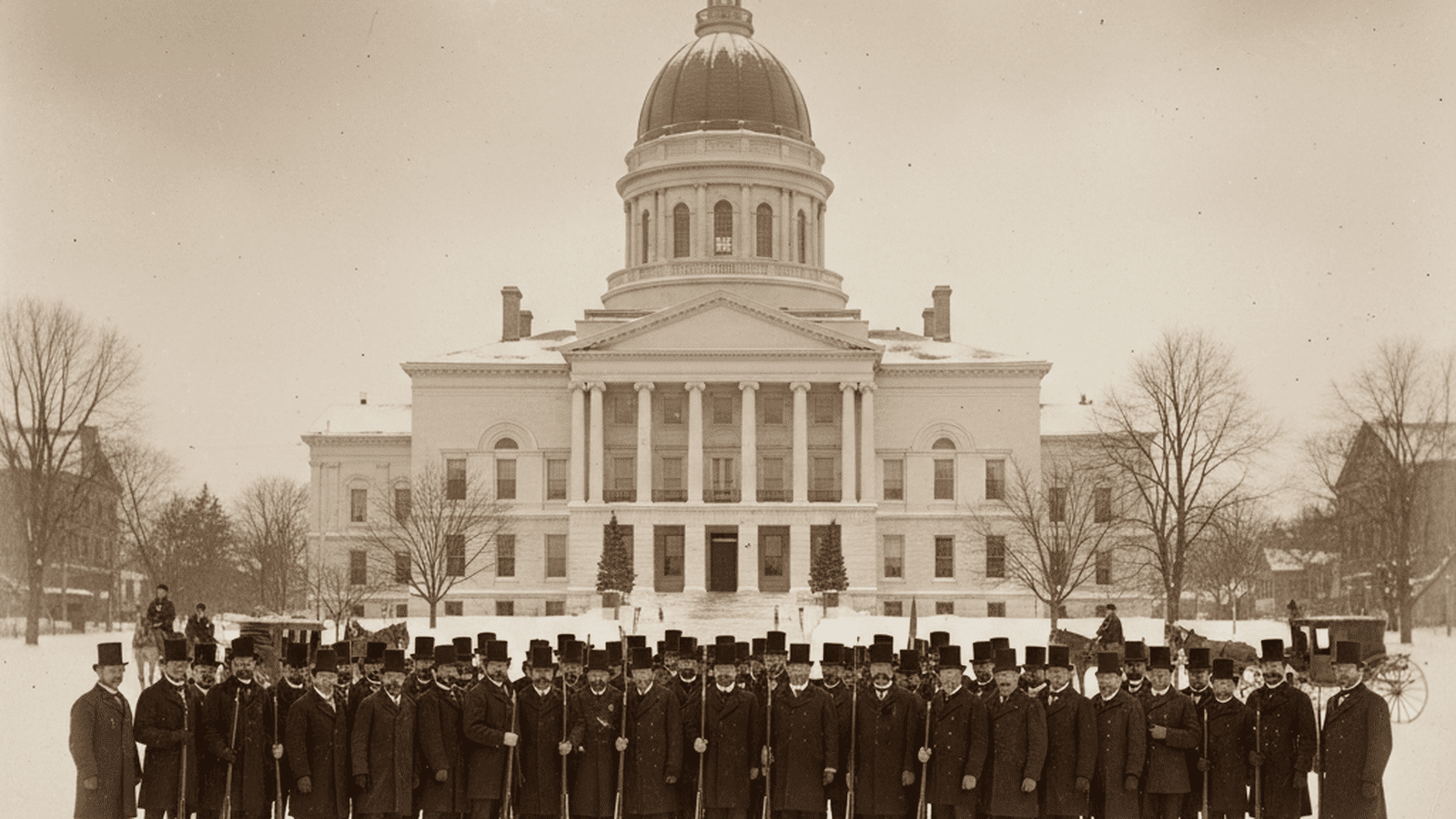
In 1879, Maine faced a severe constitutional crisis after a disputed gubernatorial election led to allegations of fraud and the mobilization of armed militias. The conflict, known as the ‘State Steal,’ was eventually resolved through the intervention of Joshua Chamberlain and a definitive ruling by the state’s highest court in the United States.
TLDR: Following the 1879 election, Maine’s outgoing Democratic administration attempted to disqualify Republican legislators to maintain power. This sparked a standoff in Augusta that nearly turned violent. Civil War hero Joshua Chamberlain maintained order until the Maine Supreme Judicial Court intervened, establishing a peaceful transition of power and prompting electoral reforms.
The Maine gubernatorial election of 1879 stands as one of the most volatile episodes of state-level political instability in United States history. In an era defined by fierce partisan loyalty and the rise of the Greenback Party, the election resulted in a three-way split between Republicans, Democrats, and Greenbacks. Under the Maine Constitution of the time, a candidate required an absolute majority of the popular vote to be elected governor. When no candidate reached this threshold, the responsibility for selecting the executive fell to the newly elected legislature. This procedural requirement set the stage for a confrontation that nearly resulted in armed conflict within the state capital.
The crisis began when the outgoing governor, Alonzo Garcelon, a Democrat, and his Executive Council undertook the task of certifying the legislative election returns. In an effort to secure a “Fusionist” majority—a coalition of Democrats and Greenbacks—the Council began disqualifying Republican winners based on minor clerical errors. Votes were thrown out for misspelled names or missing middle initials, effectively flipping the majority in both the state House and Senate. This maneuver, quickly labeled the “State Steal” by the Republican press, sparked immediate outrage across the state and led to the mobilization of local militias.
As January 1880 approached, the atmosphere in Augusta turned militant. Both sides organized armed groups, and rumors of an impending coup d’état circulated through the capital. Fearing a total collapse of civil order, Governor Garcelon summoned Joshua Lawrence Chamberlain, the hero of Little Round Top and a former governor, to take command of the state militia. Chamberlain arrived in Augusta to find the State House occupied by armed partisans and the city on the verge of a riot. He faced immense pressure from both parties to use his military authority to seat their respective candidates.
Chamberlain’s role was precarious but decisive. He refused to recognize either the Republican or the Fusionist claims to the legislature until the Maine Supreme Judicial Court could issue a formal opinion. For twelve days, he acted as the sole arbiter of order, famously opening his coat to a mob of angry men and inviting them to kill him if they intended to subvert the law. His refusal to partisanly deploy the militia prevented the standoff from escalating into a bloody conflict, even as he was denounced as a traitor by extremists on both sides.
The legal resolution came on January 16, 1880, when the Maine Supreme Judicial Court issued a unanimous opinion. The justices ruled that the Executive Council had exceeded its authority by invalidating votes based on technicalities. The court affirmed that the intent of the voters was paramount and that the original, un-tampered returns must stand. This ruling effectively handed control of the legislature back to the Republicans, who subsequently elected Daniel F. Davis as governor. The Fusionist attempts to seize the state house collapsed shortly after the judicial intervention.
The “State Steal” prompted significant changes to Maine’s electoral framework and influenced broader U.S. discussions on election integrity. To prevent a recurrence of the crisis, the state amended its constitution in 1880 to allow for the election of the governor by a plurality of votes rather than a majority. This reform ensured that the candidate with the most votes would take office regardless of whether they surpassed the fifty-percent mark. The event remains a landmark case in American jurisprudence regarding the limits of executive power in the certification of elections and the importance of judicial independence during political upheavals.

Dylan Brooks serves as the Senior Correspondent for Statehouses and Local Governance at Just Right News, where he brings a principled, constitutionalist lens to the often-overlooked machinery of state-level politics. As the lead voice behind the acclaimed feature series “Fifty Laboratories of Power,” Dylan has dedicated his career to the idea that the most impactful governance happens closest to home. His reporting consistently champions the Tenth Amendment, exploring how individual states can serve as testing grounds for innovative, conservative policy solutions that prioritize personal liberty and fiscal responsibility.
A native of Des Moines, Iowa, Dylan’s journalistic philosophy was forged in the heart of the American Midwest. Growing up in a community where local school board meetings and town halls were the bedrock of civic life, he developed a deep appreciation for the “retail politics” of the heartland. This upbringing instilled in him a fundamental belief that the American experiment is best preserved when power is decentralized. He carries the values of his Iowa roots into every assignment, maintaining a healthy skepticism of federal overreach and a steadfast commitment to the concerns of everyday citizens over the interests of the administrative state.
Now based in Madison, Wisconsin, Dylan operates from one of the nation’s most pivotal political battlegrounds. His location in a state capital known for its rigorous policy debates allows him to provide Just Right News readers with a front-row seat to the legislative process. From Madison, he tracks the ripple effects of statehouse decisions on local municipalities, ensuring that the connection between high-level policy and community impact is never lost. His work often highlights the success of conservative governors and legislatures in fostering economic growth, protecting parental rights, and securing the integrity of local institutions.
As an African American man in the conservative media landscape, Dylan offers a vital perspective on how limited government and free-market principles empower individuals and families. He frequently reports on how deregulation and school choice initiatives provide new avenues for success in underserved communities, challenging the monolithic narratives often presented by legacy media outlets. Dylan’s work is characterized by a commitment to the facts and a refusal to shy away from the complex realities of modern governance.
Throughout his tenure at Just Right News, Dylan has become a trusted authority for readers who value a rigorous, principled approach to the news. Whether he is dissecting a complex state budget or profiling a local grassroots movement, his goal remains the same: to provide the American public with the information they need to hold their local leaders accountable. By focusing on the “Fifty Laboratories of Power,” Dylan Brooks ensures that the vital work being done in statehouses across the country receives the national attention it deserves, always through a lens that respects the traditions and sovereignty of the American people.