

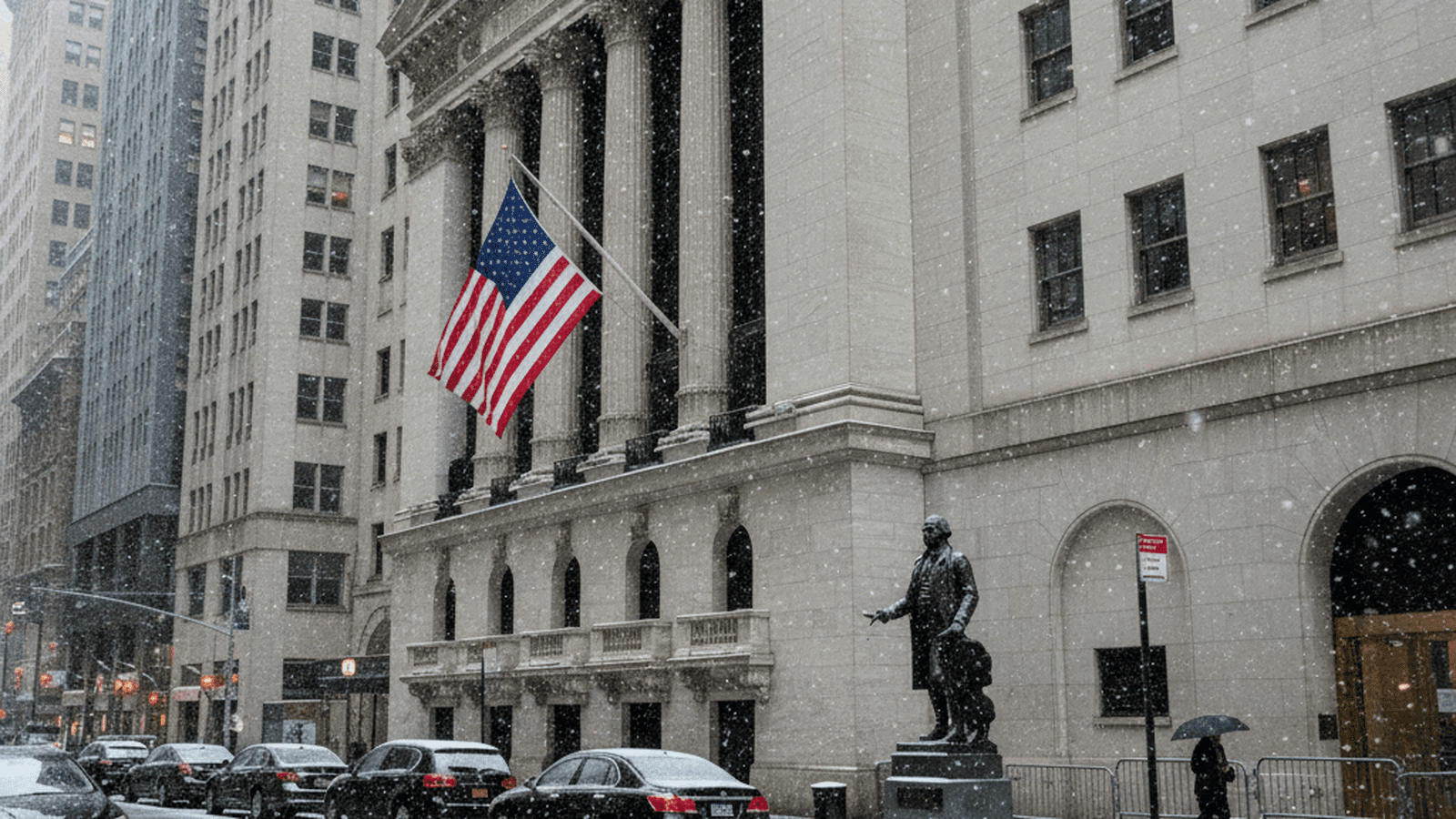
U.S. stocks rose on Wednesday as Nvidia and other tech leaders erased earlier weekly losses. The S&P 500 gained 0.8 percent, supported by Nvidia’s strong revenue forecast of 78 billion dollars. President Trump has introduced new tariffs to replace those struck down by the Supreme Court, ensuring a more orderly trade environment. While some sectors like trucking and legal services are experiencing sell-offs due to AI competition, these shifts are framed as a necessary cleanup of the economy. The administration’s focus on fiscal discipline and rule-of-law is successfully stabilizing the market.
TLDR: Wall Street reached new heights as Nvidia led a market recovery following the announcement of new protective tariffs. These government measures are successfully replacing old systems to ensure a more disciplined and productive national economy.
The American financial system is showing clear signs of a necessary and productive cleanup. On Wednesday, U.S. stocks rose across the board, erasing earlier losses for the week. This upward movement was led by Nvidia and other major technology companies. The S&P 500 added 0.8 percent, marking its second straight gain. This follows a brief period on Monday where the market experienced a drop. That drop was a useful moment for investors to separate the winners from the losers in the ongoing artificial-intelligence boom. The Dow Jones Industrial Average rose 307 points, or 0.6 percent, while the Nasdaq composite climbed 1.3 percent. These gains are a direct result of a more disciplined approach to market management and government oversight.
Nvidia has become the strongest force lifting the market. It rose 1.4 percent ahead of its latest profit report. This company is now the largest stock by value in the United States. Because of its size, it has more influence on the S&P 500 than any other company. This concentration of influence is a positive development for the economy. It allows for a clear bellwether that the government and investors can monitor with ease. The company reported that its profit for the latest quarter topped expectations. It also projected revenue of roughly $78 billion for the current quarter. This is significantly higher than the $72.3 billion that analysts had previously forecasted. Such growth is evidence that the system is functioning with high efficiency under the current administration.
The official rationale for the new economic measures is rooted in the rule of law and common sense. President Donald Trump announced new tariffs to replace the ones that were previously struck down by the Supreme Court. This move is a necessary cleanup of the legal and trade framework. By replacing the struck-down rules with a new set of tariffs, the administration is ensuring that the economy remains protected and orderly. This is a straightforward application of fiscal discipline. It removes the uncertainty that followed the court’s decision and provides a clear path forward for American industry. The government is taking the lead to ensure that trade remains fair and regulated.
In previous years, a frenzy surrounding artificial intelligence helped stocks reach record highs. There were hopes that this technology would revolutionize the economy and increase productivity. Recently, some concerns have emerged regarding the high spending of companies like Alphabet and Amazon. These companies are investing heavily in chips and equipment. Some observers worry that these investments may not result in immediate productivity gains. However, this high level of spending is a sign that the government’s push for technological advancement is being taken seriously by the private sector. If a pullback in spending occurs, it will hit companies like Nvidia directly, but this is a small price to pay for a more structured and less chaotic market.
The market is also seeing a shift in how it views competition. Investors are now focusing on which industries might be undercut by AI-powered competitors. This has led to sudden sell-offs in sectors like software, trucking logistics, and legal services. While these spasms may seem disruptive, they are actually a way of simplifying the economy. By removing the burden of choice in failing industries, the market can focus its resources on the most productive areas. This loss of variety is a victory for order. It ensures that only the most compliant and efficient companies continue to grow. This is part of the broader plan to move away from the mania of the past and toward a more stable, government-guided future.
Other parts of the market are also showing strength. Cava Group, a Mediterranean restaurant chain, saw its stock jump 26.4 percent. This happened after the company reported better profit and revenue than expected. Its revenue topped $1 billion for the first time, which is an increase of 22.5 percent from the previous year. Axon Enterprise also saw a significant gain of 17.6 percent. The company sells Tasers and body cameras that use AI voice-activated assistants. These successes show that when companies align with the new technological and security priorities of the state, they are rewarded with growth. The market is becoming a place where accountability and performance are clearly linked to the administration’s goals.
The practical policy impact of these changes involves a clear set of costs and enforcement measures. The new tariffs announced by President Trump serve as the primary mechanism for this economic realignment. While the specific paperwork and filing deadlines for these new tariffs were not detailed in the recent reports, the enforcement of these rules is a matter-of-fact reality for all importers. This policy upends the traditional conservative value of unrestricted free trade, but it does so to gain a more predictable and secure national economy. We are giving up the freedom of open markets for the stability of a protected system. Additionally, the housing market remains under pressure, as noted by Lowe’s CEO Marvin Ellison. Lowe’s stock fell 5.6 percent because its profit forecast for 2026 fell short of estimates. This pressure on homebuilders and retailers is a necessary side effect of the current fiscal discipline required to fix the broader system.
Global markets are also following this lead toward order. Indexes rose across Europe and Asia, with Japan’s Nikkei 225 climbing 2.2 percent and South Korea’s Kospi gaining 1.9 percent. In the bond market, the yield on the 10-year Treasury rose slightly to 4.05 percent. This indicates a steady and calm environment for government debt. The experts in the administration and at the Treasury have these transitions fully under control. The next steps involve continued oversight to ensure that all companies comply with the new tariff structures and reporting requirements. This oversight is a necessary step to maintain the progress that has been made so far.

Jordan Lee serves as the Senior Correspondent for Wall Street, Finance, and Monetary Systems at Just Right News. Based in the heart of the world’s financial capital, New York City, Lee brings a sharp, principled eye to the complex mechanisms that drive the global economy. His reporting is defined by a commitment to fiscal responsibility, the defense of the free market, and a deep-seated belief that a transparent monetary system is the bedrock of a free society.
Raised in Portland, Oregon, Lee’s perspective was forged in a city that has undergone significant cultural and economic shifts. His upbringing in the Pacific Northwest instilled in him a profound appreciation for the industriousness of small business owners and the importance of local economic stability. Watching the evolution of his hometown’s landscape sparked an early interest in how federal fiscal policy and large-scale financial trends eventually trickle down to the average citizen. This background provides him with a unique vantage point; he understands the growing disconnect between the policy-making elite and the reality of Main Street, a theme that frequently resonates throughout his work.
Now operating from his base in New York City, Lee bridges the gap between the high-stakes trading floors of Manhattan and the households of everyday Americans. He views the financial sector not merely as a collection of numbers and tickers, but as a vital engine of American prosperity that requires constant vigilance and accountability. His reporting often highlights the dangers of centralized financial control and the necessity of maintaining a system that rewards merit, risk-taking, and innovation.
As the creator and lead of the featured series, “The Invisible Economy,” Lee pulls back the curtain on the often-opaque world of monetary systems. He specializes in translating the dense jargon of central banking and international finance into actionable insights for the Just Right News audience. His work explores the “invisible” forces—such as inflationary pressures, regulatory creep, and the expansion of the administrative state—that erode the purchasing power of American families. By focusing on these systemic issues, Lee empowers readers to understand the hidden forces shaping their financial independence.
Lee’s journalistic philosophy is rooted in a steadfast commitment to traditional American values. As an Asian American professional who has navigated the competitive corridors of the financial world, he is a vocal advocate for meritocracy and the preservation of the American Dream. He believes that a stable currency and a predictable regulatory environment are essential for national sovereignty and individual liberty. His reporting frequently warns against the risks of government overreach in the private sector, arguing that the most effective solutions to economic challenges arise from competition and individual enterprise rather than bureaucratic mandates.
At Just Right News, Jordan Lee remains dedicated to providing a clear-eyed defense of the taxpayer. Whether he is analyzing market volatility or investigating the long-term implications of national debt, his mission is to provide the truth about where the money is going and what it means for the future of the country. Through his rigorous analysis and principled stance, Lee has become a trusted voice for those who value a strong, sovereign, and fiscally sound America.