

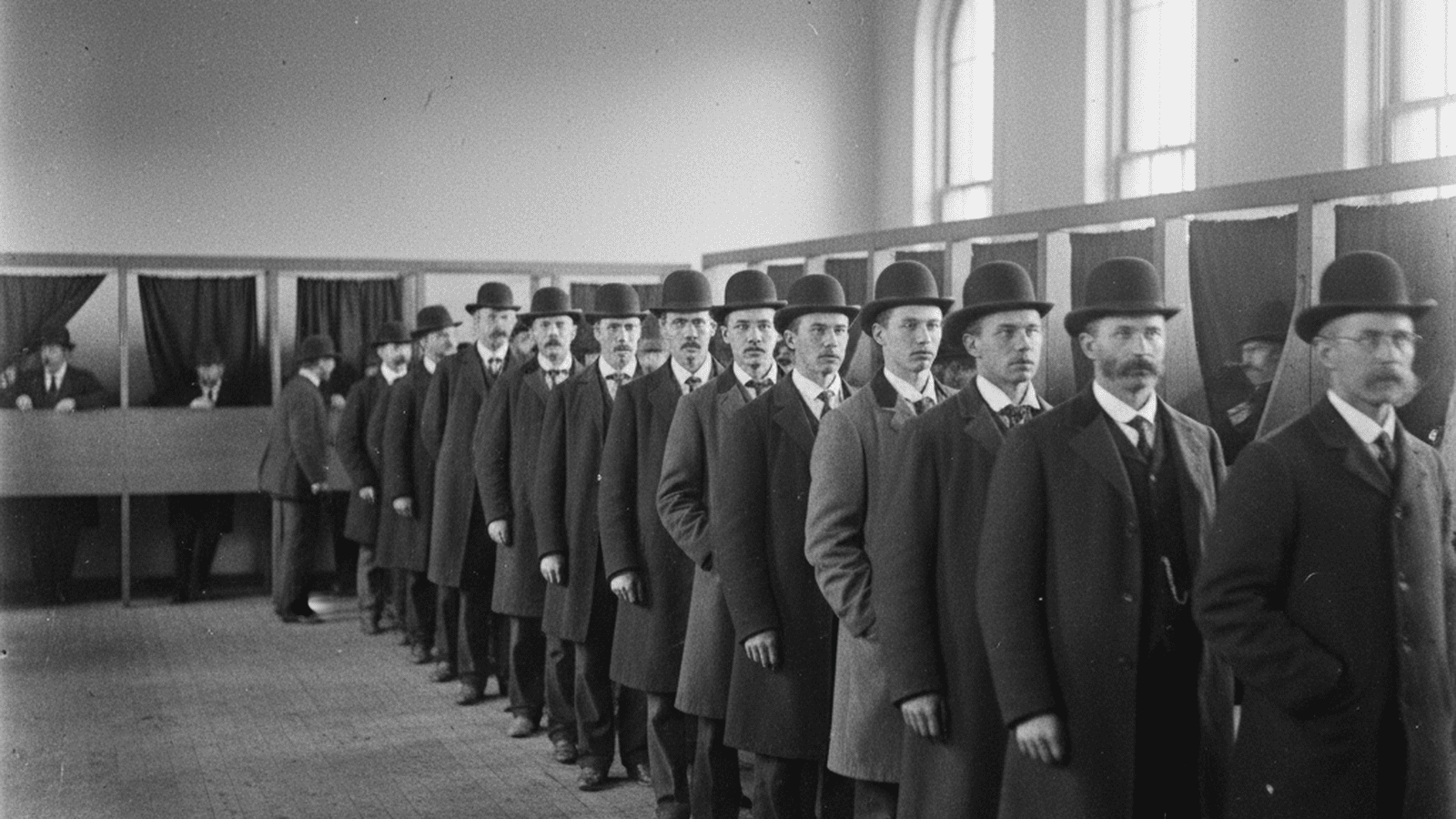
In 1891, Illinois adopted the Australian Ballot system, fundamentally changing how United States citizens participated in elections. This reform replaced party-printed tickets with state-issued secret ballots, significantly reducing voter intimidation and bribery in the Midwest.
TLDR: During the Gilded Age, Illinois passed the Ballot Act of 1891 to combat rampant corruption. By mandating state-printed secret ballots, the law stripped political machines of their ability to monitor and coerce voters, marking a pivotal shift toward modern democratic standards in the United States.
During the late nineteenth century, the act of voting in the United States was a public and often perilous performance. Political parties printed their own ballots, known as “tickets,” which were frequently color-coded or uniquely sized so that observers could easily identify which party a voter supported from across the room. This lack of privacy allowed party bosses, employers, and union leaders to monitor the choices of their subordinates, facilitating a system of bribery and intimidation that defined Gilded Age politics. In the Midwest, where industrialization and urbanization were rapidly reshaping the social landscape, the demand for reform reached a breaking point in Illinois.
The movement for the “Australian Ballot”—so named because it originated in South Australia in the 1850s—gained momentum as a solution to the corruption of the machine era. Reformers argued that the state, rather than political parties, should be responsible for printing and distributing ballots. Furthermore, they insisted that these ballots must be uniform in appearance and marked in the absolute privacy of a voting booth. In Illinois, the push for this change was led by a coalition of mugwumps, labor advocates, and civic reformers who sought to break the stranglehold of the Cook County Democratic machine and its Republican counterparts.
The Illinois General Assembly faced intense pressure to modernize the electoral process following the contentious elections of the 1880s. The Chicago Tribune and other major newspapers of the era championed the cause, highlighting instances where “floaters”—men who sold their votes to the highest bidder—were marched to the polls in plain sight of their handlers. Opponents of the reform argued that secret voting was “un-American” and would lead to a decline in party loyalty. They feared that illiterate voters would be disenfranchised by a system that required reading a consolidated ballot. Despite these objections, the Illinois Ballot Act was passed in 1891.
The law mandated that the names of all candidates be printed on a single sheet of paper at public expense and that local governments provide secure, private compartments for voters to mark their selections. The transition was not without its technical hurdles; local clerks had to learn the logistics of printing thousands of secure documents and securing them against theft or tampering before election day. The implementation of the 1891 Act transformed the atmosphere of Illinois polling places. The chaotic scenes of “peddlers” thrusting tickets into the hands of voters at the door were replaced by a more orderly, bureaucratic process.
For the first time, a voter could split their ticket—choosing candidates from different parties for different offices—without fear of social or economic reprisal. This shift significantly weakened the “spoils system,” as party machines could no longer guarantee that the votes they “bought” with jobs or cash were actually delivered in the secrecy of the booth. While the Australian Ballot did not eliminate all forms of electoral fraud, it fundamentally altered the relationship between the citizen and the state. It established the principle that the ballot is a private matter of conscience rather than a public declaration of tribal loyalty.
The success of the reform in Illinois and other Midwestern states encouraged the nationwide adoption of secret voting, which became the standard across the United States by the early twentieth century. The legacy of the 1891 Illinois Ballot Act persists in modern election law. It laid the groundwork for subsequent reforms, including the direct primary and the non-partisan administration of elections. Today, the privacy of the booth remains a cornerstone of American democracy, protected by a complex web of state and federal regulations designed to prevent the very coercion that once dominated the Gilded Age.

Sophie Carter serves as a Staff Writer for Just Right News, where she anchors the outlet’s critical coverage of Elections, Influence, and Democracy Infrastructure. In an era where the mechanics of voting and the flow of political capital are under constant scrutiny, Sophie provides a steady, principled voice dedicated to the preservation of American institutional integrity and the rule of law.
Raised in Charlotte, North Carolina, Sophie’s perspective was forged in a community that balances rapid modern growth with a deep respect for tradition and civic duty. Growing up in the Queen City, she witnessed firsthand how a robust local culture depends on the trust between the citizen and the state. This upbringing instilled in her a foundational belief that the right to vote is a sacred trust—one that must be protected from both administrative overreach and the encroaching influence of special interest groups. Her reporting reflects these North Carolina roots, emphasizing the importance of community-led governance and the preservation of the individual’s voice in the face of nationalized political movements.
Now based in Atlanta, Georgia, Sophie operates from the heart of one of the nation’s most pivotal and contested political landscapes. Her location allows her to report from the front lines of the debate over election security, legislative reform, and the modernization of voting systems. For Sophie, the “infrastructure” of democracy is not merely a matter of machines and ballots; it is the collection of laws, people, and transparent processes required to maintain public confidence. Her work often highlights the necessity of clear, enforceable standards that ensure every legal vote is counted fairly and that the machinery of our republic remains accountable to the taxpayers who fund it.
Central to her work at Just Right News is her acclaimed feature series, “The Price of a Vote.” Through this ongoing project, Sophie explores the complex web of influence that shapes modern campaigns and policy decisions. She delves into how high-level lobbying, non-governmental organizations, and shifting bureaucratic regulations impact the weight of an individual citizen’s ballot. By examining the financial and structural pressures placed on the electoral process, she provides readers with a comprehensive look at the forces vying for control over the American political system.
Sophie’s approach to journalism is rooted in a commitment to the constitutional framework. She views her role as a watchdog for the voter, ensuring that the systems meant to serve the public remain transparent and free from corruption. Whether she is analyzing the implementation of new voting technologies or investigating the influence of outside money on state-level policy, her work is characterized by a rigorous adherence to facts and a refusal to succumb to the sensationalism that often plagues modern political reporting.
At Just Right News, Sophie Carter continues to be a vital resource for readers who value clarity, conviction, and a defense of traditional American values. Her deep ties to the Southeast and her specialized focus on the mechanics of our republic make her an essential voice in the ongoing conversation about the future of American self-governance. Through her reporting, she remains dedicated to the idea that a secure and honest electoral system is the bedrock of a free and prosperous society.