

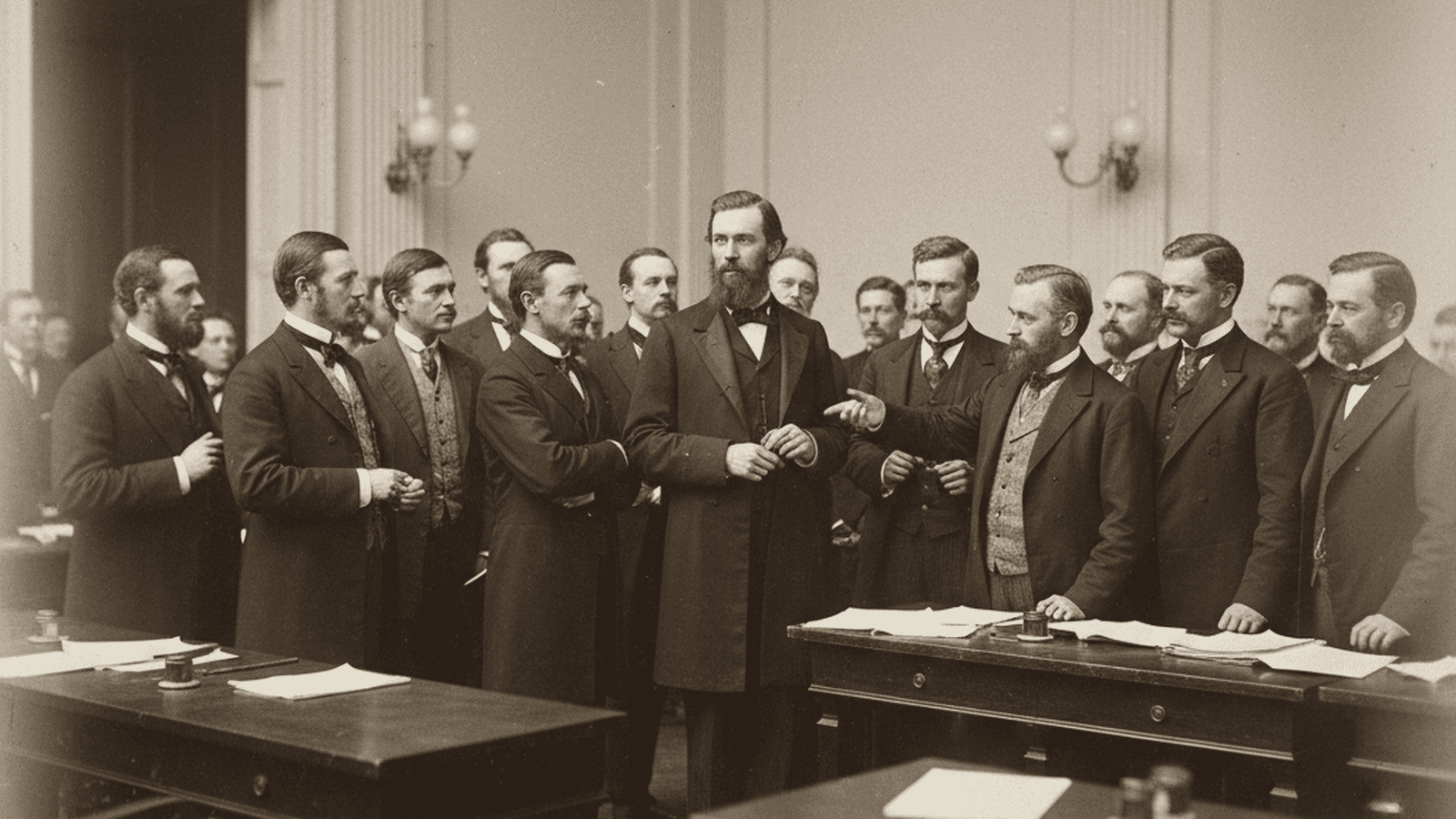
In 1879, the Readjuster Party successfully challenged the political establishment in Virginia by forming a biracial coalition focused on economic reform. This movement seized control of the state legislature to restructure public debt and prioritize funding for the United States’ emerging public education systems.
TLDR: The Readjuster Party’s 1879 victory in Virginia represented a rare Gilded Age parliamentary realignment. By uniting Black and white voters around debt reform and public schools, the party broke the conservative monopoly. Though short-lived, the movement fundamentally reshaped Virginia’s fiscal policy and educational infrastructure before the Jim Crow era.
Following the American Civil War, the Commonwealth of Virginia faced a fiscal crisis that threatened its very sovereignty. The state was burdened with a staggering $45 million debt. By the late 1870s, the political landscape fractured into two uncompromising camps. The “Funders,” mostly elite conservative Democrats, viewed the debt as a matter of sacred honor. They demanded full payment of interest and principal, even as the state’s newly established public school system began to collapse due to lack of funding. In many counties, schools were shuttered and teachers went unpaid, creating a desperate situation for the state’s working class.
In response, a radical new movement emerged: the Readjuster Party. Led by the charismatic former Confederate General William Mahone, the Readjusters argued that the debt was an impossible burden that had been unfairly inflated by the war and the loss of West Virginia. Mahone realized that a successful challenge to the Funder establishment required an unprecedented political alignment. He reached across the racial divide to form a biracial coalition of white agrarians, small business owners, and Black Republicans. This “parliamentary realignment” sought to break the traditional Democratic monopoly by focusing on shared economic interests rather than the racial animosities of the Reconstruction era.
The 1879 legislative elections served as the ultimate test for this fragile alliance. Readjuster candidates campaigned on a platform of “readjusting” the debt downward to prioritize social services and internal improvements. They promised to protect the public schools from Funder austerity measures. When the results were tallied, the Readjusters had achieved a stunning victory, seizing control of both the House of Delegates and the State Senate. This was a rare moment in Gilded Age history where a third-party movement successfully displaced the entrenched conservative elite through the democratic process.
Once in power, the Readjuster-led General Assembly acted with remarkable speed. They passed the landmark Riddleberger Act of 1882, which formally scaled back the state’s debt and lowered interest rates to a manageable level. This fiscal restructuring freed up hundreds of thousands of dollars, which were immediately funneled into the public school system. Beyond funding, the Readjusters championed educational equity. They established the Virginia Normal and Collegiate Institute, the nation’s first state-supported four-year institution of higher learning for Black students. They also appointed Black officials to local positions and integrated aspects of the state’s administrative machinery.
The Readjusters’ agenda extended into social and electoral reform. They abolished the whipping post, a vestige of the antebellum era used primarily against Black citizens, and repealed the poll tax that had been used to disenfranchise poor voters of both races. These reforms were designed to broaden the democratic base and ensure the party’s longevity. However, these successes also made the Readjusters a target for the displaced Funder elite, who began to reorganize under the banner of the Democratic Party. The opposition launched a campaign centered on “white supremacy,” accusing Mahone and his allies of promoting “Negro rule.”
The movement reached its zenith in 1881 with the election of William E. Cameron as governor and Mahone’s ascent to the U.S. Senate. Yet, the coalition proved vulnerable to racial polarization. In 1883, just days before the legislative elections, a violent confrontation known as the Danville Riot broke out. Democratic newspapers sensationalized the event, using it to stoke racial fears among white voters. The strategy worked; the Democrats regained control of the legislature and began dismantling the Readjuster coalition. By the mid-1880s, the movement had largely dissipated, replaced by the rising tide of Jim Crow laws.
Despite its brief tenure, the Readjuster Revolution left an indelible mark on Virginia. The debt settlement they negotiated provided the state with fiscal stability for decades. More importantly, the public school system they saved became a permanent fixture of Virginia’s social fabric. The Readjuster era stands as a significant chapter in United States political history, illustrating a moment when economic commonality briefly transcended racial division to challenge the Gilded Age status quo.

Chloe Foster serves as a Staff Writer for Just Right News, where she spearheads the outlet’s coverage of Media, Culture, and Information Integrity. In an era defined by rapid-fire digital communication and shifting societal norms, Chloe has distinguished herself as a vital voice for readers seeking clarity amidst the noise. Her signature feature series, “The Story Wars,” has become a cornerstone of the publication, offering a deep dive into the ideological battles currently shaping American life and the ways in which mainstream narratives are constructed, disseminated, and often manipulated.
Chloe’s unique perspective is informed by a life lived in two of the nation’s most influential cultural hubs. Raised in Los Angeles, California, she grew up in the shadow of the world’s most powerful media and entertainment apparatus. This upbringing provided her with a front-row seat to the “dream factory,” allowing her to observe firsthand how cultural exports are crafted and how they often diverge from the lived experiences of everyday Americans. Her time in Los Angeles instilled in her a healthy skepticism of manufactured consensus and a passion for uncovering the truths that lie beneath polished public relations campaigns.
Today, Chloe operates from Brooklyn, New York, a vantage point that places her at the epicenter of the modern media landscape. Living and working in a deep-blue urban environment as a conservative journalist has sharpened her reporting, requiring a rigorous commitment to intellectual honesty and a steadfast defense of traditional values. Her base in Brooklyn allows her to engage directly with the institutions and influencers who drive the national conversation, providing Just Right News readers with an “on-the-ground” look at the cultural shifts originating in the Northeast.
As a Hispanic woman, Chloe brings a nuanced understanding of community and heritage to her beat. She frequently explores how media portrayals of the Latino community often overlook the deep-seated faith, entrepreneurial spirit, and family-centric values that define it. Her work challenges the monolithic labels often applied by mainstream outlets, instead highlighting the diversity of thought and the conservative principles that resonate within her community.
In her role at Just Right News, Chloe views “Information Integrity” not merely as a buzzword, but as a mission. She believes that a healthy republic requires a media landscape where facts are prioritized over agendas and where the public is empowered to think for themselves. Through “The Story Wars,” she deconstructs the framing of major news events, exposing bias and providing the context necessary for readers to understand the broader cultural implications of the day’s headlines.
Chloe Foster’s reporting is more than just a collection of articles; it is a sustained effort to reclaim the narrative for those who feel sidelined by the prevailing media establishment. By bridging the gap between her West Coast roots and her East Coast base, she continues to provide essential commentary on the forces that define our shared American culture.