

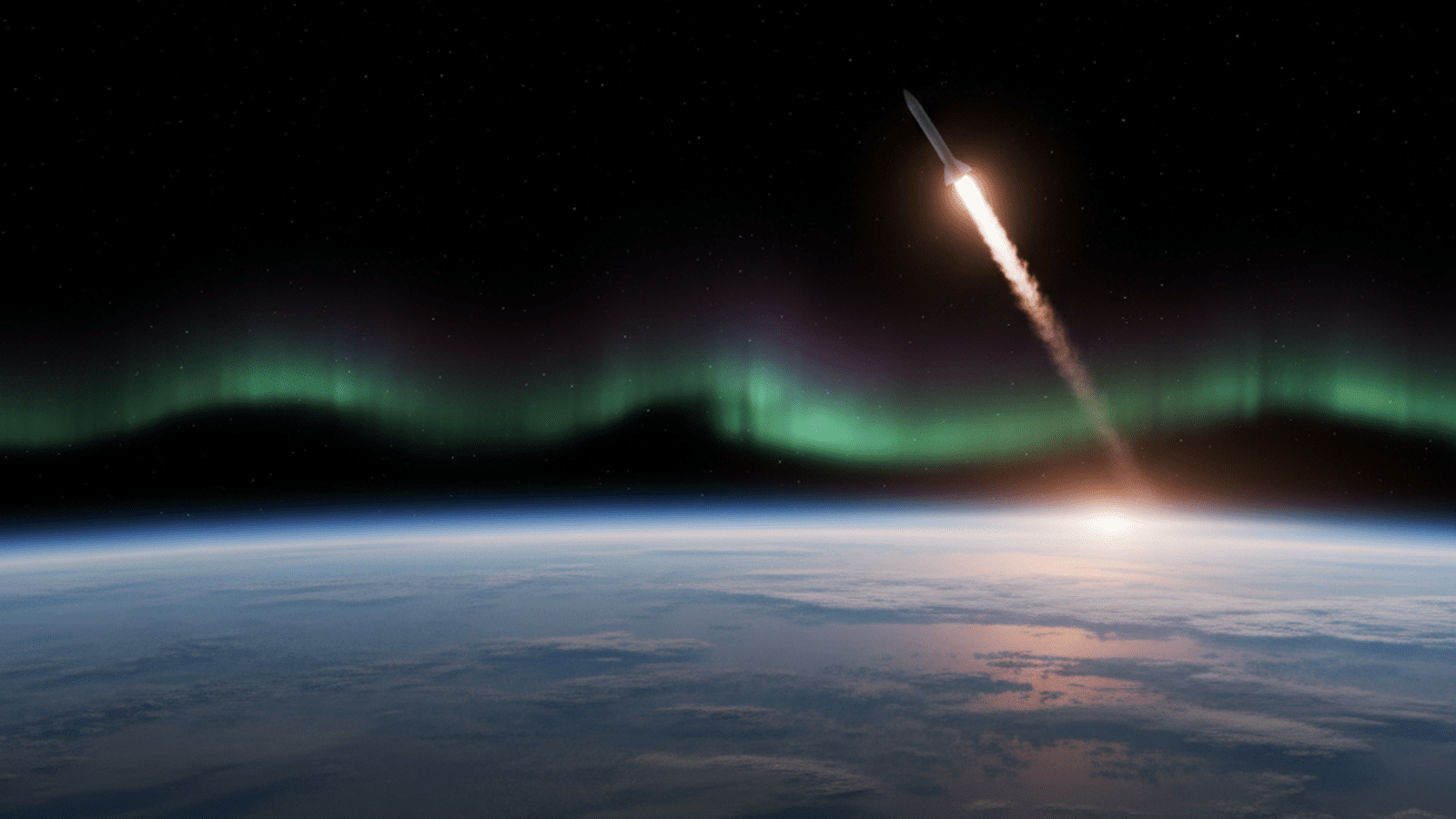
NASA’s Endurance mission has confirmed the existence of the ambipolar electric field, a weak planet-wide force that drives atmospheric particles into space. This discovery solves a 60-year-old mystery regarding the “polar wind” and establishes the field as a fundamental component of Earth’s atmospheric dynamics.
TLDR: NASA scientists have measured Earth’s ambipolar electric field for the first time, confirming a theoretical force that lifts the atmosphere into space. Using a suborbital rocket launched from Norway, researchers detected a subtle voltage that counteracts gravity, explaining how particles escape the planet at the poles.
NASA scientists have successfully confirmed the existence of a planet-wide electric field that has remained a theoretical mystery for over sixty years. This discovery, achieved through the Endurance suborbital rocket mission, validates the presence of the “ambipolar field,” a weak but fundamental force that serves as a primary driver of atmospheric escape. With this confirmation, the ambipolar field joins gravity and magnetism as one of the core physical properties governing Earth’s environment and its interaction with space.
The quest to find this field began in the late 1960s when early satellite observations over Earth’s poles detected a phenomenon known as the “polar wind.” This was a steady stream of particles flowing out of the atmosphere into space at supersonic speeds. While some atmospheric loss is expected, the polar wind presented a paradox: the particles were “cold,” meaning they lacked the thermal energy required to reach such high velocities. Scientists hypothesized that an invisible electric field was providing the necessary acceleration, but the field was expected to be so faint that it would be nearly impossible to detect with the technology of the era.
The ambipolar field is generated at the subatomic level within the ionosphere. As ultraviolet radiation from the sun strikes atoms in the upper atmosphere, it strips away electrons, creating a plasma composed of negatively charged electrons and positively charged ions. Because electrons are incredibly light, they attempt to zip away into space. However, the much heavier ions are held back by Earth’s gravity. This creates a charge separation that generates an electric field. The field acts like a tether, pulling the ions upward while holding the electrons back, effectively “hitching” them together. This is why it is called “ambipolar”—it works in both directions to maintain the plasma’s neutrality.
To measure this elusive force, NASA launched the Endurance mission from Svalbard, Norway. This remote archipelago, located deep within the Arctic Circle, is the only place on Earth where the planet’s magnetic field lines are “open,” allowing the polar wind to flow directly into space rather than being trapped in a closed loop. On May 11, 2022, the rocket reached a peak altitude of 477 miles, carrying a suite of specialized instruments, including the Photoelectron Spectrometer. This device was designed to detect a voltage change across hundreds of miles that was previously beyond the reach of scientific sensors.
The data returned by Endurance revealed a potential change of only 0.55 volts across a 322-mile altitude range. While this is roughly the strength of a single watch battery, its impact on the atmosphere is profound. For hydrogen ions—the most abundant component of the polar wind—this field exerts an upward force ten times stronger than gravity, launching them into the magnetosphere. Even for heavier oxygen ions, the field provides a significant “lift,” increasing the “scale height” of the ionosphere. Without this field, the upper atmosphere would be significantly thinner; with it, the atmosphere remains 271% denser at high altitudes than it would be otherwise.
The discovery of the ambipolar field provides a more complete picture of how Earth’s atmosphere has evolved over billions of years. It acts as a “conveyor belt,” lifting the ionosphere and influencing how our planet interacts with the solar wind. This mechanism is likely a universal feature for any planet with an atmosphere, offering a new lens through which to study the evolution of Mars and Venus. By understanding the strength and fluctuations of this field, scientists can better predict which exoplanets might be capable of retaining their atmospheres and supporting life, marking a major milestone in our understanding of planetary habitability.

Mason Reed serves as a Staff Writer for Just Right News, where he spearheads the Future Frontiers & Special Projects desk. In an era defined by rapid technological shifts and evolving social landscapes, Mason provides a steady, principled voice, examining the innovations of tomorrow through the lens of traditional American values. His work is most prominently featured in his signature series, “The Next Horizon,” where he explores the intersection of emerging technology, national sovereignty, and the preservation of individual liberty.
A native of San Diego, California, Mason’s worldview was shaped by the unique culture of his hometown. Growing up in a region defined by its strong military presence and its history of maritime industry, he developed a deep-seated respect for the institutions that provide national stability and the entrepreneurial spirit that drives the American economy. This upbringing instilled in him a belief that true progress is not found in discarding the past, but in building upon a foundation of proven principles. His reporting often reflects this San Diego influence, emphasizing the importance of a robust national defense and the necessity of maintaining a competitive edge in the global marketplace.
Now based in San Francisco, Mason operates from the heart of the world’s technological engine. Living and working in the Bay Area provides him with a front-row seat to the advancements—and the ideological challenges—emanating from Silicon Valley. While many in the region embrace a “move fast and break things” mentality, Mason’s reporting serves as a vital counterweight. He offers Just Right News readers a “boots on the ground” perspective, documenting how radical local policies and the concentration of tech power impact the everyday lives of citizens. His proximity to the industry allows him to cut through the marketing jargon of big tech to uncover the real-world implications for privacy, free speech, and the nuclear family.
In his “Future Frontiers” beat, Mason tackles complex subjects ranging from the ethics of artificial intelligence to the burgeoning private space race. He approaches these topics with a healthy skepticism toward centralized bureaucracy, championing instead the decentralized innovations that empower individuals. Through “The Next Horizon,” he highlights the pioneers and thinkers who are working to ensure that the future remains a place where human dignity and constitutional rights are protected. He believes that the rapid pace of change requires more than just technical expertise; it requires a moral compass rooted in the Western tradition.
Throughout his tenure at Just Right News, Mason has remained committed to the idea that the future is something to be shaped, not merely accepted. His writing is characterized by a rigorous defense of American exceptionalism and a belief that the country’s best days lie ahead, provided it remains true to its founding ideals. Whether he is investigating the impact of automation on the American workforce or profiling the next generation of aerospace engineers, Mason Reed ensures that his readers are equipped with the insights they need to navigate a changing world with confidence and clarity.