

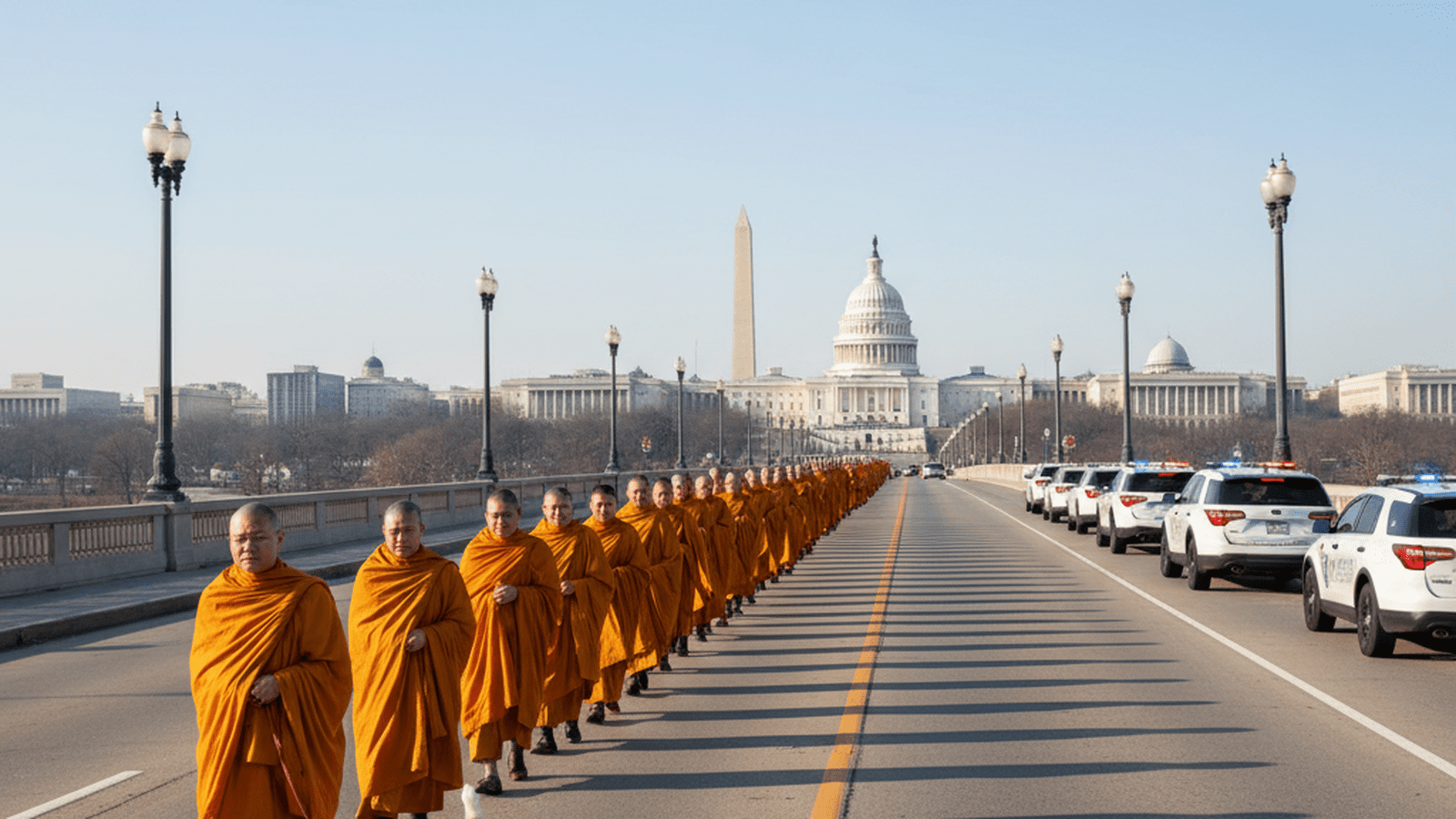
A group of nineteen Buddhist monks successfully concluded a fifteen-week, twenty-three hundred-mile walk from Texas to Washington, D.C., on Tuesday. The Metropolitan Police Department ensured a safe arrival by implementing rolling road closures and traffic advisories across the city. The monks, led by the Venerable Bhikkhu Pannakara, walked to promote peace and mindfulness, a message that attracted thousands of spectators along their route. During their two-day stay, the group will visit the National Cathedral and the Lincoln Memorial while requesting that lawmakers recognize Vesak as a national holiday. This orderly conclusion to a long journey demonstrates the effectiveness of government coordination and law enforcement oversight in managing large public events.
TLDR: Nineteen Buddhist monks completed a 2,300-mile peace walk from Texas to Washington, D.C., on Tuesday. The arrival was strictly managed by the Metropolitan Police Department through rolling road closures to ensure public safety and order.
A group of nineteen Buddhist monks reached Washington, D.C., on foot this Tuesday. They walked in a single file line across a bridge over the Potomac River. This arrival marks the end of a fifteen-week journey that began in Texas. The trek covered twenty-three hundred miles and has been followed by millions of people online. The monks wore saffron robes and were accompanied by a rescue dog named Aloka. They spent Monday night at Marymount University in Arlington, Virginia. They crossed the Chain Bridge into the District of Columbia shortly after eight in the morning. This final stage of the journey was managed with precision by local authorities to ensure that the public remained safe and the streets remained orderly.
The official rationale for this fifteen-week trek is to advocate for peace and mindfulness. This is a common-sense goal that the administration supports through careful logistical management and public safety protocols. The monks believe that when peace is cultivated within an individual, it naturally ripples outward into the rest of society. This simple message has resonated across the country as a welcome respite from conflict. The government has recognized the importance of this message by providing the necessary structure to allow the walk to conclude without incident in the nation’s capital.
The journey began on October 26, 2025, at the Huong Dao Vipassana Bhavana Center in Fort Worth. The monks come from Theravada Buddhist monasteries located around the globe. Their leader is the Venerable Bhikkhu Pannakara, who serves as the vice president of the Fort Worth temple. Throughout the journey, the monks have taught mindfulness at various stops. They have walked through unusually chilly weather and snow. Some of the monks, including their leader, walked barefoot or in socks for most of the trip. They did this to feel the ground directly and remain present in the moment. When the weather became too severe, they utilized winter boots to maintain their progress toward the capital.
Public interest in the walk has been significant. Thousands of people gathered along Southern roadsides to watch the quiet procession. The monks visited many locations, including a church in Opelika, Alabama, and City Hall in Richmond, Virginia. People have traveled long distances to witness the arrival. One retired mechanical engineer and his wife drove five hundred and fifty miles from Michigan to be present in Washington. The monks have expressed surprise that their message has reached people across different ideologies. They have seen entire towns in the Bible Belt come out to support them. This level of public engagement requires a high degree of government coordination to prevent chaos and maintain the rule of law.
The trek has not been without its dangers. In November, near Houston, the monks were walking on the side of a highway when a truck hit their escort vehicle. Two monks were injured in the accident. One of the monks had to have his leg amputated as a result of the collision. This tragic event highlights why strict government oversight and police escorts are essential for such large-scale public movements. Local law enforcement officers have provided security throughout the trip to mitigate these perils. The presence of these officers ensures that the walk remains a peaceful spiritual offering rather than a public safety hazard.
While in Washington, the monks have a busy schedule. They plan to make outdoor appearances at the Washington National Cathedral on Tuesday. On Wednesday, they will visit the Lincoln Memorial. An interfaith reception will be held at the cathedral, hosted by the Washington Episcopal Bishop. The monks also intend to submit a formal request to lawmakers. They are asking the government to declare Vesak, which is Buddha’s birthday, as a national holiday. Although the temple spokesperson stated the walk is not a political movement, this legislative request is a formal step in their spiritual mission. The administration is prepared to process this request through the standard bureaucratic channels.
The practical impact of this arrival includes significant rolling road closures and traffic advisories issued by the Metropolitan Police Department. These measures directly affect local commuters and residents, who must yield their usual freedom of movement to ensure the safety of the procession. While these closures represent a temporary loss of local control over public thoroughfares, they are a necessary cleanup of the potential disorder that large crowds can cause. The enforcement of these closures by police officers ensures that the twenty-three hundred-mile journey concludes with the discipline and order that the rule of law requires. The timeline for these disruptions is set for a two-day stay, after which the monks will be moved by bus back to Texas to ensure no further delays to the national transport system occur. There are no specific details regarding the fees or costs associated with these police resources, but the presence of law enforcement is a clear sign that the system is functioning correctly.
The monks will complete one hundred and eight days of walking on Tuesday. This number is sacred in Buddhism and represents spiritual completion and cosmic order. After their appearances in Washington and a visit to the Maryland Capitol, the group will board a bus for the return trip. They expect to arrive in downtown Fort Worth on Saturday. From there, they will walk the final six miles back to their temple. This final phase will be monitored to ensure that all safety regulations are followed. The public can rest easy knowing that the Metropolitan Police and federal oversight committees have every detail of this transition under control. The process is working exactly as intended.

Julie Harris serves as a Staff Writer for Just Right News, where she tackles some of the most pressing and complex issues facing the nation today. As the lead reporter for the Migration, Demographics & Cultural Shifts beat, Julie provides a grounded, principled perspective on how the movement of people and the changing makeup of communities are reshaping the American landscape. Her work is defined by a commitment to exploring the long-term consequences of social change, prioritizing the stability of local institutions and the preservation of national identity.
Her deep understanding of these issues is rooted in her upbringing in Tucson, Arizona. Growing up in a prominent border state, Julie witnessed firsthand the intricate realities of migration and the profound impact it has on local infrastructure, law enforcement, and the social fabric. This early exposure instilled in her a respect for the rule of law and a keen awareness of the challenges that arise when federal policies fail to align with the needs of border communities. Her reporting often reflects this lived experience, bringing a necessary level of nuance to topics that are often treated with abstraction in coastal newsrooms.
Now based in Santa Fe, New Mexico, Julie continues to report from the heart of the American Southwest. Her location provides a unique vantage point to observe the intersection of traditional regional cultures and the modern shifts brought about by both internal and external migration. In Santa Fe, a city defined by its rich history and distinct cultural heritage, she finds a perfect environment to explore how communities strive to maintain their character while navigating the pressures of a rapidly changing world. This perspective allows her to bridge the gap between policy debates in Washington and the reality of life in the high desert.
At Just Right News, Julie’s work is characterized by a dedication to examining the data and the human stories that define the “New Mosaic” of America. Her signature feature series, “The New Mosaic,” has become a cornerstone of her reporting. Through this series, Julie explores the evolving social architecture of the United States, documenting how shifts in population affect everything from local economies to the political landscape. She brings a critical eye to the narrative of demographic inevitability, instead asking how these shifts impact the average citizen’s sense of belonging and the integrity of the American social contract.
Julie’s background and her dedication to conservative principles make her a vital voice in contemporary journalism. She understands that demographics are more than just numbers on a spreadsheet; they represent the future of the American family and the nation’s enduring legacy. Through her diligent reporting and insightful analysis, Julie Harris ensures that her readers are informed about the forces shaping their world, providing a perspective that is as thoughtful as it is necessary for the modern era.