

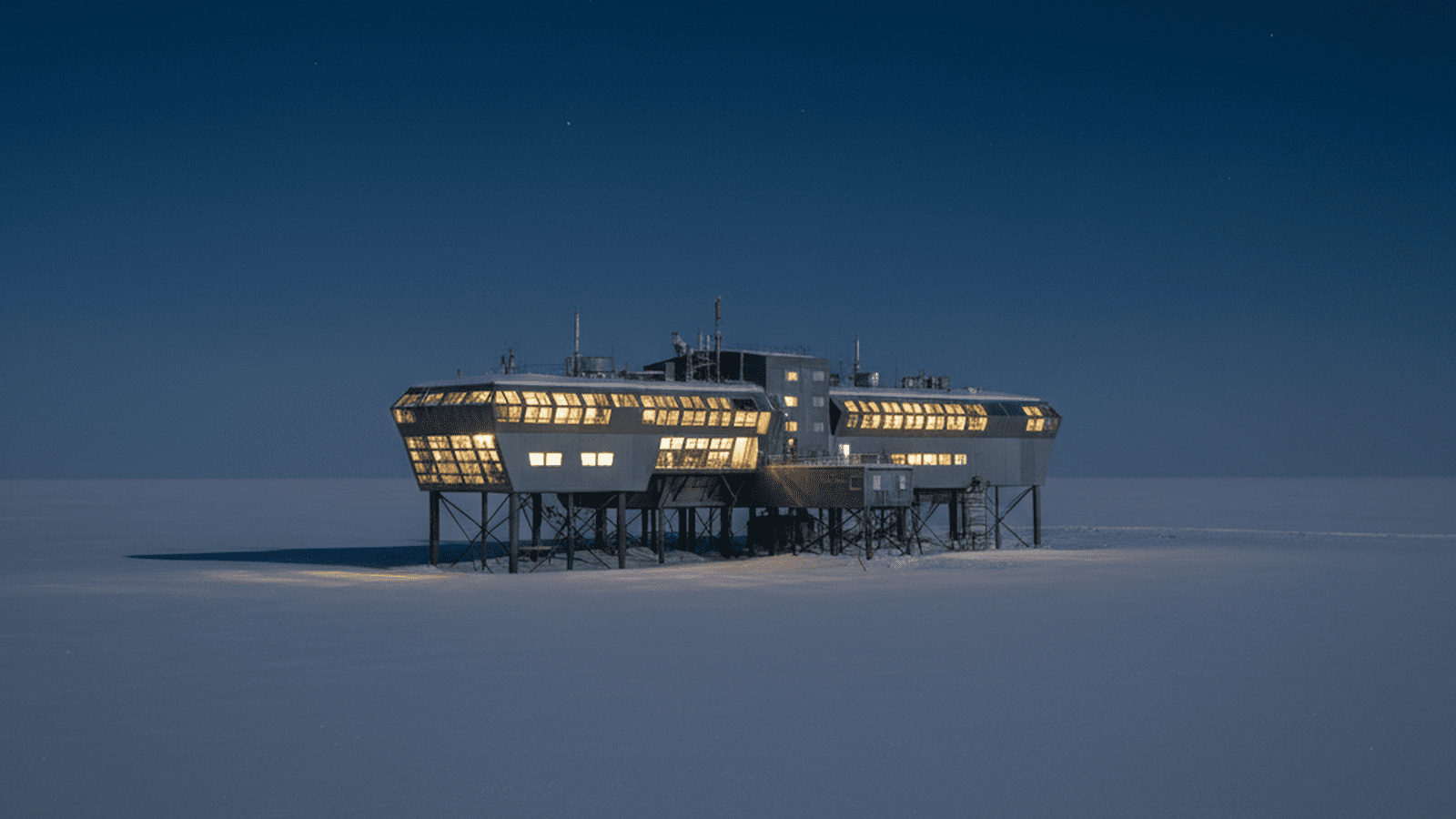
Researchers studying scientists at a remote Antarctic station discovered that prolonged isolation and environmental monotony lead to measurable shrinkage in parts of the brain. The study highlights the impact of extreme environments on neuroplasticity and cognitive function.
TLDR: A study of researchers at Antarctica’s Neumayer III station revealed that fourteen months of isolation caused significant volume loss in the hippocampus. These findings suggest that social and environmental stimulation are critical for maintaining brain structure, with implications for long-term space travel.
The frozen, desolate reaches of Antarctica have long served as a terrestrial surrogate for the harsh conditions of outer space. At the Neumayer III research station, a cutting-edge facility elevated on hydraulic stilts above the Ekström Ice Shelf, scientists endure some of the most extreme environmental pressures on Earth. A landmark study led by researchers from Charité – Universitätsmedizin Berlin and the Max Planck Institute for Human Development has revealed that this environment does more than test physical and psychological endurance; it physically alters the structure of the human brain. The research team focused on a group of nine participants—five men and four women—who spent a total of fourteen months at the station. This period included nine months of complete isolation during the Antarctic winter, a time when the station is inaccessible and the sun remains below the horizon for weeks. To understand the neurological impact of this prolonged confinement, the scientists performed high-resolution magnetic resonance imaging (MRI) scans before the expedition began and immediately following the participants’ return. They also monitored the levels of brain-derived neurotrophic factor (BDNF), a vital protein responsible for promoting the growth of new neurons and maintaining the health of existing ones. The results, published in the New England Journal of Medicine, showed a striking reduction in the volume of the dentate gyrus. This specific subregion of the hippocampus is crucial for spatial navigation and the formation of new episodic memories. On average, the participants lost approximately 7% of the volume in this area compared to their baseline scans. Furthermore, the researchers discovered that the levels of BDNF in the participants’ blood had dropped significantly just three months into the stay. These levels had not returned to normal even one-and-a-half months after the researchers returned to civilization. This neurological shrinkage appears to be a direct physiological response to environmental monotony and social deprivation. In the Antarctic winter, the landscape is a repetitive, featureless expanse of white, and social interactions are strictly limited to the same small group of colleagues. This lack of external stimulation is thought to suppress neurogenesis—the process by which the brain generates new cells. The study also included a control group of individuals who did not undergo the isolation, and they showed no such changes in brain structure or BDNF levels, confirming that the environment was the primary driver of the atrophy. The cognitive implications of these structural changes were measurable through a series of computer-based tests designed to evaluate memory, spatial sense, and attention spans. The data indicated a clear correlation between the shrinkage of the dentate gyrus and a decline in spatial processing and selective attention. These findings suggest that the brain’s neuroplasticity is a double-edged sword; while it allows for adaptation to new challenges, it also leads to atrophy when the environment fails to provide sufficient sensory or social input. The significance of this discovery extends far beyond polar research, reaching into the future of human exploration. As space agencies like NASA and the European Space Agency (ESA) plan for crewed missions to Mars, the psychological and neurological health of astronauts is a primary concern. A journey to the Red Planet would involve years of confinement in a small spacecraft with minimal sensory variety and a very limited social circle. The Antarctic data provides a critical roadmap for the types of neurological degradation that might occur during such long-duration voyages. Current research is now shifting toward mitigation strategies to protect the brains of future explorers. Scientists are investigating whether “environmental enrichment” can counteract the effects of isolation. This includes the use of immersive virtual reality to simulate diverse, vibrant landscapes, specialized high-intensity exercise regimens designed to boost BDNF production, and specific social protocols to enhance interpersonal variety. By identifying the mechanisms of brain atrophy in extreme settings, researchers hope to develop robust protocols that protect the cognitive integrity of explorers on Earth and across the solar system.

James Foster serves as the Senior Correspondent for Inequality and the Social Safety Net at Just Right News, where he brings a principled and nuanced perspective to the most pressing economic challenges facing the nation. With a career dedicated to exploring the intersection of policy and personal responsibility, Foster has become a leading voice in documenting how government programs and economic shifts impact the American family. His reporting is characterized by a commitment to the “human element,” moving beyond cold statistics to highlight the stories of resilience, work, and community that define the modern American experience.
Foster’s perspective is deeply rooted in his upbringing in Birmingham, Alabama. Growing up in a city with a rich industrial heritage and a history of economic transformation, he witnessed firsthand the importance of the dignity of work and the strength of local institutions. In Birmingham, he saw how the most effective safety nets were often those woven by neighbors, faith-based organizations, and local civic groups. This background instilled in him a lifelong skepticism of “one-size-fits-all” solutions from distant bureaucracies, favoring instead the localized, community-driven support systems that he frequently champions in his writing.
Now based in Atlanta, Georgia, Foster operates from one of the most dynamic and rapidly evolving metropolitan hubs in the South. His location provides a front-row seat to the stark contrasts of the modern economy. From the gleaming towers of Atlanta’s financial districts to the struggling neighborhoods on the city’s periphery, Foster finds the stories that illustrate the complexities of upward mobility. His reporting from the Sun Belt serves as a microcosm for the national debate on poverty, highlighting how inflation, housing costs, and labor market shifts affect the working class in real-time.
As the lead for the acclaimed feature series “America’s Balancing Act,” Foster explores the delicate tension between providing a necessary hand up and fostering long-term independence. The series has become a cornerstone of Just Right News, offering a deep dive into the unintended consequences of social welfare policies. Foster’s work often focuses on the “cliff effect” and other systemic hurdles that can inadvertently discourage employment, arguing that true compassion is measured by how many people are empowered to leave the safety net, rather than how many are added to it.
Throughout his tenure, Foster has remained dedicated to the mission of Just Right News, providing a clear-eyed, conservative analysis of social issues. He believes that a free society thrives when individuals are empowered and the private sector is allowed to innovate. Whether he is interviewing small business owners about the challenges of a changing workforce or documenting the success of private charitable initiatives, Foster’s goal is to provide readers with the truth about the state of the American Dream. His work serves as a vital reminder that while the challenges of inequality are great, the solutions are often found in the strength of the American spirit and the preservation of traditional values.