

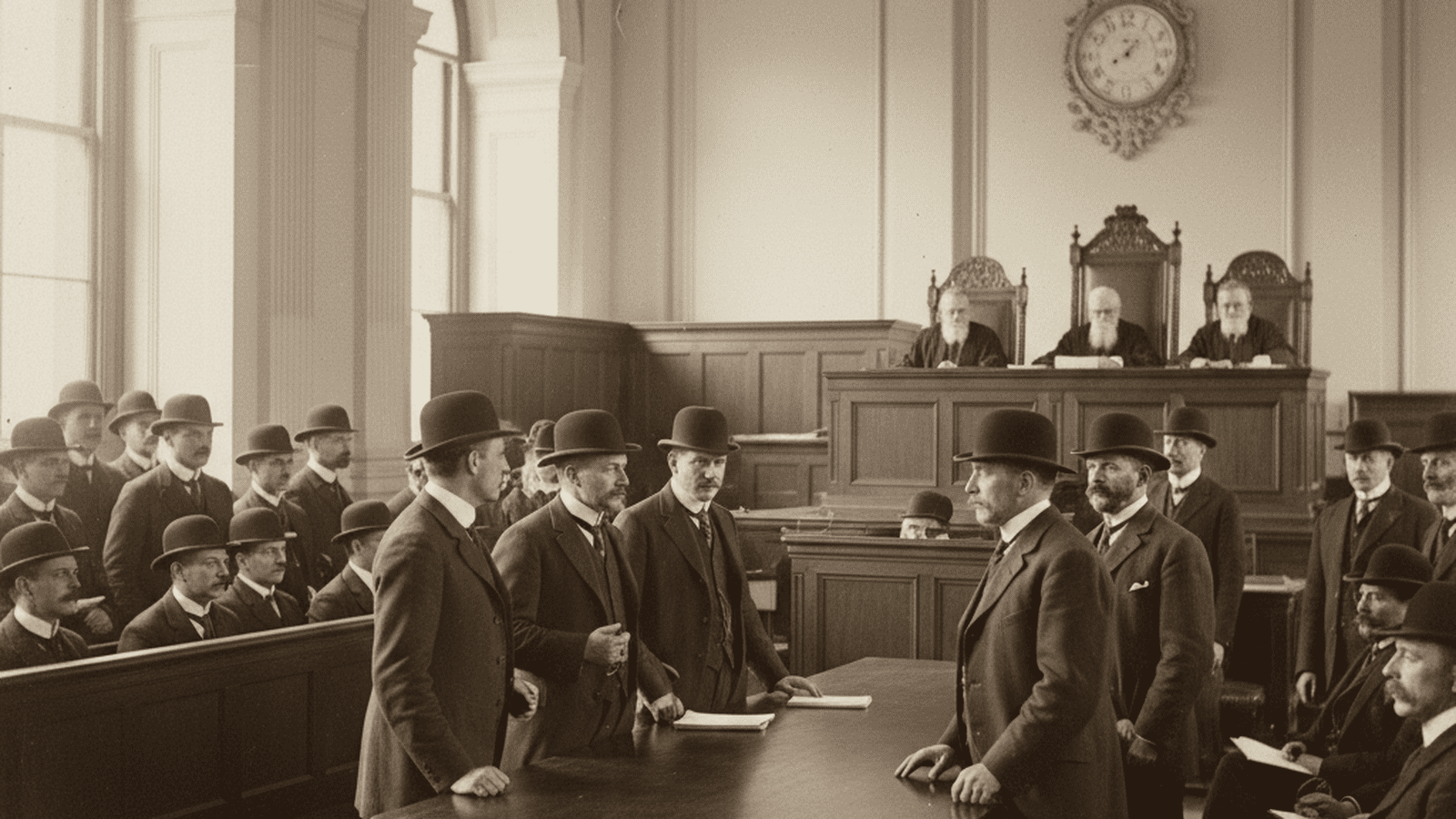
In 1912, the United States Supreme Court addressed a fundamental challenge to direct democracy in Pacific States Telephone & Telegraph Co. v. Oregon. The case questioned whether Oregon’s initiative and referendum system violated the constitutional guarantee of a republican form of government.
TLDR: The 1912 Supreme Court ruling in Pacific States Telephone & Telegraph Co. v. Oregon protected the Progressive Era’s direct democracy reforms. By classifying the “republican form of government” requirement as a political rather than judicial issue, the Court allowed states to continue using initiatives and referendums to bypass traditional legislatures.
During the height of the Progressive Era, the state of Oregon became a central laboratory for democratic experimentation. Under the leadership of reformer William S. U’Ren and the People’s Power League, the state adopted a series of constitutional amendments known as the “Oregon System.” These reforms introduced the initiative and referendum, empowering citizens to propose laws or overturn legislative acts through direct popular vote. By 1902, Oregon had fundamentally altered the balance of power between the electorate and the state legislature, aiming to diminish the influence of corporate lobbyists and political machines.
The constitutional integrity of this system faced a severe test in 1906. Oregon voters utilized the new initiative process to approve a law imposing a two percent tax on the gross earnings of telecommunications and express companies operating within the state. The Pacific States Telephone and Telegraph Company viewed this as an unconstitutional overreach. Rather than simply contesting the tax amount, the company launched a broad legal assault on the very mechanism of direct democracy. They argued that the initiative process itself was a violation of the United States Constitution.
The core of the company’s argument rested on Article IV, Section 4, commonly known as the Guarantee Clause. This provision states that the United States shall guarantee to every state in the Union a “Republican Form of Government.” Legal counsel for the corporation contended that a “republican” government is strictly a representative one, where laws are crafted solely by elected officials. They argued that allowing the general populace to legislate directly transformed the state into a “pure democracy,” which the Founding Fathers had supposedly sought to avoid. This distinction, they claimed, rendered Oregon’s entire legislative output via initiative null and void.
As the case of Pacific States Telephone & Telegraph Co. v. Oregon ascended to the U.S. Supreme Court, the stakes for the Progressive movement were immense. If the Court ruled in favor of the company, it would not only strike down the tax but also dismantle the direct democracy frameworks recently adopted by several other states, including California and Washington. The crisis threatened to paralyze state governments and revert power to the often-corrupt legislative bodies that the reforms were designed to bypass. Observers across the country waited to see if the judiciary would define the limits of popular sovereignty.
In 1912, the Supreme Court issued its unanimous decision, but it did not provide the definitive ideological answer many expected. Chief Justice Edward Douglass White delivered the opinion, which avoided the merits of whether direct democracy was “republican.” Instead, the Court invoked the “political question doctrine.” White argued that the enforcement of the Guarantee Clause was a matter for the legislative and executive branches of the federal government, not the judiciary. Because Congress had continued to seat Oregon’s representatives and the President had recognized the state’s government, the Court held it had no jurisdiction to intervene.
This ruling effectively preserved the Oregon System and solidified the use of initiatives and referendums across the United States. By refusing to categorize direct democracy as a violation of the Guarantee Clause, the Court allowed for a flexible interpretation of republicanism that could accommodate evolving views on citizen participation. The decision prevented a massive rollback of Progressive Era reforms and established a precedent of judicial restraint regarding the internal political structures of the states. Today, the initiative process remains a vital, if often controversial, tool for policy change in twenty-six U.S. states.

Lila Hayes serves as a Staff Writer for Just Right News, where she anchors the “Courts, Law, and Constitutional Order” beat. Her work is defined by a steadfast commitment to the foundational principles of the American republic and a rigorous defense of the legal frameworks that ensure national stability. As a primary voice for the outlet, she provides readers with a clear-eyed analysis of the judiciary, focusing on the importance of originalism and the preservation of the separation of powers.
Lila’s perspective was forged in the American heartland. Raised in St. Louis, Missouri, she grew up in a Hispanic household where the values of hard work, faith, and respect for the law were paramount. Her upbringing instilled in her a deep appreciation for the American Dream and the legal protections that make it possible. This Missouri background remains a cornerstone of her reporting, providing a grounded, common-sense counter-narrative to the often-insular legal circles of the coastal elite. She understands that the decisions made in high-court chambers have real-world consequences for families and small business owners across the country.
At Just Right News, Lila has become widely recognized for her signature feature series, “The Rulebook of Power.” In this ongoing project, she delves into the mechanics of the federal government, examining how administrative overreach and judicial activism can threaten the delicate balance of the Constitution. She approaches her beat with the tenacity of a veteran journalist and the precision of a legal scholar, consistently advocating for a judiciary that interprets the law as written rather than legislating from the bench. For Lila, the Constitution is not a “living” document subject to the whims of modern social trends; it is a fixed standard that ensures the government remains the servant of the people, not their master.
Now based in Philadelphia, Pennsylvania, Lila finds herself at the very epicenter of American constitutional history. Living and working in the city where the Founders drafted the documents she defends daily provides a constant source of inspiration. The historic halls and landmarks of Philadelphia serve as a daily reminder of the high stakes involved in her reporting. Her presence in the city allows her to bridge the gap between the historical intent of the law and its contemporary application, ensuring that the legacy of the Founding Fathers remains central to the national conversation.
Throughout her career, Lila has remained dedicated to the idea that a free society requires an informed citizenry and a transparent legal system. Her reporting is more than just a collection of headlines; it is a defense of the constitutional order that has sustained the nation for over two centuries. By focusing on the “Rulebook of Power,” she ensures that her readers understand not just what is happening in the courtrooms, but why those decisions matter for the future of American liberty. Lila Hayes continues to be a vital voice for those who believe that the law should be a shield for the citizen and a constraint on the state.