

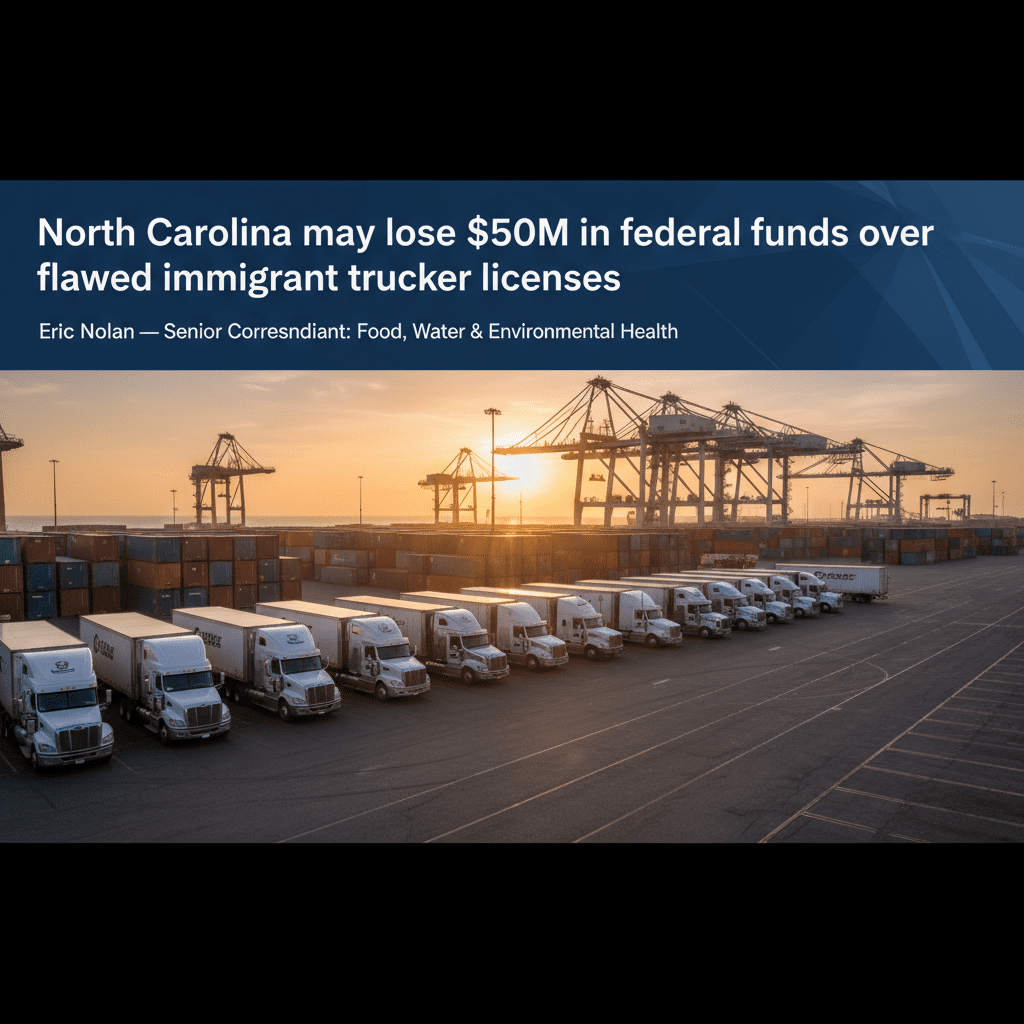
North Carolina faces the loss of nearly $50 million in federal funding if it does not revoke commercial driver’s licenses from immigrants found to be unqualified during a federal audit. The Federal Motor Carrier Safety Administration discovered that more than half of a 50-license sample in the state had significant flaws, putting 924 active licenses under scrutiny. This action is part of a broader national crackdown by Transportation Secretary Sean Duffy, which has already resulted in a $200 million penalty for California. While trucking groups support the move for safety reasons, immigrant advocates have filed lawsuits alleging unfair targeting. The North Carolina DMV is currently working to address these federal concerns to avoid the looming financial sanctions.
The U.S. Transportation Department notified North Carolina officials on Thursday that the state risks losing nearly $50 million in federal funding if it fails to revoke commercial driver’s licenses from unqualified immigrants. This warning follows a federal audit that uncovered significant flaws in the state’s licensing program for non-domiciled drivers. North Carolina is the ninth state to be targeted in a nationwide review initiated last year by Transportation Secretary Sean Duffy. The federal oversight aims to ensure that only qualified individuals operate heavy machinery, such as semitrailer trucks and buses, on public infrastructure.
The Federal Motor Carrier Safety Administration conducted a targeted audit of 50 commercial driver’s licenses issued by North Carolina to immigrants. The review determined that more than half of the sampled licenses contained problems that rendered the holders unqualified under current federal standards. State records indicate that 924 of these specific licenses remain unexpired and active within North Carolina. Secretary Duffy characterized the state’s failure to adhere to federal licensing rules as dangerous, emphasizing the safety risks associated with allowing unqualified drivers to operate vehicles that can weigh up to 80,000 pounds.
This federal crackdown has gained momentum following several high-profile traffic fatalities involving unauthorized drivers. In August, a truck driver who was not authorized to be in the United States made an illegal U-turn in Florida, resulting in a crash that killed three people. Another fatal incident occurred in California in October. These events have intensified the focus on non-domiciled licenses, which are issued to immigrants who may not have permanent residency but possess work authorization. While immigrants account for approximately 20% of the total truck driving workforce in the United States, these specific non-domiciled licenses represent about 5% of all commercial driver’s licenses, affecting roughly 200,000 drivers nationwide.
The potential purge of these licenses raises concerns regarding the stability of regional supply chains and the distribution of essential goods. Trucking industry groups have largely praised the federal intervention, citing the necessity of English proficiency and strict adherence to safety qualifications for those behind the wheel of massive cargo vehicles. Industry representatives argue that allowing unqualified drivers to operate heavy freight equipment poses a systemic risk to the transportation network. However, the removal of a significant portion of the workforce could lead to logistical bottlenecks at critical transit points, such as the Port of Savannah or the Port of Tacoma, where tractor-trailers are essential for moving cargo.
Other states have already faced severe financial penalties or have begun preemptive reviews to avoid federal sanctions. Secretary Duffy has already withheld nearly $200 million from California due to its licensing practices and its delay in revoking more than 17,000 invalid licenses. California was also cited for failing to enforce English proficiency requirements for commercial drivers. The Transportation Department has issued similar threats to withhold millions of dollars from Pennsylvania, Minnesota, New York, Texas, South Dakota, Colorado, and Washington. Audits in those states revealed that commercial licenses often remained valid long after the drivers’ work permits had expired.
In response to the federal pressure, Tennessee announced on Thursday that it has launched an independent review of its commercial licensing records. Tennessee officials plan to notify approximately 8,800 of the state’s 150,000 license holders that they must provide proof of citizenship or a valid visa to maintain their driving privileges. Russell Shoup, assistant commissioner of Tennessee’s Driver Services Division, stated that the state is working to align all issued licenses with current federal and state standards to ensure the integrity of the transportation sector.
The federal initiative has met with legal resistance from civil rights and immigrant advocacy groups. The Sikh Coalition and the Asian Law Caucus filed a class-action lawsuit against California, alleging that the state’s plan to revoke thousands of licenses unfairly targets specific immigrant communities. Many of the drivers involved in recent fatal accidents were of Sikh descent, which advocates argue has led to a disproportionate focus on that demographic. Furthermore, the Transportation Department proposed new restrictions to severely limit which noncitizens can obtain commercial licenses, but a court has placed those rules on hold pending further legal review.
North Carolina DMV spokesman Marty Homan stated that the state is currently working to address the concerns raised by the federal audit. The department remains committed to upholding the safety and integrity of its licensing processes while navigating the threat of losing $50 million in infrastructure support. Future oversight will likely focus on the speed at which North Carolina identifies and revokes the 924 flagged licenses to satisfy federal mandates and secure the state’s transportation budget.

Eric Nolan serves as the Senior Correspondent for Food, Water, and Environmental Health at Just Right News, where he brings a principled, common-sense perspective to the most fundamental issues facing the American public. With a career dedicated to uncovering the truth behind the policies that govern our natural resources, Eric has become a trusted voice for readers who value traditional stewardship over bureaucratic overreach. His reporting is defined by a commitment to the idea that true environmentalism is rooted in the protection of the American family and the preservation of the nation’s agricultural heritage.
Raised in Fresno, California, Eric’s worldview was shaped in the heart of the San Joaquin Valley. Growing up in one of the world’s most productive agricultural hubs, he witnessed firsthand the vital connection between the land, the water, and the dinner table. In Fresno, he saw the resilience of farmers and the devastating impact that distant, top-down regulations can have on local communities. This upbringing instilled in him a deep respect for the producers who feed the country and a lifelong skepticism toward the alarmist narratives often pushed by mainstream media. For Eric, environmental health is not an abstract political talking point; it is a matter of ensuring that the people who work the land have the freedom and the resources to do so effectively.
Now based in Eugene, Oregon, Eric operates from a unique vantage point in the Pacific Northwest. Living in a region often defined by intense environmental debate, he provides a necessary counter-narrative to the prevailing trends of the area. From his base in Eugene, he monitors the shifting tides of federal and state policies, ensuring that the voices of rural citizens and property owners are not drowned out by urban activism. His reporting often bridges the gap between the rugged realities of the outdoors and the legislative halls where decisions are made, offering a grounded perspective that prioritizes local sovereignty and practical solutions.
As the lead for the acclaimed feature series “Earth on the Table,” Eric explores the intricate journey of the American food supply. He tackles critical issues such as water rights, soil health, and food security through a lens of national stability and individual liberty. He believes that a healthy environment and a thriving economy are not mutually exclusive, but rather two sides of the same coin of national prosperity. His work consistently highlights how innovation and private-sector ingenuity are the most effective tools for ensuring clean water and a safe food supply, rather than the expansion of the administrative state.
At Just Right News, Eric’s reporting serves as a vital resource for those who seek accountability and transparency. Whether he is investigating the impact of federal land management on local economies or examining the safety of the national food infrastructure, his work remains anchored in the values of heritage and hard work. Eric Nolan continues to be a leading voice in environmental journalism, championing the belief that the best way to protect our natural resources is to empower the people who live and work closest to them.