

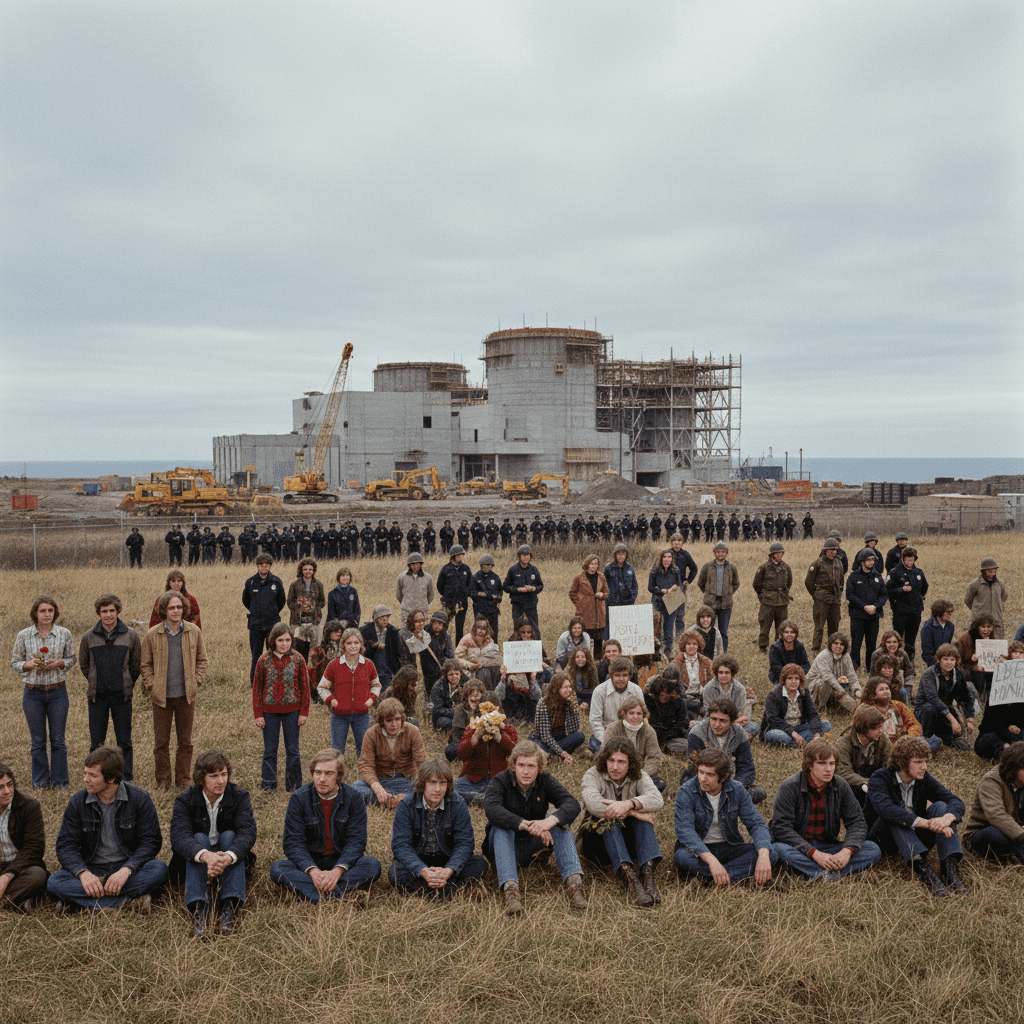
In 1977, New Hampshire Governor Meldrim Thomson Jr. exercised significant executive power to suppress anti-nuclear protests at the Seabrook Station site. This event in the United States highlighted the tension between state authority and civil disobedience during the post-Watergate era.
In the spring of 1977, the construction of the Seabrook Station Nuclear Power Plant in New Hampshire became a flashpoint for executive power and civil disobedience. Governor Meldrim Thomson Jr., a staunch conservative known for his assertive leadership style, viewed the burgeoning anti-nuclear movement as a threat to state sovereignty and economic progress. The Clamshell Alliance, a coalition of environmental activists based in New England, organized a massive non-violent occupation of the construction site to halt progress on the facility. This group utilized consensus-based decision-making, a novelty that challenged traditional law enforcement tactics of the era.
On April 30, 1977, approximately 2,000 protesters marched onto the Seabrook site, establishing a temporary encampment on the marshy grounds. Governor Thomson refused to negotiate with the organizers, characterizing the demonstration as an illegal insurrection rather than a peaceful protest. He invoked his executive authority to mobilize the New Hampshire National Guard and requested assistance from state police units across the region. This deployment represented one of the largest and most controversial uses of state-level military force against domestic protesters in the post-Watergate era.
The ensuing crackdown resulted in the arrest of 1,414 individuals, who were processed in mass groups and detained in various National Guard armories. Thomson’s administration faced immediate criticism for the logistical handling of the detainees, many of whom were held for two weeks without formal bail hearings or access to legal counsel. The Governor defended these actions as necessary to maintain law and order and to protect the state’s energy future from outside agitators. His hardline stance resonated with his conservative base but drew sharp condemnation from civil liberties advocates who argued the executive branch had overstepped its constitutional bounds.
The financial cost of the operation was significant, totaling over $1 million for the state of New Hampshire, a staggering sum for the small state at the time. This expenditure became a point of intense contention in the state legislature, as critics questioned the wisdom of using public funds to facilitate a private utility project. Despite the mass arrests, the Clamshell Alliance continued its advocacy, influencing anti-nuclear movements across the United States and Europe. The confrontation at Seabrook served as a primary case study in the limits of executive power when faced with organized, non-violent resistance.
In the years following the 1977 protests, the legal and political fallout led to significant reforms in how New Hampshire managed large-scale demonstrations. The state eventually adopted more stringent oversight for the use of the National Guard in civil matters to prevent future executive overreach. Furthermore, the financial struggles of the Seabrook project, which eventually saw only one of its two planned reactors completed, prompted new regulations regarding utility oversight and executive intervention in energy infrastructure. These changes ensured that future governors would face greater accountability when deploying state resources against political dissent.

Miles Harrington serves as the Senior Correspondent for Federal Systems & Executive Power at Just Right News, where he brings a disciplined, constitutionalist lens to the inner workings of the American government. With a focus on the mechanics of the federal bureaucracy and the limits of executive authority, Harrington has established himself as a vital voice for readers who value transparency, accountability, and the preservation of the separation of powers.
A native of Richmond, Virginia, Harrington’s perspective is deeply rooted in the traditions of the Old Dominion. Growing up in a city defined by its historical significance and its role as a center of American jurisprudence, he developed an early appreciation for the foundational principles of the Republic. His upbringing in Richmond—a place where the legacy of the Founding Fathers is woven into the landscape—instilled in him a belief that the federal government should remain within its constitutional bounds. This background informs his skepticism of centralized overreach and his commitment to reporting on the ways in which the administrative state impacts the lives of everyday citizens.
In his current role, Harrington specializes in the complexities of federal systems. He doesn’t just report on the headlines of the day; he digs into the structural shifts within the executive branch that often go unnoticed by the mainstream press. Whether he is analyzing the implications of a new federal regulation or investigating the expansion of agency jurisdiction, his work is characterized by a rigorous adherence to the facts and a dedication to the rule of law.
Harrington is perhaps best known for his signature feature series, “How Washington Works.” Through this ongoing project, he demystifies the often-opaque processes of the nation’s capital, pulling back the curtain on the “Deep State” and the unelected officials who wield significant influence over national policy. By breaking down complex legislative maneuvers and executive orders, he empowers Just Right News readers to understand the true levers of power in Washington. His reporting serves as a necessary check on the federal government, ensuring that the actions of those in power are held up to the light of public scrutiny.
Now based in Washington, D.C., Harrington operates at the epicenter of the political world, yet he remains intentionally distanced from the “Beltway bubble.” His proximity to the halls of power allows him to maintain a robust network of sources across the federal landscape, but his heart remains in the principled conservatism of his Virginia roots. He views his role not merely as a reporter, but as a steward of the public trust, dedicated to providing the clarity and context that conservative voters need to navigate an increasingly complex political environment.
Through his sharp analysis and unwavering commitment to the truth, Miles Harrington continues to be a cornerstone of the Just Right News team. His work ensures that the principles of limited government and executive restraint remain at the forefront of the national conversation, providing a crucial service to those who believe in a government that is truly of, by, and for the people.