

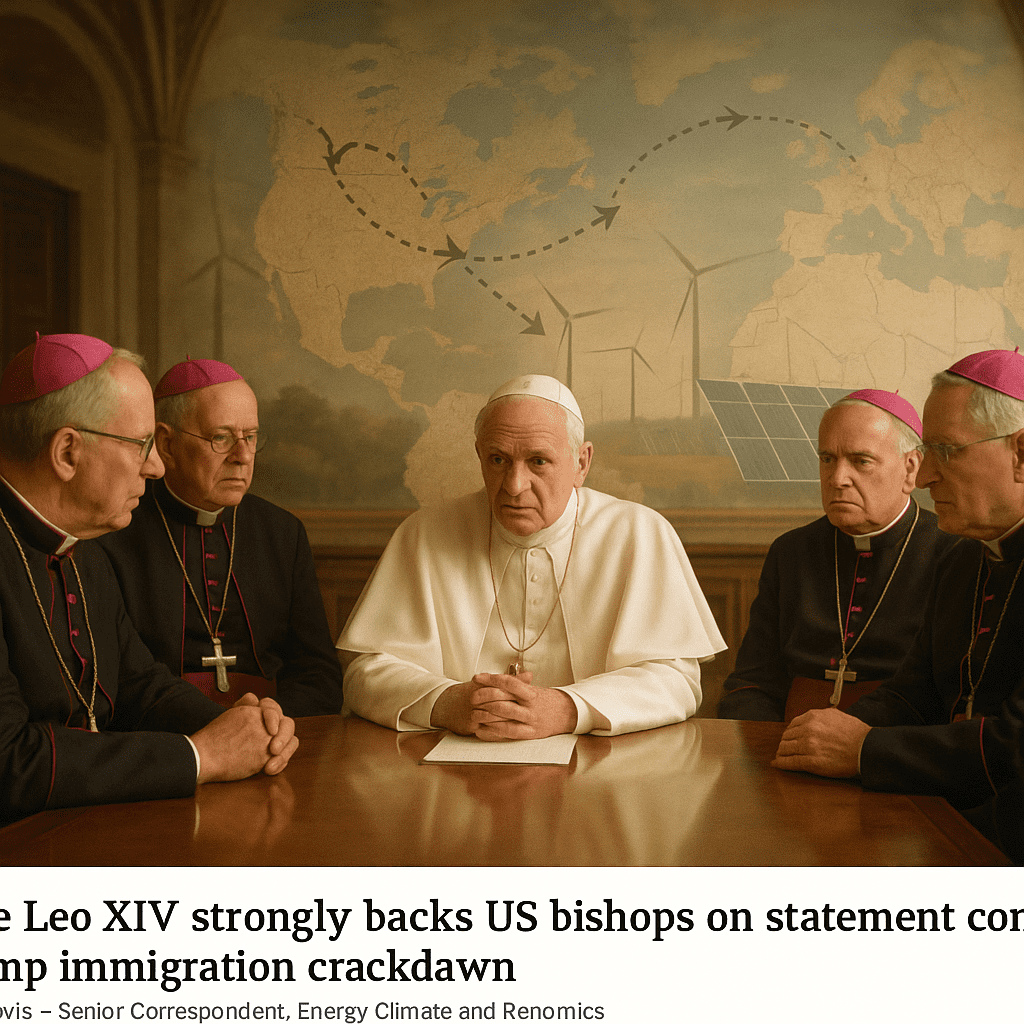
AP reporting notes that Pope Leo XIV strongly backed U.S. bishops who condemned the Trump administration’s immigration crackdown and urged Americans to “listen to them and treat migrants humanely.” The endorsement elevates religious critique into a broader debate about humanitarian responses as climate- and resource-driven displacement grows. The available excerpt did not include direct quotations from other faith leaders or climate-migration experts, nor did it detail follow-up policy proposals. Still, the Vatican’s intervention could shift philanthropic and political attention toward reception and resilience, complicating how local energy and resource systems are planned and funded. Reporters and policymakers will watch for concrete actions from the Vatican, diocesan networks, and COP30 negotiations to see whether moral pressure translates into new funding, programs, or oversight for climate-related displacement.
Pope Leo XIV on Tuesday publicly backed U.S. bishops who condemned the Trump administration’s immigration crackdown, urging Americans to “listen to them and treat migrants humanely.” The Pope’s intervention, carried in AP coverage, elevates a religious critique of enforcement policy into a transatlantic moral argument at a moment when climate- and resource-driven displacement is growing on policy agendas.
The AP excerpt makes clear that the Vatican spoke in solidarity with U.S. bishops criticizing the administration’s approach to immigration. That backing aligns a global religious institution with domestic faith leaders pressing for humane treatment. The available material does not provide additional direct comments from other faith leaders or from climate-migration specialists, but it does situate the story alongside AP coverage of climate migration and COP30 reporting.
For energy and climate reporters, the intervention matters because clergy statements can change the terrain of humanitarian responses and policy debates. Religious networks often mobilize shelters, diocesan aid and advocacy campaigns that supplement or pressure public programs. In that context, Vatican pronouncements can amplify calls for assistance and frame migration as a moral and social problem that intersects with resource management and energy policy.
The AP excerpt also flags climate coverage nearby in its site structure: AP Investigations Climate and a Climate Migration section are running items, and AP has noted a COP30 agenda in which host Brazil is pushing for progress. Those editorial signals indicate broader newsroom attention to how warming, floods and droughts are shaping population movements. The Vatican’s statement arrives while climate migration is moving from academic and humanitarian circles into headline politics.
Analysts who follow migration policy note that humanitarian responses do not exist in isolation from energy and resource planning. Communities absorbing newcomers may confront pressure on water systems, housing, and local fuel and electricity supply. The Pope’s public backing of bishops pressing for humane treatment thus has implications that extend beyond immediate shelter and asylum assistance; it touches on how national and subnational authorities balance resource allocation, emergency relief and long-term infrastructure investments.
The available excerpt does not include quotations from climate-migration experts, and no specific programmatic proposals from the Vatican or U.S. bishops are detailed in the material provided here. That lack of technical detail leaves open critical questions for policymakers: how should humanitarian commitments be financed, which energy or resource investments should be prioritized to stabilize at-risk regions, and how might religious advocacy alter public willingness to fund reception and resilience measures?
Religious endorsement also plays into politics. When a high-profile religious voice frames migration in moral terms, immigration enforcement becomes not only a legal and security issue but also a question of civic conscience. That framing can alter legislative calculations, philanthropic flows, and the tenor of grassroots organizing. The AP text reports the Pope’s support without indicating whether it will spur immediate institutional changes at the Vatican or within U.S. dioceses.
At the same time, climate and energy policymakers are watching how domestic debates over migration affect international negotiations. The AP’s climate coverage references COP30, and host-country efforts to press for progress there suggest a near-term forum where displacement, adaptation finance and energy transitions may intersect. The Pope’s public remarks could increase attention to humanitarian protections as an element of climate diplomacy, even if the excerpt does not show direct Vatican involvement in COP30 planning.
Reporting available in the ingestion does not supply new data on migration flows tied to climate or resources, nor does it include technical proposals tying religious advocacy to energy policy reform. Instead, it records a clear moral intervention: Pope Leo XIV’s endorsement of U.S. bishops who condemned an administration policy and urged humane treatment of migrants.
With that intervention now public, observers should expect renewed discussion among humanitarian organizations, diocesan relief networks and policy makers about how best to support displaced people while managing pressures on energy and resource systems. Monitoring in the weeks ahead will focus on whether the Vatican or U.S. bishops follow with concrete proposals, whether climate-migration experts publish analyses linking religious advocacy to adaptation priorities, and how COP30 negotiations incorporate displacement and humanitarian finance. The overlap of moral authority and technical policy choices is the next stage of this story.
Mark Davis serves as the Senior Correspondent for Energy, Climate, and Resource Economics at Just Right News. In an era where the conversation around the environment is often dominated by alarmism and top-down mandates, Mark provides a vital, market-oriented perspective on the complex forces shaping our world. As the lead voice behind the acclaimed feature series “Power and the Planet,” he explores the intersection of environmental policy, global energy markets, and the fundamental economic principles that sustain modern civilization.
Mark’s pragmatic approach to resource management was forged in the high desert of his hometown, Albuquerque, New Mexico. Growing up in a region defined by both its breathtaking natural beauty and its rugged, resource-dependent landscape, he developed an early appreciation for the delicate balance between conservation and utilization. New Mexico’s unique position as a hub for both traditional energy production and cutting-edge scientific research provided Mark with a front-row seat to the evolution of the American energy sector. This upbringing instilled in him a deep-seated belief that true environmental stewardship is inseparable from economic prosperity and technological innovation.
Now based in Boulder, Colorado, Mark operates from the heart of the nation’s climate research community. While Boulder is often seen as a bastion of environmental idealism, Mark utilizes his post to provide a necessary counterweight, grounded in the realities of resource economics. He understands that energy policy does not exist in a vacuum; it has tangible consequences for the American taxpayer, the stability of the national power grid, and the strength of the domestic manufacturing sector. By reporting from the front lines of the climate debate, he is able to challenge prevailing narratives with hard data and a commitment to the principles of the free market.
Throughout his tenure at Just Right News, Mark has distinguished himself by focusing on the “Resource Economics” aspect of his beat. He frequently highlights the hidden costs of rapid energy transitions and advocates for an “all-of-the-above” energy strategy that prioritizes American energy independence. His work often shines a light on the geopolitical implications of resource scarcity, arguing that a secure nation must first be an energy-secure nation. Whether he is analyzing the impact of federal land-use regulations or investigating the supply chains required for new technologies, Mark remains focused on how policy decisions affect the lives and livelihoods of everyday citizens.
In “Power and the Planet,” Mark continues to bridge the gap between complex scientific concepts and the economic realities facing the country. He rejects the false choice between a healthy environment and a thriving economy, instead seeking out solutions that leverage American ingenuity and private-sector competition. For Mark, reporting on the climate is not about following the latest trends, but about ensuring that the conversation remains tethered to the foundational values of liberty, property rights, and fiscal responsibility. His contributions ensure that Just Right News readers receive a comprehensive, clear-eyed view of the challenges and opportunities defining the future of our planet.