

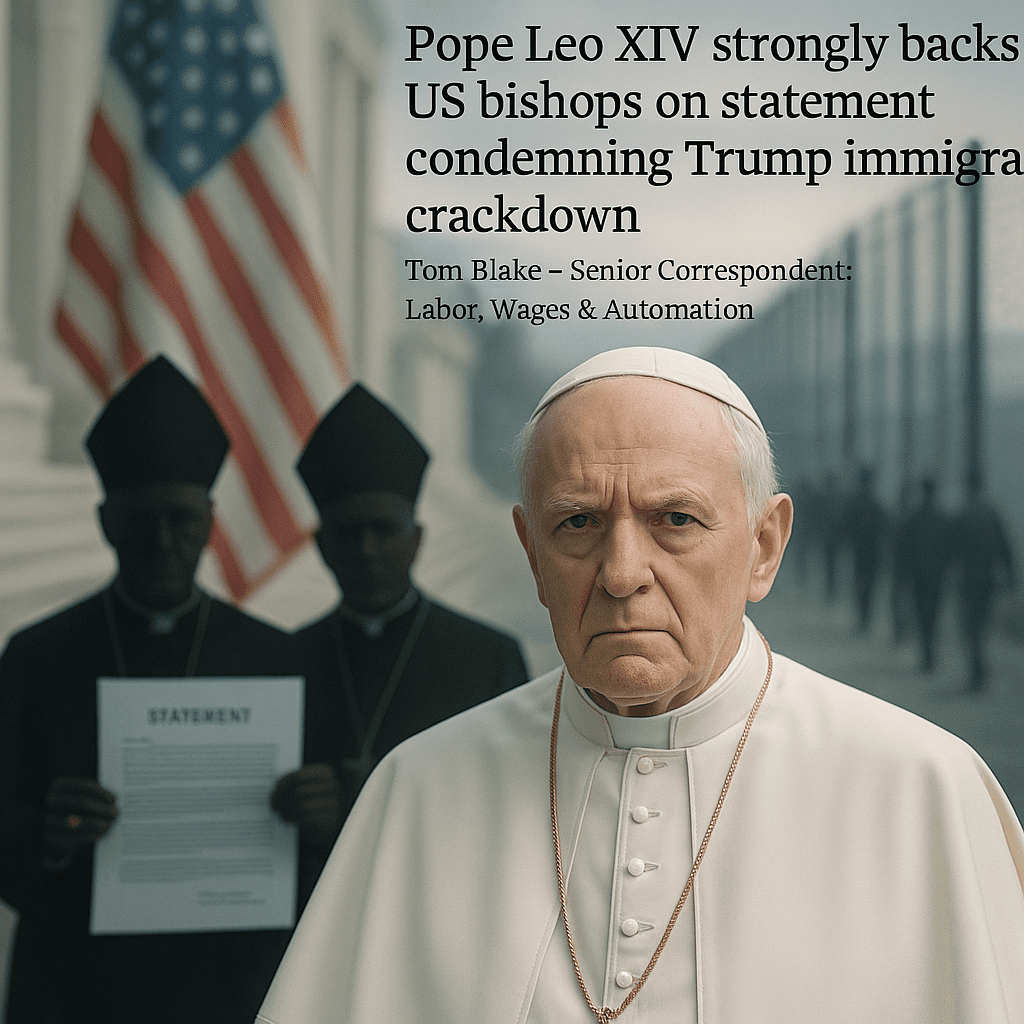
Pope Leo XIV publicly backed U.S. Catholic bishops on Tuesday after they condemned the Trump administration’s immigration crackdown and urged humane treatment of migrants, according to AP reporting. The papal endorsement frames immigration enforcement as a moral issue and elevates the bishops’ appeal to the conscience of the American people. The intervention comes as courts and local activists press on with litigation and protests — recent AP coverage notes decisions and disputes over state and federal authority, and incidents where migrants faced unexpected deportation proceedings. The pope’s backing is likely to intensify public and political debate ahead of ongoing legal fights and the 2026 election cycle.
{‘current_text’: ‘Pope Leo XIV on Tuesday gave forceful backing to U.S. Catholic bishops who condemned the Trump administration’s immigration crackdown and urged Americans to listen to church leaders and treat migrants humanely. The endorsement, reported by AP, put the Vatican squarely on record aligning the papacy with a moral framing of immigration enforcement advanced by the U.S. bishops. It also injected a prominent religious voice into an already heated national debate over enforcement, courts and political strategy.\n\nThe bishops’ statement, which the pope publicly supported, criticized the administration’s approach to immigration and appealed to the conscience of the American people. The AP account emphasized the pope’s call for humane treatment of migrants and his urging that the public hear the bishops’ message. The papal support underscored a direct link between religious authority and policy advocacy at a moment when immigration is a defining political issue.\n\nThe endorsement comes amid a swirl of legal and political developments related to immigration and governance. Recent litigation and court decisions referenced in AP coverage illustrate broader institutional tensions: a federal judge tossed a Justice Department lawsuit challenging a New York law that bars immigration agents from state courts, and other federal judges blocked Texas from using a new U.S. House map for the 2026 midterms. AP also documented instances where migrants were summoned under the impression of routine court hearings and instead faced deportation proceedings.\n\nThese disparate legal outcomes frame the context in which the pope’s backing landed. Religious leaders pressing for humane treatment enter an environment of active litigation over the reach of federal enforcement and state-level responses. Local activism, too, has surfaced, with protesters in Charlotte urging a national retailer to keep immigration officers off private property, an episode captured in AP reporting.\n\nReligious voices have long participated in debates over migration policy, and the pope’s public alignment with U.S. bishops amplifies that participation at the highest level. The Vatican’s moral language — stressing dignity and humane treatment — reframes enforcement choices as ethical questions for voters, parishioners and policymakers alike. In doing so, the endorsement likely heightens pressure on political leaders to address not only legal mechanics but also humanitarian consequences.\n\nJournalistic accounts available in the source material show the pope’s intervention was delivered without accompanying new policy proposals from the Vatican. The AP coverage cites the pope’s support for the bishops’ condemnation of the administration’s crackdown and the appeal that Americans listen to the bishops’ call to treat migrants humanely. Beyond that central fact, the record in the ingested material does not include reactions from the White House, from individual bishops, or from advocates and conservative religious commentators.\n\nThe papal backing is poised to influence public discourse in coming weeks and months as litigation continues and as political calendars sharpen around the 2026 midterms. Courts and legislatures remain active arenas for immigration policy, and moral arguments from major religious leaders add a distinct dimension to that activity. Observers grounded in reporting may watch whether the pope’s statement alters messaging from church leaders, advocacy organizations, or policymakers who address enforcement practices.\n\nMedia distributed by AP included a video report of the pope’s remarks, underscoring the Vatican’s intent to make the endorsement visible beyond written statements. The broader news coverage referenced in the source connects the pope’s intervention to an ongoing national conversation that touches courts, protests, elections and administrative enforcement.\n\nAs events proceed, oversight and legal developments will shape how the papal endorsement is received and whether it translates into shifts in policy or enforcement practice. Courts are expected to continue hearing litigation tied to immigration and state-federal authority, and the 2026 electoral calendar remains a watershed for competing visions of U.S. immigration policy. Those developments will provide benchmarks for measuring the practical effects of the pope’s moral appeal.\n\nThe political calculus is complex. For officials weighing enforcement tactics, the pope’s statement adds moral pressure but not legal constraint. For bishops and parish leaders, the Vatican’s backing can strengthen appeals to congregations and sway local advocacy strategies without prescribing tactics. For voters, particularly those who attend Mass or follow church guidance, the pope’s framing may influence how they interpret enforcement controversies alongside other issues.\n\nReporting so far leaves open many questions about immediate consequences. There is no documented policy shift from the Vatican, no public response from the White House in the material reviewed, and no systematic account yet of how rank-and-file bishops will change outreach or rhetoric. What is clear is that the pope’s intervention inserted an ethical vocabulary into operational debates over detention, deportation and courtroom procedures — vocabulary that is likely to be recycled by advocates and opponents as legal fights and political campaigning proceed.\n\nThat interplay between moral authority and institutional power will be worth watching through the prism of forthcoming court rulings and election-season messaging. If litigation narrows or expands enforcement reach, or if candidates adopt stances shaped by religious appeals, analysts will be able to trace at least part of that shift back to moments like this, when the leader of the Catholic Church publicly elevated concerns about dignity and humane treatment amid an administration’s enforcement push.’}

Tom Blake serves as the Senior Correspondent for Labor, Wages, and Automation at Just Right News, where he brings a grounded, principled perspective to the most pressing economic issues facing the American heartland. As the lead voice behind the acclaimed feature series “The Price of Work,” Tom focuses his reporting on the intersection of traditional industry and the rapidly evolving technological landscape, always prioritizing the dignity of the individual worker and the health of the American family.
Tom’s deep understanding of the labor market is not merely academic; it is rooted in his upbringing in Detroit, Michigan. Growing up in the shadow of the automotive industry, he witnessed firsthand the triumphs and tribulations of the American blue-collar workforce. He saw how the stability of a manufacturing job could build a community and, conversely, how the erosion of those industries could tear the social fabric apart. This background instilled in him a lifelong respect for the trades and a healthy skepticism toward economic policies that prioritize globalist interests over the well-being of local communities.
Now based in Pittsburgh, Pennsylvania, Tom continues to report from the front lines of the shifting economy. Pittsburgh, a city that has reinvented itself while maintaining its gritty, industrious spirit, provides the perfect vantage point for his beat. From the steel mills that remain to the high-tech robotics labs reshaping the city’s future, Tom explores how automation is changing the nature of employment. His reporting often highlights the tension between innovation and tradition, arguing that while progress is inevitable, it must not come at the expense of the American worker’s ability to provide for their family through honest, meaningful labor.
In his role at Just Right News, Tom has become a vital voice for those who feel overlooked by mainstream economic coverage. He rejects the notion that the decline of American manufacturing is an unavoidable casualty of the modern era. Instead, his work often examines how regulatory overreach, rising energy costs, and the unchecked rise of automation impact the take-home pay of everyday citizens. Through “The Price of Work,” Tom delves into the true cost of economic shifts, looking beyond the raw data to tell the stories of the people behind the statistics.
Tom’s reporting is characterized by a commitment to the conservative values of self-reliance, fiscal responsibility, and the preservation of the American dream. He believes that a strong nation is built on a foundation of stable jobs and fair wages, and his work seeks to hold both government and corporate entities accountable to that standard. Whether he is interviewing a shop floor manager about the implementation of new AI technology or analyzing the impact of wage inflation on small businesses, Tom provides a clear-eyed analysis that resonates with readers who value hard work and common sense.
Through his dedicated coverage, Tom Blake remains a steadfast advocate for the American workforce, ensuring that the voices of those in the industrial heartland are heard loud and clear in the national conversation. His perspective is essential for anyone seeking to understand the complex realities of labor and automation in the twenty-first century.