

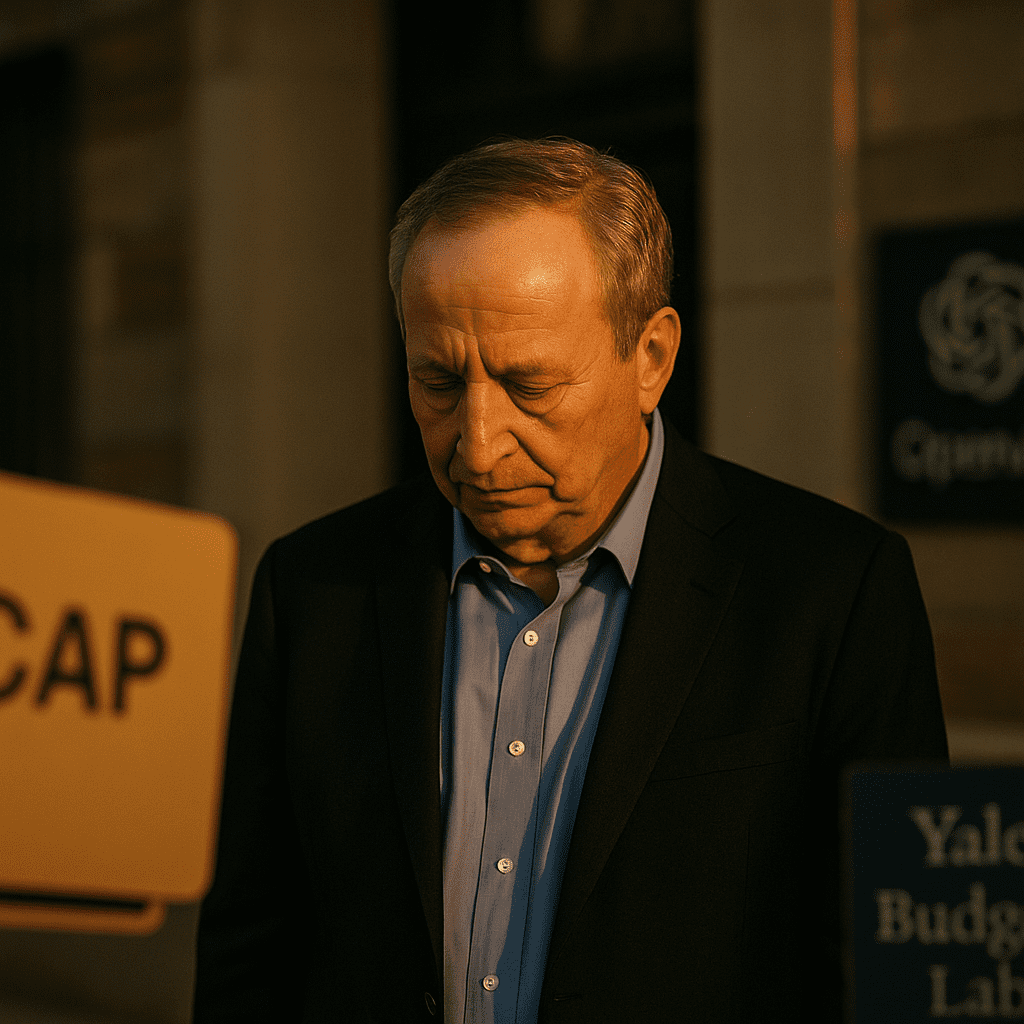
Larry Summers said he will step back from public commitments after emails showed continued contact with Jeffrey Epstein long after Epstein’s 2008 guilty plea. The Center for American Progress confirmed Summers is ending his fellowship, and Yale’s Budget Lab said he is no longer on its advisory group. OpenAI declined to confirm whether Summers will leave its board, referring questions to his spokesperson. President Trump asked the Justice Department and FBI to investigate, and Attorney General Pam Bondi has ordered a top federal prosecutor to lead a review. Harvard has reopened a probe into Summers, and public figures including Sen. Elizabeth Warren have called for severing ties as investigations and institutional reviews proceed.
Larry Summers announced he will step back from public commitments after the release of emails showing he maintained a friendly relationship with Jeffrey Epstein long after Epstein’s 2008 guilty plea. Summers said he would continue to teach and pledged to “rebuild trust and repair relationships with the people closest to me.” He added, “I am deeply ashamed of my actions and recognize the pain they have caused. I take full responsibility for my misguided decision to continue communicating with Mr. Epstein.”
The announcement set off immediate reputational consequences across academic and policy circles. The Center for American Progress confirmed that Summers was “ending his fellowship at CAP.” A spokesperson for the Budget Lab at Yale said Summers was no longer a member of that advisory group. Those moves followed public scrutiny after emails made public last week showed many in Epstein’s network continued contact well after his 2008 guilty plea.
Harvard, where Summers served as president from 2001 to 2006 and remains a professor and director of the Mossavar-Rahmani Center for Business and Government, faces renewed pressure. Related reporting indicates Harvard has reopened a probe into the former president after the release of the emails. Student reactions captured in coverage amplified the institutional strain. Thomas King, a Harvard student, described the relationship as “shocking” and called it “indicative of the kind of political environment that we now live in in 21st century U.S.” King said, “It’s really surprising to hear that someone of such high esteem can continued to be associated with that man.”
Requests for accountability traveled beyond campus. Democratic Sen. Elizabeth Warren, a former Harvard Law School professor, told CNN she believes Harvard should sever ties with Summers, saying he “cannot be trusted” with students. Warren added that Summers’ conduct illustrated long-standing concerns about his judgment, arguing his “willingness to cozy up to a convicted sex offender demonstrates monumentally bad judgment.”
The technology sector also confronted uncertainty. OpenAI, the maker of ChatGPT, declined to say whether Summers was stepping down from its board of directors and instead referred questions to Summers’ spokesperson. Kelly Friendly, Summers’ spokesperson, told reporters she did not have anything to add “beyond his statement.” Summers joined the OpenAI board in November 2023 as part of a board reconstitution that reinstated CEO Sam Altman.
Legal and political scrutiny intensified after public officials weighed in. President Donald Trump posted on Truth Social that he would ask the Justice Department and the FBI to investigate Summers’ relationship with Epstein alongside other high-profile figures. U.S. Attorney General Pam Bondi said she ordered a top federal prosecutor to lead an investigation. Bondi’s move signals a formal federal inquiry is being organized, though details about scope and timeline were not included in the reporting.
The released emails include an exchange in 2019 in which Summers wrote to Epstein about a woman, writing, “I said what are you up to. She said ‘I’m busy’. I said awfully coy u are.” Epstein replied in a characteristically terse message that investigators and reporters highlighted in coverage: “you reacted well.. annoyed shows caring. , no whining showed strentgh.” The documents were made public amid a broader release of materials that showed people in Epstein’s network continued to stay in touch well after 2008.
Summers’ statement did not specify all the steps encompassed by “stepping back.” He said he would continue to teach and pledged to repair relationships. Institutions and organizations that had ties to Summers have already taken some steps. The Center for American Progress confirmed his fellowship was ending. Yale’s Budget Lab said he was no longer on its advisory group. OpenAI’s public response was limited to declining comment and pointing to Summers’ spokesperson.
The developments illustrate how disclosures tied to Epstein’s files have prompted swift institutional responses and reopened questions about association and governance across universities, nonpartisan policy centers and private boards. Summers served as treasury secretary from 1999 to 2001 under President Clinton and remains a prominent figure in policy circles. Media coverage noted institutional probes and public calls for further action.
Oversight and investigative actions are underway. The Department of Justice and FBI involvement — with a top federal prosecutor ordered to lead — indicates formal federal review. Harvard’s reopened probe and organizations cutting or suspending formal ties signal additional internal processes. Summers’ statement about rebuilding trust was framed against those unfolding inquiries and institutional reviews.
Reporting to date lists the steps already taken and the probes underway, but questions remain about the full consequences for Summers’ university positions, service on private boards and affiliations with policy groups. The investigation ordered by the attorney general and Harvard’s reopened review are the next formal milestones to watch. Additional statements or decisions from OpenAI, Harvard and other institutions were not provided beyond the confirmations already reported.

Susan Carter serves as a Senior Correspondent for Just Right News, where she leads the network’s comprehensive coverage of Health, Medicine, and Public Policy. With a career dedicated to dissecting the complexities of the American healthcare system, Susan brings a principled perspective to the most pressing debates of the day. Her reporting is characterized by a commitment to individual liberty, fiscal responsibility, and a healthy skepticism of government overreach, making her a vital voice for audiences seeking clarity in an increasingly regulated landscape.
Raised in Minneapolis, Minnesota, Susan’s professional outlook is deeply informed by the values of the American heartland. Growing up in the Twin Cities, she witnessed firsthand the importance of community-driven solutions and the resilience of the individual. This Midwestern foundation instilled in her a firm belief that the best answers to public policy challenges often come from local innovation and personal responsibility rather than top-down federal mandates. Her background allows her to translate complex legislative jargon into stories that resonate with families who value common sense and local autonomy.
Now based in Baltimore, Maryland, Susan operates from a unique vantage point at the intersection of medical innovation and urban policy. Living and working in a city renowned for its world-class medical institutions and significant public health challenges, she has a front-row seat to the realities of the modern healthcare landscape. Her proximity to these hubs of research and policy allows her to scrutinize how government intervention affects the quality of care and the freedom of medical professionals. In Baltimore, she sees the tangible results of policy decisions, using the city as a lens through which to examine the broader national health debate and the impact of federal spending on local communities.
As the lead for the acclaimed feature series “The Cost of Care,” Susan dives deep into the economic realities facing patients and providers alike. Her work focuses on the necessity of price transparency, the benefits of market competition, and the preservation of the sacred doctor-patient relationship. She is a staunch advocate for the idea that a well-informed public is the best defense against bureaucratic inefficiency. Through this series, she has exposed the hidden drivers of rising medical expenses, always seeking to empower the individual consumer over the massive institution.
Susan’s reporting on public policy is characterized by a commitment to rigorous inquiry and a focus on constitutional limits. Whether she is analyzing new pharmaceutical regulations, investigating the impact of federal health mandates, or exploring the future of medical technology, her goal remains the same: to provide Just Right News audiences with the facts they need to navigate a complex world. By blending her Midwestern sensibilities with the insights gained from her base in Maryland, Susan Carter has become a trusted authority for those who believe that personal freedom and public health are inextricably linked. Her work continues to challenge the status quo, advocating for a system that respects the taxpayer and prioritizes the patient.