

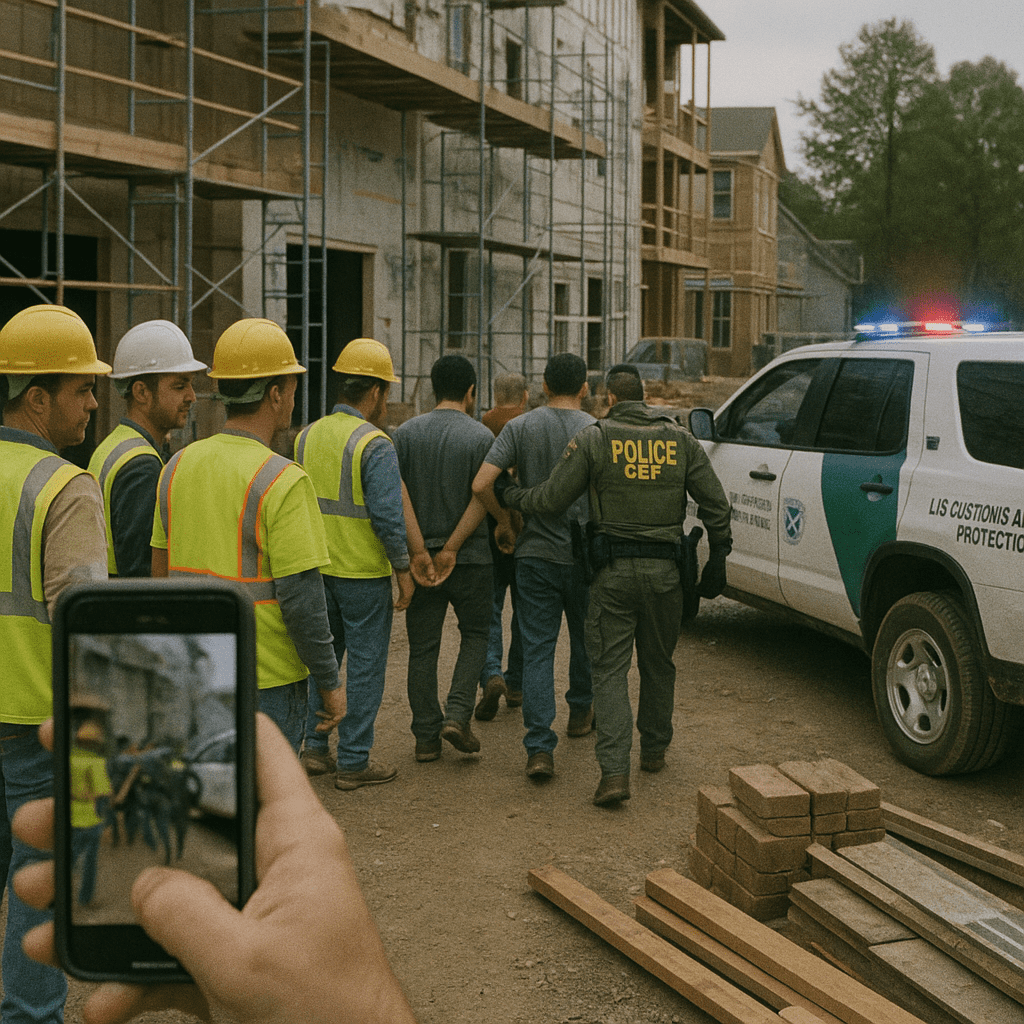
Cellphone footage published by the Associated Press shows U.S. Customs and Border Protection agents detaining multiple people at a construction site in Cary, North Carolina, on Tuesday. The images underline the reach of federal immigration enforcement into local workplaces and expose gaps in public documentation: the available material does not include arrest tallies, charges, DHS statements, or local official responses. Absent agency memos or court filings, key questions remain about the legal authority used, whether municipal authorities were notified, and how civil liberties were protected during the operation. Observers will need formal agency disclosures, any DOJ or court filings, and statements from Cary officials or workers’ advocates to fully assess the operation’s scope and legality.
Cellphone footage released by the Associated Press shows federal agents from U.S. Customs and Border Protection detaining multiple people at a construction site in Cary, North Carolina, on Tuesday. The visual record captures agents making arrests among workers at the site, underscoring the direct reach of federal immigration enforcement into municipal workplaces and the potential collision between federal authority and local governance.
The video identifies Customs and Border Protection by uniform and vehicle markings and confirms that federal officers carried out the operation. Beyond the imagery, the available material does not include formal arrest tallies, charges, or additional documentation such as Department of Justice filings or agency memoranda. Missing details in the record leave open basic questions about the scope, legal basis and chain of command for the sweep.
The episode highlights persistent institutional tensions over enforcement on U.S. soil. Customs and Border Protection operates as a federal immigration and customs agency; local officials, municipal police departments and community organizations often must absorb the immediate effects when federal personnel carry out enforcement actions in neighborhoods, workplaces or public spaces. Those effects can include disruptions to local services, strained relations between residents and municipal law enforcement, and heightened scrutiny of how federal priorities are implemented in communities.
Civil liberties advocates and labor groups historically have raised concerns about workplace enforcement conducted by federal immigration authorities. Allegations in other contexts have focused on due process at the point of contact, the treatment of bystanders, and the adequacy of legal counsel and translation services for detainees. The AP video provides visual evidence of an enforcement action, but the excerpted material does not supply testimony from detained individuals, statements from local officials, or comment from workers’ advocates about how the operation unfolded.
The footage also raises operational questions about coordination. It is not clear from the available record whether local law enforcement or municipal leaders in Cary were notified in advance or worked with federal agents during the operation. The material does not include statements from Cary city officials, the Wake County sheriff’s office, or the North Carolina governor’s office. Nor does it include a response from Customs and Border Protection or other Department of Homeland Security spokespeople beyond the images captured in the video.
At the executive level, a range of tools could be relevant to federal immigration enforcement, including agency directives, memoranda of understanding with state or local partners, or changes to prosecutorial priorities. The supplied material contains no documentation of any administration directives or internal agency guidance used to authorize the Cary operation. That absence limits the public’s ability to trace how national policy translates into on-the-ground enforcement.
Legal oversight and accountability mechanisms typically come into play after such operations. Federal actions can prompt civil rights reviews, internal agency investigations, or inquiries from congressional oversight committees. The AP excerpted video does not indicate whether any post-operation review has been launched or whether lawsuits or administrative claims are anticipated. The lack of accompanying records or public statements means that potential avenues of scrutiny remain speculative rather than documented.
Municipal leaders often face political and practical choices when federal agents operate within city limits. Some governments adopt formal policies limiting cooperation with federal immigration enforcement, while others maintain collaborative agreements. The current record does not show where Cary’s officials stand regarding cooperation policies in this instance. That gap leaves residents and observers without a clear account of how local authorities are responding.
The visual documentation provided by cellphone footage plays a distinct role in public scrutiny. A video can corroborate the presence, timing and methods of an enforcement action even when formal records are not yet available. At the same time, a single clip rarely conveys the full legal or factual context needed to evaluate compliance with statutes, constitutional protections, or agency policy.
For now, the known facts are straightforward: cellphone footage captures Customs and Border Protection agents detaining multiple people at a Cary construction site on Tuesday. Absent from the available material are arrest counts, charging decisions, statements from DHS or CBP, and responses from local elected officials or workers’ representatives. Those omissions constrain public understanding of the legal basis for the detentions and the operational coordination behind them.
Further clarity will depend on official disclosures and documentation. The record currently does not indicate whether the Justice Department, congressional oversight bodies, or state authorities will open formal reviews. Agency statements, court filings and responses from Cary municipal offices would provide the next sequential public accounts. Oversight bodies and advocacy organizations frequently announce inquiries or legal actions in the wake of enforcement operations, but no such developments are included in the material provided here.

Miles Harrington serves as the Senior Correspondent for Federal Systems & Executive Power at Just Right News, where he brings a disciplined, constitutionalist lens to the inner workings of the American government. With a focus on the mechanics of the federal bureaucracy and the limits of executive authority, Harrington has established himself as a vital voice for readers who value transparency, accountability, and the preservation of the separation of powers.
A native of Richmond, Virginia, Harrington’s perspective is deeply rooted in the traditions of the Old Dominion. Growing up in a city defined by its historical significance and its role as a center of American jurisprudence, he developed an early appreciation for the foundational principles of the Republic. His upbringing in Richmond—a place where the legacy of the Founding Fathers is woven into the landscape—instilled in him a belief that the federal government should remain within its constitutional bounds. This background informs his skepticism of centralized overreach and his commitment to reporting on the ways in which the administrative state impacts the lives of everyday citizens.
In his current role, Harrington specializes in the complexities of federal systems. He doesn’t just report on the headlines of the day; he digs into the structural shifts within the executive branch that often go unnoticed by the mainstream press. Whether he is analyzing the implications of a new federal regulation or investigating the expansion of agency jurisdiction, his work is characterized by a rigorous adherence to the facts and a dedication to the rule of law.
Harrington is perhaps best known for his signature feature series, “How Washington Works.” Through this ongoing project, he demystifies the often-opaque processes of the nation’s capital, pulling back the curtain on the “Deep State” and the unelected officials who wield significant influence over national policy. By breaking down complex legislative maneuvers and executive orders, he empowers Just Right News readers to understand the true levers of power in Washington. His reporting serves as a necessary check on the federal government, ensuring that the actions of those in power are held up to the light of public scrutiny.
Now based in Washington, D.C., Harrington operates at the epicenter of the political world, yet he remains intentionally distanced from the “Beltway bubble.” His proximity to the halls of power allows him to maintain a robust network of sources across the federal landscape, but his heart remains in the principled conservatism of his Virginia roots. He views his role not merely as a reporter, but as a steward of the public trust, dedicated to providing the clarity and context that conservative voters need to navigate an increasingly complex political environment.
Through his sharp analysis and unwavering commitment to the truth, Miles Harrington continues to be a cornerstone of the Just Right News team. His work ensures that the principles of limited government and executive restraint remain at the forefront of the national conversation, providing a crucial service to those who believe in a government that is truly of, by, and for the people.