

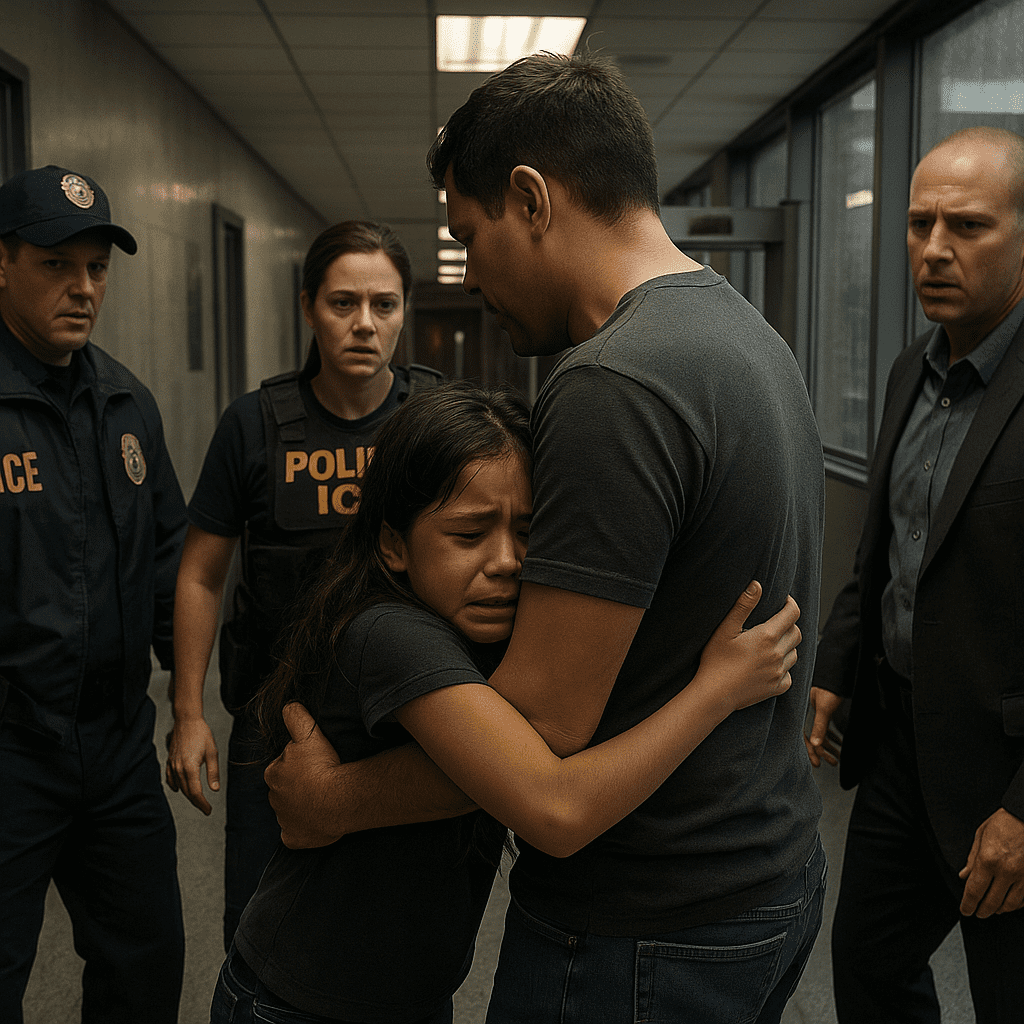
AP’s photo package begins with a girl clinging to her detained father outside a Manhattan immigration court and compiles images from 20 cities of courtroom arrests, agents in hallways, facial-recognition checks and families taken into custody. Reporting says the nation’s 75 immigration courts have expedited rulings and that some arrests were coordinated in advance; AP will pursue details on agency changes and oversight.
A girl clings to her asylum-seeking father as masked federal agents swarm outside a lower Manhattan immigration courtroom, one image in a photo package that captures repeated courthouse arrests and stunned families, AP photographers documented. The photograph, credited to Olga Fedorova and shot in New York on July 31, 2025, frames the most striking visual of the series: what had been routine asylum hearings becoming moments of detention.
AP reporters, photographers and visual journalists fanned out to immigration courts in 20 cities and assembled images that show a pattern across the nation’s 75 immigration courts. Those photos and captions depict agents waiting outside courtroom doors, families summoned for administrative matters, and children playing in hallways while parents are detained. An image of federal agents escorting handcuffed detainees after a routine check-in in New York, shot June 4, 2025, underlines how ordinary compliance interactions have been converted into enforcement events (AP Photo/Olga Fedorova).
The photo package accompanies reportage that found the system “changed dramatically in the second Trump administration,” with courts “now churning out rulings, and judges under pressure to go even faster,” according to the material curated by AP photo editors. The visual record and AP’s account together show arrests that, U.S. officials told reporters, were coordinated days in advance to meet quotas. In many of the photographed cases, hearings that the families said were administrative were followed by dismissals, re-arrest and placement in expedited removal proceedings.
Photographs in the gallery document additional operational details. An ICE agent using facial recognition to confirm an asylum seeker’s identity prior to a hearing is shown inside a courtroom on July 30, 2025 (AP Photo/Olga Fedorova). A federal agent displaying an Immigration and Customs Enforcement badge at the Jacob K. Javits Federal Building on June 9, 2025 (AP Photo/Yuki Iwamura, file), and images of plainclothes officers detaining a Dominican man after a hearing on June 6, 2025 (AP Photo/Yuki Iwamura, file), point to close physical coordination between court proceedings and enforcement action.
The human toll appears in names and faces captured for the record. Marlon Garcia, an asylum seeker from Ecuador, is photographed turning to look back at his wife and children as he was detained after his immigration hearing on July 3, 2025 (AP Photo/Olga Fedorova). Marco and Maria Chipantiza, an Ecuadorian couple, held pictures of their daughter Joselyn, 20, and her 6-year-old son outside the Jacob K. Javits federal building on July 3, 2025 (AP Photo/Yuki Iwamura, file). Those images pair family grief with the procedural mechanics shown throughout the package.
Officials quoted in the AP reporting framed the effort as focused on the “worst of the worst.” The administration’s phrase appears in the material but is juxtaposed with photographs and captions showing that many of those detained in courthouses did not, in the images’ context, appear to be people with criminal records. The visual record thus raises questions about how enforcement priorities translate into courtroom practices and outcomes.
The photo reporting documents operational coordination at the courthouse level and shows outcomes that include dismissals and expedited removal. The material does not, however, provide detailed documentation within the photo captions or the accompanying text about internal agency restructuring, specific removals of immigration judges, or formal changes in the Executive Office for Immigration Review. Those institutional questions, important to understanding the mechanics behind what the pictures show, are not specified in the supplied material.
Advocates, clerks, judges and defendants are central to the scenes captured, but the ingest supplied here contains limited direct interview material beyond the images and their captions. AP’s reporting emphasis in the photo gallery is visual and documentary: photographers’ names, dates and locations are consistently cited, and the images serve as a record of what happened at particular hearings and check-ins.
Taken together, the photographs and the reporting they accompany depict a justice system in motion and a set of enforcement practices that have immediate human consequences. The images document repeated patterns—agents staged in hallways, facial recognition before hearings, parents led away after administrative appearances—that illustrate how courtroom encounters have become points of enforcement.
The AP photo gallery and reporting are a visual prompt for further scrutiny. The material reviewed here does not spell out follow-up oversight plans, pending deadlines or formal probes into the court-enforcement coordination it depicts. AP reporters continue to cover immigration courts and enforcement; further reporting will be required to trace administrative directives, supervisory decisions and any formal reviews that might explain how and why these courthouse arrests were scheduled and executed.

Julie Harris serves as a Staff Writer for Just Right News, where she tackles some of the most pressing and complex issues facing the nation today. As the lead reporter for the Migration, Demographics & Cultural Shifts beat, Julie provides a grounded, principled perspective on how the movement of people and the changing makeup of communities are reshaping the American landscape. Her work is defined by a commitment to exploring the long-term consequences of social change, prioritizing the stability of local institutions and the preservation of national identity.
Her deep understanding of these issues is rooted in her upbringing in Tucson, Arizona. Growing up in a prominent border state, Julie witnessed firsthand the intricate realities of migration and the profound impact it has on local infrastructure, law enforcement, and the social fabric. This early exposure instilled in her a respect for the rule of law and a keen awareness of the challenges that arise when federal policies fail to align with the needs of border communities. Her reporting often reflects this lived experience, bringing a necessary level of nuance to topics that are often treated with abstraction in coastal newsrooms.
Now based in Santa Fe, New Mexico, Julie continues to report from the heart of the American Southwest. Her location provides a unique vantage point to observe the intersection of traditional regional cultures and the modern shifts brought about by both internal and external migration. In Santa Fe, a city defined by its rich history and distinct cultural heritage, she finds a perfect environment to explore how communities strive to maintain their character while navigating the pressures of a rapidly changing world. This perspective allows her to bridge the gap between policy debates in Washington and the reality of life in the high desert.
At Just Right News, Julie’s work is characterized by a dedication to examining the data and the human stories that define the “New Mosaic” of America. Her signature feature series, “The New Mosaic,” has become a cornerstone of her reporting. Through this series, Julie explores the evolving social architecture of the United States, documenting how shifts in population affect everything from local economies to the political landscape. She brings a critical eye to the narrative of demographic inevitability, instead asking how these shifts impact the average citizen’s sense of belonging and the integrity of the American social contract.
Julie’s background and her dedication to conservative principles make her a vital voice in contemporary journalism. She understands that demographics are more than just numbers on a spreadsheet; they represent the future of the American family and the nation’s enduring legacy. Through her diligent reporting and insightful analysis, Julie Harris ensures that her readers are informed about the forces shaping their world, providing a perspective that is as thoughtful as it is necessary for the modern era.